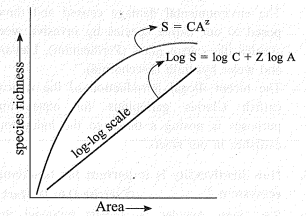
Question
Explain Species-Area relationships graph.

Need a full question paper?

Generate a complete, print-ready paper with questions like this in minutes — across 16+ boards, with answer keys.

Start Generating Free

Similar questions

How interesingly Gene is amplified by using PCR? Explain with diagram.
How is a transgenic tobacco plant protected against Meloidogyne incognita? Explain the procedure.
Read the following and answer any four questions from (i) to (v) given below:

Kangaroo rat seldom drinks water. It has thick coat to minimise evaporative desiccation. TI1e animal seldom comes out of its comparatively humid and cool burrow during the day time. 90% of its water requirement is met from metabolic water (water produced by respiratory breakdown of fats) while 10% is obtained from its food. Loss of water is minimised by producing nearly solid urine and faeces. As the animal faces acute water scarcity, it develops two types of adaptations : reducing water loss and ability to tolerate desert conditions.

  1. Kangaroo rat is a:
  1. Partial regulators
  2. Partial conformer
  3. Regulator
  4. Conformer
  1. Metabolic water refers to:
  1. Water required for metabolic activities.
  2. Water present in intercellular fluid.
  3. Water produced during oxidation of fat or carbohydrate.
  4. Water taken in, to promote metabolism.
  1. Desert animals minimise water loss by:
  1. Producing highly concentrated urine.
  2. Promoting maximum reabsorption of water in kidney tubules.
  3. Possessing one of the longest loop of Henle in kidney tubules.
  4. All of these.
  1. Assertion: Kangaroo rat can tolerate and thrive in wide temperature range and is known as stenothermal.

Reason: Kangaroo rats go into hibernation during winter to escape cold weather.

  1. Both assertion and reason are true and reason is the correct explanation of assertion.
  2. Both assertion and reason are true but reason is not the correct explanation of assertion.
  3. Assertion is true but reason is false.
  4. Both assertion and reason are false.
  1. The adaptations in an organism are meant for:
  1. Optimum primary production.
  2. Optimum life span.
  3. Optimum mobility.
  4. Optimum survival and reproduction.
Explain co-dominance in humans with the help of example.
Read the following and answer any four questions from (i) to (v) given below:
The foundations of recombinant DNA (rDNA) were laid by the discovery of restriction enzymes. These enzymes are present in many bacterias where they function as a part of their defense mechanism called the Restriction Modification system (RM system). Molecular basis of this system was explained first by Werner Arber in 1962. The Restriction Modification system consists of two components:
  • A restriction enzyme (called restriction endonuclease) identifies the introduced foreign DNA and cuts it into pieces.
  • The second component is a modification enzyme (methylase) that adds a methyl group to DNA at specific site to protect it from the restriction enzyme cleavage.
  1. Restriction endonucleases are enzymes present in ________ where they function as a part of _______ mechanism.
  1. (i) bacteria (ii) digestive
  2. (i) protists (ii) transcription
  3. (i) plant cells (ii) replication
  4. (i) prokaryotes (ii) defence
  1. Which of the following statements regarding modification enzyme is correct?
  1. It adds methyl group to one or two bases usually within the host DNA sequence to protect it from the restriction enzyme.
  2. It adds ethyl group to one or two bases usually within the sequence recognised by the restriction enzymes.
  3. It adds methyl group to only one of bases within the foreign DNA sequence that is recognised by the restriction enzymes.
  4. None of these.
  1. Which of the following is a type II restriction enzyme?
  1. Alu I
  2. EcoR I
  3. BamH I
  4. All of these.
  1. Which of the following is the first discovered restriction endonuclease?
  1. Sal I
  2. EcoR I
  3. Hind II
  4. EcoR II
  1. Components of Restriction Modification System include?
  1. Restriction enzyme.
  2. Modification enzyme.
  3. Lysing enzyme.
  4. Both (a) and (b).
Explain exponential growth equation with well labeled diagram.###Explain exponential growth.
Describe: Genetic engineered insulin
Read the following and answer any four questions from (i) to (v) given below:

Over population causes number of family problems. Strategies like birth control methods help to control population explosion. Natural methods of birth control do not involve medications or devices to prevent pregnancy, but rather rely on behavioural practices and/ or making observations about menstrual cycle.

  1. Which method helps in contraception by temporary absence of sex?
  1. Coitus interruptus.
  2. Withdrawal method.
  3. Rhythm method.
  4. Lactational amenorrhea method.
  1. Assertion: The effectiveness of coitus interruptus method is limited.

Reason: Some sperms may pass into vagina before ejaculation.

  1. Both assertion and reason are true, and reason is the correct explanation of assertion.
  2. Both assertion and reason are true, but reason is not the correct explanation of assertion.
  3. Assertion is true, but reason is false.
  4. Both assertion and reason are false.
  1. Why is lactational amenorrhea effective for about 4-5 months after parturition?
  1. Ovulation occurs on about the 14th day of menstruation.
  2. Ovulation does not occur during intense lactation.
  3. This method inhibits mobility of sperms.
  4. Both (b) and (c).
  1. Which fact is not the basis of periodic absence method of birth control?
  1. Ovum remains alive for about 1-2 days.
  2. Ovulation occurs on about 14th day of menstruation.
  3. Sperms survive for about 3 days.
  4. Alteration in uterine endometrium.
  1. On which days of menstrual cycle should coitus be avoided to prevent fertilisation?
  1. 10-17
  2. 6-13
  3. 1-5
  4. 15-28
Explain: Acquired Immunity.
Read the following and answer any four questions from (i) to (v) given below:

Alcohols are important industrial solvents. Ethanol, methanol, propanol and butanol are produced commercially by fermentation activity of some fungi, majorly yeasts. During fermentation, yeast cells convert cereal derived sugars into ethanol and CO2 At the same time hundreds of secondary metabolites that influence the aroma and taste of alcohol are produced. Sugar concentration affects the rate of fermentation reactions. Yeast cannot grow in very strong sugar solution. In case of complex carbohydrate containing nutrient media, 1% malt or Rhizopus is used along with yeasts. Hydrolysis of starch is carried out at high temperature for 30 ruins. 'Tile crushed food mixed with hot water for obtaining malt in called mash. 'Tile nutrient medium prior to fermentation in called wort. Wort is cooled down to appropriate temperature and inoculated with strain of yeast.

  1. Tile rate of alcohol production is measured on the basis of:
  1. Amount of sugar present in the medium.
  2. Amount of CO2 produced per unit time.
  3. Amount of yeast added in the medium.
  4. All of these.
  1. A number of chemicals are produced at the time of alcoholic fermentation with the change of nutrient media, pH and aeration. Select such by-product from the following.
  1. Phenylethanol.
  2. Amyl alcohol.
  3. Glycerol.
  4. All of these.
  1. During alcoholic fermentation of cereals and potato, the crushed food mixed with hot water for obtaining malt is called:
  1. Juice.
  2. Mash.
  3. Wort.
  4. None of these.
  1. Distilled alcohol with 95% ethanol content is called:
  1. Absolute alcohol.
  2. Rectified spirit.
  3. Gin.
  4. Brandy.
  1. Assertion: Rhizopus or 1% malt is used in the nutrient medium when it contains complex carbohydrates.

Reason: Yeast does not possess sufficient diastase or amylase. 

  1. Both assertion and reason are true and reason is the correct explanation of assertion.
  2. Both assertion and reason are true but reason is not the correct explanation of assertion.
  3. Assertion is true but reason is false.
  4. Both assertion and reason are false.