Question
Explain structure and working of biogas plant with diagram.

Answer


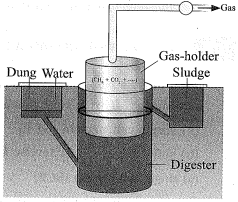
Image
→ 10-15 feet deep concrete tank is prepared for biogas plant.
→ This tank is fed by collected bio-waste and a slurry.
→ A floating cover is placed over the slurry.
→ Due to microbial activity (Methanogens) this slurry keeps rising as the gas is produced.
→ The biogas plant has an outlet.
→ This is connected to a pipe to supply biogas to nearby houses.
→ The spent slurry is removed through another outlet and may be used for as a fertiliser.
→ The biogas plants are more often built in rural areas.
→ The biogas thus produced is used for cooking and lighting.
→ In biogas plant, bacteria produce a mixture of gases from biogas such as carbon dioxide, methane and hydrogen.
→ These bacteria are collectively called as methanobacterium.
Need a full question paper?

Generate a complete, print-ready paper with questions like this in minutes — across 16+ boards, with answer keys.

Start Generating Free

Similar questions

Describe tissue culture.
Suggest some methods to assist infertile couples to have children.
Read the following and answer any four questions from (i) to (v) given below:
The first menstruation is called menarche, that usually occurs between 12 and 15 years. In human females, menstruation is repeated at an average interval of about 28/29 days and is called menstrual cycle. It is regulated by certain hormones, as pituitary gland is stimulated by releasing factors produced in the hypothalamus. The hormones produced by pituitary gland influence the ovaries. The hormones secreted by the ovaries affect the walls of the uterus.
  1. The breakdown of endometrium is characteristic of:
  1. Proliferative phase.
  2. Luteal phase.
  3. Ovulatory phase.
  4. Menstrual phase.
  1. Which days of the menstrual cycle marks the proliferative phase?
  1. 1-5
  2. 15-28
  3. 6-13
  4. 10-14
  1. Which of the following occurs during secretory phase?
  1. Empty Graafian follicle changes into corpus luteum.
  2. Primary follicle changes into Graafian follicle.
  3. Endometrium rebuilds and estrogen secretion increases.
  4. LH surge, inducing release of an ovum.
  1. Identify the hormones that attain peak level during ovulatory phase.
  1. FSH.
  2. Progesterone.
  3. LH.
  4. Both (a) and (c).
  1. Withdrawal of which hormone causes degeneration of corpus luteum?
  1. FSH.
  2. LH.
  3. Progesterone.
  4. Estrogen.
Explain Methodology of HGP
What is oogenesis? Give a brief account of oogenesis.###Define or Characterise: (i) Primary oocyte. (ii) Primary follicle. (iii) Secondary follicle. (iv) Tertiary follicle. (v) Antrum. (vi) Secondary oocyte. (vii) Graafian follicle.
Read the following and answer any four questions from (i) to (v) given below:

Organism P has thick lips and tongue so that it can easily feed on the commonly available spiny plants. Organism Q has thick layer of insulating fat under the skin. It was strong hooves to walk steadily on steep surfaces and lives in burrows during winters. Organism R has bright colours and sticky pads on its fingers and toes. It lives on trees.

  1. Which of the following is correct habitat for organisms P regarding its adaptation?
  1. Grassland biome.
  2. Desert biome.
  3. Tropical rainforest.
  4. Tropical deciduous forest.
  1. Which of the following is correct match regarding organism Q and its habitat?
  1. Tundra - Polar bear.
  2. Tropical rain forest - Deer.
  3. Grassland - Bighorn sheep.
  4. Desert - Camel.
  1. Which of the following is incorrect regarding organisms R's habitat?
  1. The vegetation shows stratification.
  2. Epiphytic growth is rich.
  3. Standing crop is highest.
  4. Deep rooted shrubs are common due to abundant sunlight.
  1. The dominant plants in habitat where P lives could be:
  1. Opuntia
  2. Nymphaea
  3. Deodar
  4. both (a) and (c).
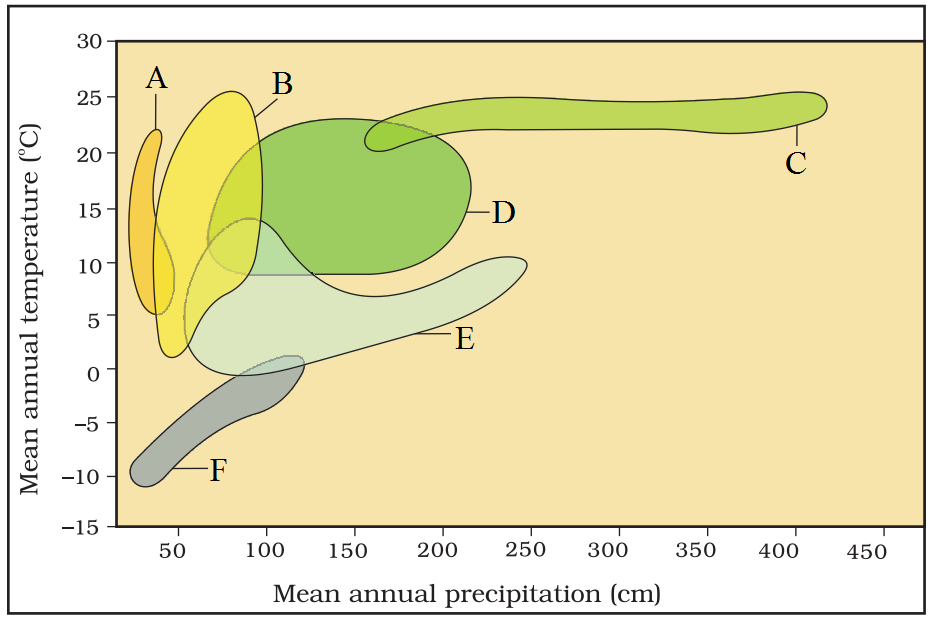
  1. Organisms P, Q and R respectively most likely occur in:

  1. F, B and A.
  2. C, A, E.
  3. A, F and C.
  4. B, D and A.
What is transgenic animals? How it is useful for man kind?
Describe Sex Determination in honey bee with diagram.
Read the following and answer any four questions from (i) to (v) given below:
RNA or ribonucleic acid is a single chain polyribonucleotide which functions as carrier of coded genetic or hereditary information from DNA to cytoplasm for taking part in protein and enzyme synthesis. Six types of RNAs are ribosomal, transfer, messenger, genomic, small nuclear and small cytoplasmic RNA. Out of these, rRNA, mRNA and tRNA are major classes of RNAs that are involved in gene expression.
  1. Which one is referred to a soluble RNA?
  1. mRNA
  2. tRNA
  3. rRNA
  4. hnRNA
  1. The RNA that picks up specific amino acid from amino acid pool in the cytoplasm to ribosome during protein synthesis is?
  1. rRNA
  2. hnRNA
  3. mRNA
  4. tRNA
  1. Which of the following is found in both DNA and messenger RNA?
  1. Double helix structure
  2. Ribose
  3. Sugar-phosphate chain
  4. Thymine
  1. Which of the following statements regarding RNA is correct?
  1. Messenger RN As carries coded information for synthesis of polypeptide.
  2. Ribosomal RNAs bind with tRNA to catalyse the formation of phosphodiester bonds.
  3. Genomic RNA is always single stranded.
  4. Synthesis of rRNA occurs in cytoplasm by RNA polymerase III
  1. In studying a virus, you find the following proportions of nitrogenous bases present: adenine 23%, guanine 37%, cytosine 23% uracil 17%. Which of the following statement(s) regarding this virus is/are correct?
  1. It probably uses RNA as its genetic material.
  2. The genetic material of this virus is probably single stranded.
  3. Base pairing rules in virus in this virus include adenine: cytosine.
  1. I only
  2. I and II only
  3. II and III only
  4. All of these.
Read the following and answer any four questions from (i) to (v) given below:

A desert lizard (an ectotherm) and a mouse (an endotherm) are placed inside a chamber at 15ºC and their body temperature [T(L) for the lizard and T(M) for the mouse] and metabolic rates [M(L) for lizard and M(M) for the mouse] are monitored.

  1. Which of the following is correct regardingT(L), M(L), T(M) and M(M)?
  1. T(L) and M(L) will fall while T(M) and M(M) will increase.
  2. T(L) and M(L) will increase while T(M) and M(M) will fall.
  3. T(L) and M(L) will fall, T(M) will remain same and M(M) will increase.
  4. T(L) and M(L) will remain same, T(M) and M(M) will decrease.
  1. It can be said that some animals in their evolutionary development preferred to be ectotherms than endotherms. Which of the following can be the best suited reason for it?
  1. The metabolic reactions of these organisms can occur at a very wide range of temperature.
  2. Maintaining homeostasis is an energetically expensive process.
  3. The enzymes of these organisms are functional at high temperatures.
  4. Both (b) and (c).
  1. Organisms that can maintain a constant internal temperature are called.
  1. Homoeothermic
  2. Poikilothermic
  3. Oligothennic
  4. Heterothennic
  1. An animal that survives at temperature of 10ºC and 40ºC both can be placed under the category of:
  1. Ectotherm.
  2. Endotherm.
  3. Modifiers.
  4. Migratory organisms.
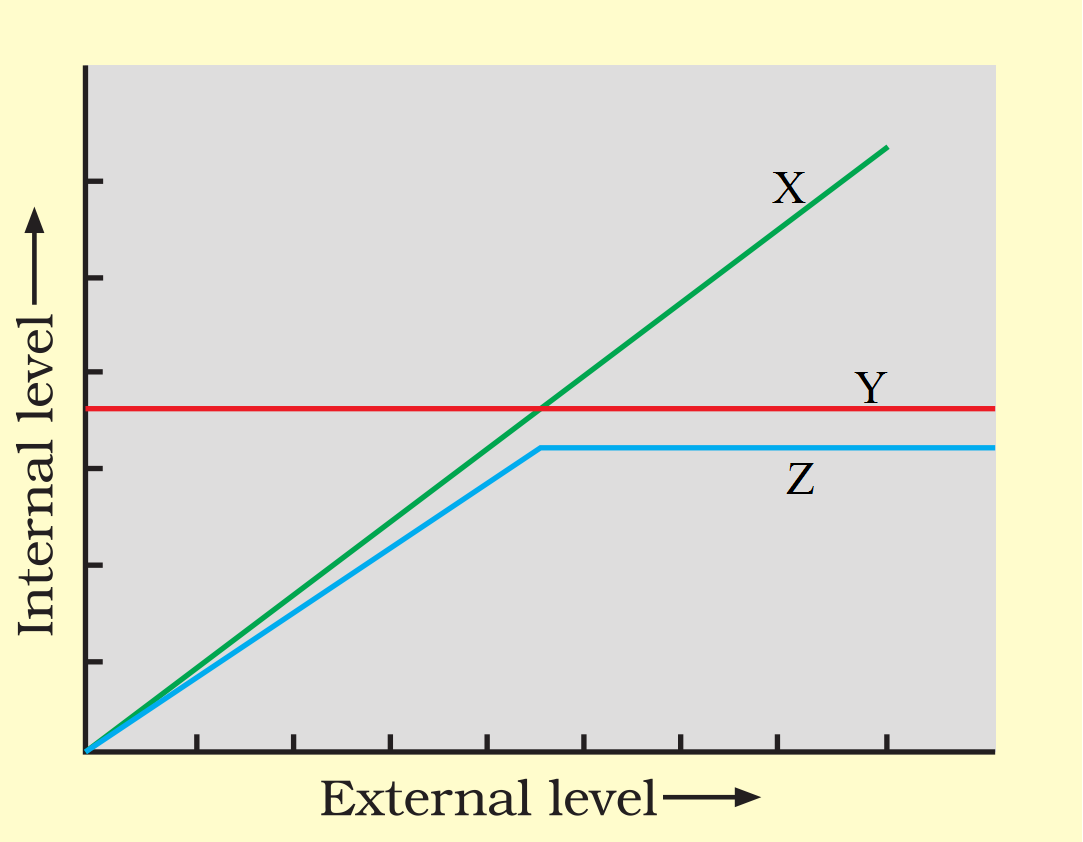
  1. Study the graph carefully and select the correct option.

  1. X could be desert lizard.
  2. Y could be mouse.
  3. Z could be desert lizard.
  4. Both (a) and (b).