Question
Explain subtraction of vectors.
Answer

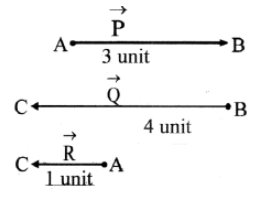
  1. When two vectors are anti-parallel (in the opposite direction) to each other, the magnitude
  2. It is important to note that only vectors of the same type (physical quantity) can be subtracted.
  3. For example, if two vectors $\overrightarrow{ P }$ = 3 unit and $\overrightarrow{ Q }$ = 4 unit are acting in opposite direction,they are subtracted as,$|\overrightarrow{ R }|=\|\overrightarrow{ P }|-| \overrightarrow{ Q }\|$
    $=|3-4|=1$ unit, directed along $\overrightarrow{Q}$

Image

Need a full question paper?

Generate a complete, print-ready paper with questions like this in minutes — across 16+ boards, with answer keys.

Start Generating Free

Similar questions

What are EM waves?
$i.$ Three resistors $1 \Omega, 2 \Omega$ and $3 \Omega$ are combined in series. What is the total resistance of the combination?
$ii.$ If the combination is connected to a battery of $\text{e.m.f.}\ 12 V$ and negligible internal resistance, obtain the potential drop across each resistor.
The height of a transmitting antenna is 68 m and the receiving antenna is at the top of a tower of height 34 m. Calculate the maximum distance between them for satisfactory transmission in line of sight mode. (Radius of Earth = 6400 km)
Calculate the escape velocity of a body from the surface of the Earth.
$($Average density of Earth $= 5.5 \times 10^3 \ kg/m^3, G = 6.67 \times 10^{-11} \ N m^2/kg^2,$ radius of Earth $R = 6.4 \times 10^6 m)$
For the study of any kind of motion, we never use Newton’s first law of motion directly. Why should it be studied?
State and explain ohm’s law.
A blacksmith fixes iron ring on the rim of the wooden wheel of a bullock cart. The diameter of the wooden rim and the iron ring are $1.5\ m$ and $1.47\ m$ respectively at room temperature of $27^{\circ} C$. To what temperature the iron ring should be heated so that it can fit the rim of the wheel $\left(\alpha_{i r o n}=1.2 \times 10^{-5} K^{-1}\right)$.
Describe Faraday’s law along with Lenz’s law.
distinguish between:
Conservative and non-conservative forces
Complete the table for two vectors $\overrightarrow{ P }$ and $\overrightarrow{ Q }$ inclined at angle θ.
 $\theta$Resultant
 vector
$(\vec{R})$
Direction of
 resultant
 vector with
 $\vec{P}(\alpha)$
i.0^(@)---------------------
ii.90^(@)--------------------
iii.180^(@)--------------------