Question
Explain surface charge density.

Answer

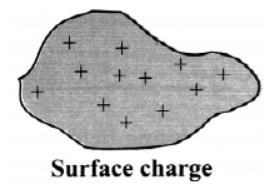
$i.$ Consider a charge $q$ uniformly distributed over a surface of area $A$ then the surface charge density $c$ is given as
$\sigma=\frac{q}{A}$
For example, charge distributed uniformly on a thin disc or a synthetic cloth. If the charge is not distributed uniformly over the surface of a conductor, then charge $dq$ on small area element $dA$ can be written as $dq = \sigma dA.$
Image
$ii. \ SI$ unit of $\sigma$ is $(C / m^2)$

Need a full question paper?

Generate a complete, print-ready paper with questions like this in minutes — across 16+ boards, with answer keys.
Start Generating Free

Similar questions

For $\overline{ v _1}=2 \hat{i}-3 \hat{j}$ and $\overline{ v _2}=-6 \hat{i}+5 \hat{j}$, determine the magnitude and direction of $\overline{ v _1}+\overline{ v _2}$.
Why light waves travel in vacuum whereas sound wave cannot?
A rubber band originally 30cm long is stretched to a length of 32cm by certain load. What is the strain produced?
Show that the critical velocity of a body revolving in a circular orbit very close to the surface of a planet of radius R and mean density ρ is $2 R \sqrt{\frac{G \pi \rho}{3}}$
What could be the equation for Gauss’ law of magnetism, if a monopole of pole strength p is enclosed by a surface?
Two satellites $A$ and $B$ are revolving around a planet. Their periods of revolution are $1$ hour and $8$ hours respectively. The radius of orbit of satellite B is $4 \times 10^4\ km$. find radius of orbit of satellite $A$
A person walks from point $P$ to point $Q$ along a straight road in $10$ minutes, then turns back and returns to point $R$ which is midway between $P$ and $Q$ after further $4$ minutes. If $PQ$ is $1 \ km,$ find the average speed and velocity of the person in going from $P$ to $R$.
Define electric field. State its $SI$ unit and dimensions.
The height of a transmitting antenna is 68 m and the receiving antenna is at the top of a tower of height 34 m. Calculate the maximum distance between them for satisfactory transmission in line of sight mode. (Radius of Earth = 6400 km)
The rate of flow of heat through a copper rod with temperature difference $30 ^{}\circ C$ is $1500$ cal/s. Find the thermal resistance of copper rod.