Questions

Answer the following in Brief

Take a timed test

32 questions · self-marked practice — reveal the answer and mark yourself.

Question 13 Marks
Calculate the electric field due to a charge of $-8.0 \times 10^{-8}\ C$ at a distance of $5.0\ cm$ from it.
Answer
Given: $q=-8 \times 10^{-8} C , r =5 cm =5 \times 10^{-2} m$
To Find: Electric field $(E)$
Formula: $E =\frac{1}{4 \pi \varepsilon_0} \frac{q}{r^2}$
Calculation: From formula,
$ E=9 \times 10^9 \times \frac{\left(-8 \times 10^{-8}\right)}{\left(5 \times 10^{-2}\right)^2}$
$=-2.88 \times 10^5 N / C$
View full question & answer
Question 23 Marks
The electric field in a region is given by $\vec{E}=5.0 \hat{k} N / C$ Calculate the electric flux through a square of side $10.0 cm$ in the following cases
i. The square is along the $X Y$ plane
ii. The square is along $X Z$ plane
iii. The normal to the square makes an angle of $45^{\circ}$ with the $Z$ axis.
Answer
Given: $\vec{E}=5.0 \hat{k} N / C ,| E |=5 N / C$ $I =10 cm =10 \times 10^{-2} m =10^{-1} m$ $A=I^2-10^{-2} m ^2$
To find: Electric flux in three cases. $\left(\varnothing_1\right)\left(\varnothing_2\right)\left(\varnothing_3\right)$
Formula: $(\varnothing _1) = EA \cos \theta $
Calculation:
Case I: When square is along the XY plane,
$\therefore \theta = 0$
$\varnothing _1 = 5 \times 10^{-2} \cos 0$
$= 5 \times 10^{-2} V m$
Case II: When square is along XZ plane,
$\therefore \theta = 90^\circ $
$\varnothing _1 = 5 \times 10^{-2} \cos 90^\circ = 0 V m$
Case III: When normal to the square makes an angle of $45^\circ $ with the Z axis.
$\therefore 0 = 45^\circ $
$\therefore \varnothing _3 = 5 \times 10^{-2} \times \cos 45^\circ $
$= 3.5 \times 10^{-2} V m$
View full question & answer
Question 33 Marks
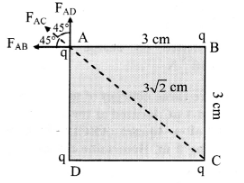
Four charges of $+6 \times 10^{-8}\ C$ each are placed at the corners of a square whose sides are $3\ cm$ each. Calculate the resultant force on each charge and show in direction on a diagram drawn to scale.
Answer
Given: $q_A = q_B = q_C = q_D = 6 \times 10^{-8} C, a = 3 cm$

Image
Magnitude of force on A due to $D$ is,
$ F _{A D}  =\frac{1}{4 \pi \varepsilon_0} \frac{ q ^2}{ r _{ AD }^2}$
$ =\frac{9 \times 10^9 \times\left(6 \times 10^{-8}\right)^2}{\left(3 \times 10^{-2}\right)^2}$
$ =3.6 \times 10^{-2} N $
Similarly,
$ F _{ AB }=3.6 \times 10^{-2} N$
$F _{ AC }=\frac{1}{4 \pi \varepsilon_0} \frac{ q ^2}{ r _{ AC }^2}$
$=\frac{9 \times 10^9 \times\left(6 \times 10^{-8}\right)^2}{\left(3 \sqrt{2} \times 10^{-2}\right)^2}$
$=1.8 \times 10^{-2} N$
$\therefore \text { Resultant force on ' } A \text { ' }$
$= F _{ AD } \cos 45+ F _{ AB } \cos 45+ F _{ AC }$
$=\left(3.6 \times 10^{-2} \times \frac{1}{\sqrt{ } 2}\right)+\left(3.6 \times 10^{-2} \times \frac{1}{\sqrt{ } 2}\right)+1.8 \times 10^{-2}$
$=6.89 \times 10^{-2} N \text { directed along } \overrightarrow{F_{A C}}$
View full question & answer
Question 43 Marks
A water drop of mass $11.0 \ mg$ and having a charge of $1.6 \times 10^{-6} C$ stays suspended in a room. What will be the magnitude and direction of electric Held in the room?
Answer
As the drop is suspended,
Force $(F)$ due to electric field balances the weight of the drop.
$\therefore F = mg ….... (1)$
Here, $m = 11.0 \ mg$
$= 11 \times 10^{-6} \ kg,$
$q = 1.6 \times 10^{-6} C$
Electric field is given by,
$ E =\frac{F}{q}$
$=\frac{m g}{q}$
$=\frac{11 \times 10^{-6} \times 9.8}{1.6 \times 10^{-6}}$
$E=67.4 \ N / C$
As upward force balances the weight, hence direction of electric field must be vertically upwards.
View full question & answer
Question 53 Marks
A free pith ball of mass $5$ gram carries a positive charge of $0.6 \times 10^{-7} C.$ What is the nature and magnitude of charge that should be given to second ball fixed $6 \ cm$ vertically below the former pith ball so that the upper pith bath is stationary?
Answer
Let $+q_2$ be the charge on lower pith ball.
Now, the upper pith ball become stationary only when its weight acting downward is balanced by the upward force of repulsion between two pith balls,
i.e.,$F _{ E }= mg$
$\therefore \frac{1}{4 \pi \varepsilon_0} \frac{ q _1 q _2}{ r ^2}= mg$
$\therefore \frac{9 \times 10^9 \times 0.6 \times 10^{-7} \times q _2}{\left(6 \times 10^{-2}\right)^2}=5 \times 10^{-3}
\times 9.8$
$\therefore q _2=3.27 \times 10^{-7} C $
Hence, the second pith ball carries a positive charge of $3.27 \times 10^{-7}C.$
View full question & answer
Question 63 Marks
Two charged particles having charge $3 \times 10^{-8} C$ each are joined by an insulating string of length $2 m$. Find the tension in the string when the system is kept on a smooth horizontal table.
Answer
 Tension $(T)$ in the string is the force of repulsion $(F)$ between the two charges. According to Coulomb’s law,
$ F =\frac{ q _1 q _2}{4 \pi \varepsilon_0 r ^2}$
$=\frac{9 \times 10^9 \times 3 \times 10^{-8} \times 3 \times 10^{-8}}{2^2}$
$F = 2.025 \times 10-6 N$
Hence, tension in the string is $2.025 × 10⁻⁶ N.$
View full question & answer
Question 73 Marks
State the precautions against static charge.
Answer
  1. Home appliances should be grounded.
  2. Avoid using rubber soled footwear.
  3. Keep your surroundings humid (dry air can retain static charges).
View full question & answer
Question 83 Marks
Explain the disadvantage of static charge.
Answer
  1. When charge transferred from one body to other is very large, sparking can take place. For example, lightning in sky.
  2. Sparking can be dangerous while refuelling your vehicle.
  3. One can get static shock, if charge transferred is large.
  4. Dust or dirt particles gathered on computer or TV screens can catch static charges and can be troublesome.
View full question & answer
Question 93 Marks
Explain the concept of static charge.
Answer
  1. Static charges can be created whenever there is a friction between an insulator and other object.
  2. For example, when an insulator like rubber or ebonite is rubbed against a cloth, the friction between them causes electrons to be transferred from one to the other.
  3. This property of insulators is used in many applications such as photocopier, inkjet printer, painting metal panels, electrostatic precipitation/separators etc.
View full question & answer
Question 103 Marks
Explain volume charge density.
Answer
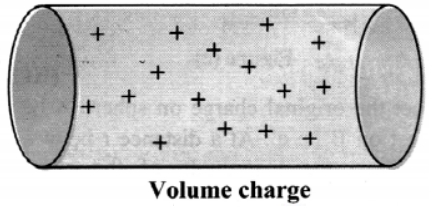
$i.$ Consider a charge $q$ uniformly distributed throughout a volume $V,$ then the volume charge density $\rho$ is given as
$\rho=\frac{q}{V}$
For example, charge on a plastic sphere or a plastic cube. If the charge is not distributed uniformly over the volume of a material, then charge $dq$ over small volume element $dV$ can be written as $dq = \rho dV.$
Image
$ii. \ S.I.$ unit of $p$ is $(C/m^3)$
$[$Note: Electric field due to a continuous charge distribution can be calculated by adding electric fields due to all these small charges.$]$
View full question & answer
Question 113 Marks
Explain surface charge density.
Answer
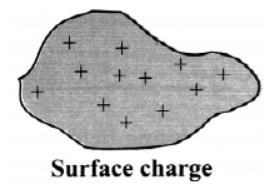
$i.$ Consider a charge $q$ uniformly distributed over a surface of area $A$ then the surface charge density $c$ is given as
$\sigma=\frac{q}{A}$
For example, charge distributed uniformly on a thin disc or a synthetic cloth. If the charge is not distributed uniformly over the surface of a conductor, then charge $dq$ on small area element $dA$ can be written as $dq = \sigma dA.$
Image
$ii. \ SI$ unit of $\sigma$ is $(C / m^2)$
View full question & answer
Question 123 Marks
Explain linear charge density.
Answer
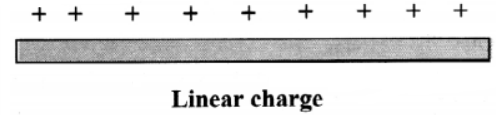
Consider charge q uniformly distributed along a linear conductor of length l, then the linear charge density (λ) is given as,
$\lambda=\frac{q}{l}$
For example, charge distributed uniformly on a straight thin rod or a thin nylon thread. If the charge is not distributed uniformly over the length of thin conductor then charge dq on small element of length dl can be written as dq = λ dl.
Image
View full question & answer
Question 133 Marks
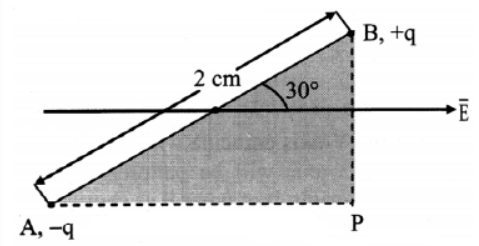
An electric dipole of length $2.0 \ cm$ is placed with its axis making an angle of $30^\circ$ with a uniform electric field of $10^5 \ N/C$ as shown in figure. If it experiences a torque of $10\sqrt3 \ N m,$ calculate the magnitude of charge on dipole.
Image
Answer
Given $: 2l = 2 \ cm = 2 \times 10^2 m$
$E = 10^5 \ N/C, τ = 10\sqrt3 \ Nm, \theta = 30^\circ$
To find: Charge $(q)$
Formula: $τ = q E 2 l \sin \theta$
Calculation: From Formula.
$ q =\frac{\tau}{ E \times 2 l \times \sin \theta}$
$=\frac{10 \sqrt{3}}{10^5 \times 2 \times 10^{-2} \times \sin 30^{\circ}}$
$=1.732 \times 10^{-2} C $
View full question & answer
Question 143 Marks
A charge of $5.0 C$ is kept at the centre of a sphere of radius $1 m.$ What is the flux passing through the sphere? How will this value change if the radius of the sphere is doubled?
Answer
Given: $q = 5C, r = 1 m$
To find: Flux $( \varnothing)$
Formulae$: i. \ E =\frac{1}{4 \pi \varepsilon_0} \times \frac{ q }{ r ^2}$
$ii. \ \varnothing=E \times A=E\left(4 \pi r^2\right)$
Calculation: From formula $(i),$
$ E =9 \times 10^9 \times \frac{5}{1^2}$
$=4.5 \times 10^{10} N / C $
From formula $(ii),$
$\varnothing= E \times 4 \pi r ^2$
$=4.5 \times 10^{10} \times 4 \times 3.14 \times 1^2$
$\varnothing=5.65 \times 10^{11} \ Vm $
This value of flux will not change if radius of sphere is doubled. Though radius of sphere will increase, increased distance will reduce the electric field intensity. As $E \propto \frac{1}{r^2}$ and $A \times r^2$ net variation in total flux will not be observed.
View full question & answer
Question 153 Marks
The electric flux through a plane surface of area $200 \ cm^2$ in a region of uniform electric field $20 \ N/C$ is $0.2 \ N m^2/C. $Find the angle between electric field and normal to the surface.
Answer
Given: $ds = 200 \ cm^2 = 2 \times 10^{-2} m^2, E = 20 \ N/C,$
$\varnothing=0.2 \ N m ^2 / C$
To find: Angle between electric field and normal $( \theta )$
Formula: $\varnothing=$ Eds $\cos \theta$
Calculation:
From formula,
$\cos \theta=\frac{\varnothing}{E d s}=\frac{0.2}{20 \times 2 \times 10^{-2}}=\frac{1}{2}$
$\therefore \theta=\cos ^{-1}\left(\frac{1}{2}\right)$
$\therefore \theta = 60^\circ$
View full question & answer
Question 163 Marks
Find the work done when a point charge of $2.0 \ pC$ is moved from a point at a potential of $-10 V$ to a point at which the potential is zero.
Answer
$V_A = -10V,$
$V_B = 0,$
$q = 2 \times 10^{-6} C$
To Find: Work done $(W)$
Formula: $V _{ BA }=\frac{W}{q}$
Calculation: From formula,
$W = V_{BA} \times q$
$= (V_B – V_A) \times q$
$= (0 + 10) \times 2 \times 10^{-6}$
$= 20 \times 10^{-6} J$
$\therefore W = 2 \times 10^{-5} J$
View full question & answer
Question 173 Marks
If $100$ joules of work must be done to move electric charge equal to $4 C$ from a place, where potential is $-10$ volt to another place where potential is $V$ volt, find the value of $V$.
Answer
Given: $q_0 = 4 C,$
$V_A = -10$ volt,
$V_B = V$ volt,
$W_{AB} = 100 J$
To Find: Potential $(V)$
Formula: $V _{ B }- V _{ A }=\frac{W_{A B}}{q_0}$
Calculation: From formula,
$V-(-10)=\frac{100}{4}=25$
$\therefore V + 10 = 25$
$\therefore V = 15$ volt
View full question & answer
Question 183 Marks
What is the magnitude of a point charge chosen so that the electric field 50 cm away has magnitude 2.0 N/C?
Answer
Given: r = 50 cm – 0.5 m, E = 2 N/C,
To find: Magnitude of charge (q)
Formula: $E =\frac{1}{4 \pi \varepsilon_0} \frac{q}{r^2}$
Calculation from formula
$E =\frac{9 \times 10^9 \times q}{0.25}$
$\therefore \quad q=\frac{E \times 0.25}{9 \times 10^9}=\frac{2 \times 0.25}{9 \times 10^9}=\frac{0.5}{9} \times 10^{-9}$
$\therefore \quad q =\frac{5}{9} \times 10^{-10}= 0 . 5 5 \times 1 0 ^{-10} C$
View full question & answer
Question 193 Marks
Find the distance from a charge of $4 µC$ placed in air which produces electric field of intensity $9 \times 10^3 N/C.$
Answer
 Given$: K = 1, E = 9 \times 103 N/C$
$q = 4 µC = 4 \times 10-6$
To Find: Distance $(r)$ Formula: $E =\frac{1}{4 \pi \varepsilon_0 K} \frac{q}{r^2}$
Calculation from formula
$9 \times 10^3=\frac{1}{4 \pi \varepsilon_0} \frac{4 \times 10^{-6}}{r^2}$
$\therefore 9 \times 10^3=9 \times 10^9 \frac{4 \times 10^{-6}}{ r ^2}$
$\therefore r^2=4$
$\therefore r =2 m$
View full question & answer
Question 203 Marks
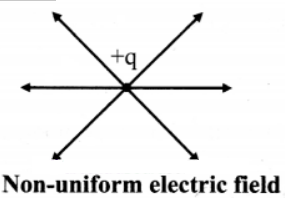
What is non-uniform electric field?
Answer
A field whose magnitude and direction is not the same at all points.
For example, field due to a point charge. In this case, the magnitude of field is same at distance r from the point charge in any direction but the direction of the field is not same.
Image
View full question & answer
Question 213 Marks
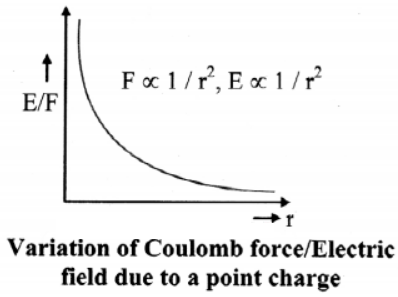
Show graphical representation of variation of coulomb force and electric field due to point charge with distance.
Answer
Electrostatic force: $F =\frac{1}{4 \pi \varepsilon_0} \frac{ q _1 q _2}{ r ^2}$
Electric field: $E : \frac{1}{4 \pi \varepsilon_0} \frac{ q }{ r ^2}$
The coulomb force (F) between two charges and electric field (E) due to a charge both follow the inverse square law.
$\left(F \propto 1 / r^2, E \propto 1 / r^2\right)$
Image
View full question & answer
Question 223 Marks
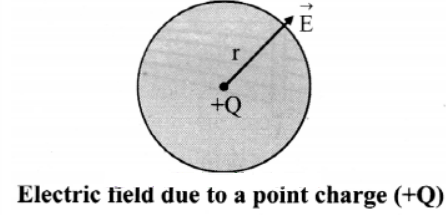
State an expression for electric field on the surface of the sphere due to a positive point charge placed at its centre.
Answer
The magnitude of electric field at a distance r from a point charge Q is same at all points on the surface of a sphere of radius r as shown in figure.
Image
ii. Magnitude of electric field is given by,
$E =\frac{1}{4 \pi \varepsilon_0} \frac{Q}{r^2}$
iii. Its direction is along the radius of the sphere, pointing away from its centre if the charge is positive.
View full question & answer
Question 233 Marks
Establish relation between electric field intensity and electrostatic force.
Answer
i. Let Q and q be two charges separated by a distance r.
The coulomb force between them is given by $\vec{F}=\frac{1}{4 \pi \varepsilon_0} \frac{Q q}{r^2} \hat{r}$
where, $\hat{r}$ is the unit vector along the line joining Q to q .
ii. Therefore, electric field due to charge Q is given $\vec{F}=\frac{\vec{F}}{ q }=\frac{1}{4 \pi \varepsilon_0} \frac{ Q }{ r ^2} \hat{ r }$
iii. Electric field at a point is useful to estimate the force experienced by a charge at that point.
View full question & answer
Question 243 Marks
Define electric field. State its $SI$ unit and dimensions.
Answer
$1.$ Electric field is the force experienced by a test charge in presence of the given charge at the given distance from it.
$\vec{E}=\lim _{q \rightarrow 0} \frac{\vec{F}}{q}$
$2.$ SI unit: newton per coulomb $(N/C)$ or volt per metre $(V/m).$
$3.$ Dimensions: $[L M T^{-3} A^{-1}]$
View full question & answer
Question 253 Marks
The electrostatic force on a small sphere of charge $0.4 \mu C$ due to another small sphere of charge $-0.8 \mu C$ in air is $0.2 N.\ (i)$ What is the distance between the two spheres? $(ii)$ What is the force on the second sphere due to the first?
Answer
$i.$ Given: $q1 = 0.4 µC = 0.4 \times 10-6 C, q2 = -0.8 µC = -0.8 \times 10-6 C, F = 0.2 N$
To find: $i.$ Distance $(r)$
$ii.$ Force on second sphere $(F)$
Formula: $F =\frac{1}{4 \pi \varepsilon_0} \frac{q_1 q_2}{r^2}$
Calculation:$​​​​​​​i.$ From formula, $ r ^2=\frac{1}{4 \pi \varepsilon_0} \frac{q_1 q_2}{F}$
$r ^2=\frac{9 \times 10^9 \times 0.4 \times 10^{-6} \times 0.8 \times 10^{-6}}{0.2}$
$=0.0144$
$\therefore r =\sqrt{0.0144}=0.12 m$
$\therefore r =12 \ cm$
$ii.$ The force on the second sphere due to the first is also $0.2 N$ and is attractive in nature.
View full question & answer
Question 263 Marks
State similarities and differences of gravitational and electrostatic forces.
Answer
i. Similarities:
a. Both forces obey inverse square law:
$F \propto \frac{1}{r^2}$
b. Both are central forces and they act along the line joining the two objects.
ii. Differences:
a. Gravitational force between two objects is always attractive while electrostatic force between two charges can be either attractive or repulsive depending on the nature of charges.
b. Gravitational force is about 36 orders of magnitude weaker than the electrostatic force.
View full question & answer
Question 273 Marks
The total charge of an isolated system is always conserved. Explain with an example.
Answer
  1. When a glass rod is rubbed with silk, it becomes positively charged and silk becomes negatively charged.
  2. The amount of positive charge on glass rod is found to be exactly the same as negative charge on silk.
  3. Thus, the systems of glass rod and silk together possesses zero net charge after rubbing.
    Hence, the total charge of an isolated system is always conserved.
View full question & answer
Question 283 Marks
Explain with an example why quantization of charge is not observed practically.
Answer
$i.$ The magnitude of the elementary electric charge $(e),$ is extremely small. Due to this, the number of elementary charges involved in charging an object becomes extremely large.
$ii.$ For example, when a glass rod is rubbed with silk, a charge of the order of one $µC (10^{-6} C)$ appears on the glass rod or silk. Since elementary charge $e = 1.6 \times 10^{-19} C.$ the number of elementary charges on the glass rod $($or silk$) $is given by
$n =\frac{10^{-6} C }{1.6 \times 10^{-19} C }=6.25 \times 10^{12}$
Since, it is tremendously large number, the quantization of charge is not observed and one usually observes a continuous variation of charge.
View full question & answer
Question 293 Marks
What is quantization of charge?
Answer
  1. Protons (+ve) and electrons (-ve) are the charged particles constituting matter, hence the charge on an object must be an integral multiple of ± e i.e., q = ± ne, where n is an integer.
  2. Charge on an object can be increased or decreased in multiples of e.
  3. It is because, during the charging process an integral number of electrons can be transferred from one body to the other body. This is known as quantization of charge or discrete nature of charge.
View full question & answer
Question 303 Marks
Explain concept of charging by conduction.
Answer
  1. When certain dissimilar substances, like fur and amber or comb and dry hair, are rubbed against each other, electrons get transferred to the other substance making them charged.
  2. The substance receiving electrons develops a negative charge while the other is left with an equal amount of positive charge.
  3. This can be called charging by conduction as charges are transferred from one body to another.
View full question & answer
Question 313 Marks
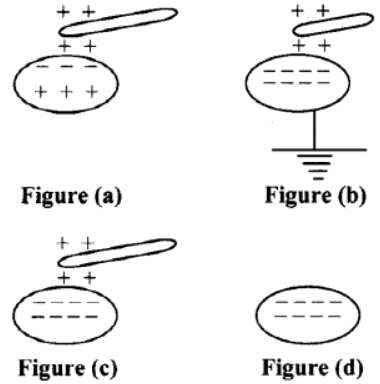
What does the below diagrams show?
Image
Answer
  1. Figure (a) shows insulated conductor.
  2. Figure (b) shows that positive charge is neutralized by electron from Earth.
  3. Figure (c) shows that earthing is removed, negative charge still stays in conductor due to positive charged rod.
  4. Figure (d) shows that when rod is removed, negative charge is distributed over the surface of the conductor.
View full question & answer
Question 323 Marks
Explain: Atoms are electrically neutral.
Answer
  1. Matter is made up of atoms which in turn consists of elementary particles proton, neutron and electron.
  2. A proton is considered to be positively charged and electron to be negatively charged.
  3. Neutron is electrically neutral i.e., it has no charge.
  4. An atomic nucleus is made up of protons and neutrons and hence is positively charged.
  5. Negatively charged electrons surround the nucleus so as to make an atom electrically neutral.
View full question & answer