Question
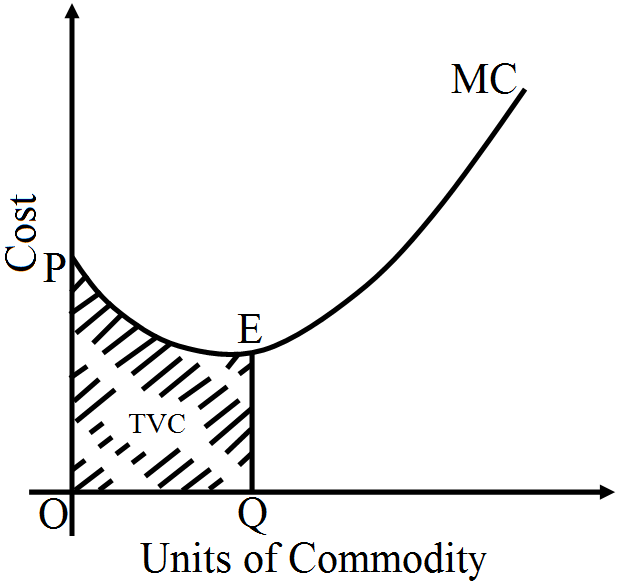
Explain that area under marginal bar cost (MC) is total variable cost (TVC).
Answer

As we know that MC is addition to the total variable cost when an additional unit is produced. This means that total variable cost (TVC) is the sum of marginal cost, since total fixed cost remains the same. This is proved with the help of given figure. Assuming output at OQ, an imaginary marginal cost (MC) is drawn in diagram. Thus, under assumption of marginal cost curve, total variable cost (TVC) is equal to the area under marginal cost curve. For example, at OQ units of output, TVC is equal to the shaded area OPEQ. It can be explained with the help of the following table.
Units of Commodity
MC
$\text{TVC}=\sum\text{MC}$
0
0
0
1
30
30
2
10
40
3
15
55
4
30
85
5
35
120

Need a full question paper?

Generate a complete, print-ready paper with questions like this in minutes — across 16+ boards, with answer keys.

Start Generating Free

Similar questions

Explain “Returns to Scale” using numerical examples. Give reasons.
Identify the three phases of the Law of Variable Proportions from the following and also give reason behind each phase:
Units of Variable Input
(Units)
Total Physical Product
1 10
2 22
3 30
4 35
5 30
When does a demand curve take the shape of a rectangular hyperbola?
Explain briefly the following determinants of supply.
  1. Increase in the price of inputs.
  2. Decrease in the tax on goods.
  3. An improvement in technology.
  4. An increase in the price of other goods.
Considering the same demand curve as in exercise 22, now let us allow for free entry and exit of the firms producing commodity X. Also assume the market consists of identical firms producing commodity X. Let the supply curve of a single firm be explained as.$\text{q}^\text{s}_f=8+3\text{p for p}\geq20$
$=0\text{ for }0\leq\text{p}<20$
  1. What is the significance of p = 20?
  2. At what price will the market for X be in equilibrium? State the reason for your answer.
  3. Calculate the equilibrium quantity and number of firms.
How are equilibrium price and quantity affected when income of the consumers:
  1. increase?
  2. decrease?
Explain how price is determined in a perfectly competitive market with fixed number of firms.
What would be an effect on equilibrium price and equilibrium quantity when demand and supply both shift leftward?
OR
There is simultaneously decrease in demand and supply of a commodity, when it will result in:
  1. No change in equilibrium price (Case I).
  2. A fall in equilibrium price. (Case III).
OR
Market for a good is in equilibrium. There is simultaneous "decrease" in both demand and supply of the goods. Explain its effect on market price.
What do you mean by excess demand? Explain with the help of a diagram as to what will be the effect of an excess demand on the price of the commodity.
OR
At a given price of a commodity, there is excess demand. Is this price an equilibrium price? If not, how will the equilibrium price be reached? Use diagram.
From the following schedule find out the level of output at which the producer is in equilibrium. Calculate profit. Give reasons for your answer.
Output(Units)
1
2
3
4
5
6
7
Price (Rs.)
24
24
24
24
24
24
24
Total Cost (Rs.)
26
50
72
92
115
139
165