Question
Explain the basis for grouping organisms into five kingdoms.

Answer


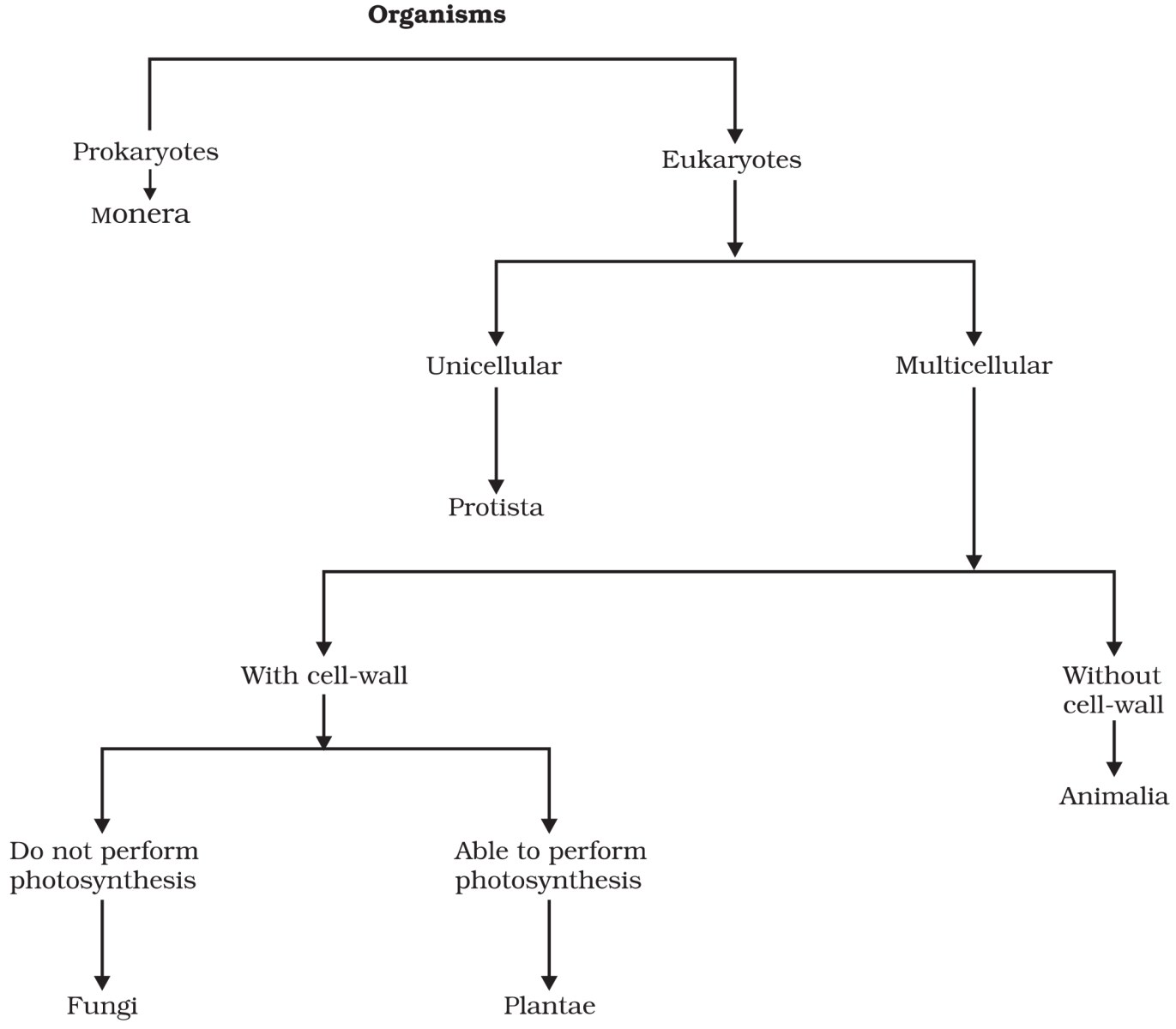
R.H. Whittaker proposed a five kingdom Classification of living organisms on the basis of Linnaeus’ system of Classification. The five kingdoms proposed by Whittaker are Monera, Protista, Fungi, Plantae, and Animalia.
The basis for grouping organisms into five kingdoms is as follows:
  1. On the basis of the presence or absence of membrane-bound organelles, all living organisms are divided into two broad categories of eukaryotes and prokaryotes. This division lead to the formation of kingdom Monera, which includes all prokaryotes.
  2. Then, eukaryotes are divided as unicellular and multicellular, on the basis of cellularity. Unicellular eukaryotes form kingdom Protista, and multicellular eukaryotes form kingdom Fungi, Plantae, and Animalia.
  3. Animals are then separated on the basis of the absence of a cell wall.
  4. Since fungi and plants both contain a cell wall, they are separated into different kingdoms on the basis of their modes of nutrition. Fungi have saprophytic mode of nutrition, whereas plants have autotrophic mode of nutrition. This results in the formation of the five kingdoms.

Need a full question paper?

Generate a complete, print-ready paper with questions like this in minutes — across 16+ boards, with answer keys.
Start Generating Free

Similar questions

State the law of constant proportions. Give one example to illustrate this law.
Draw a neat labelled diagram of an animal cell.
A liquid compound $X$ of molecular mass $18u$ can be obtained from a number of natural sources. All the animals and plants need liquid $X$ for their survival. When an electric current is passed through $200$ grams of pure liquid $X$ under suitable conditions, then $178$ grams of gas $Y$ and $22$ grams of gas $Z$ are produced. Gas $Y$ is produced at the positive electrode whereas gas $Z$ is obtained at the negative electrode. Moreover, gas $Y$ supports combustion whereas gas $Z$ burns itself causing explosions.
  1. Name $(i)$ liquid $X (ii)$ gas $Y,$ and $(iii)$ gas $Z$
  2. What is the ratio to the mass of element $Z$ to the mass of element $Y$ in the liquid $X?$
  3. Which law of chemical combination is illustrated by this example$?$
  4. Name two sources of liquid $X.$
  5. Gate an important use of $Y$ in our life.
Write important functional differences between striated and smooth muscle tissues. Draw a labeled diagram of the muscle tissue that shows rhythmic contraction and relaxation throughout the life.
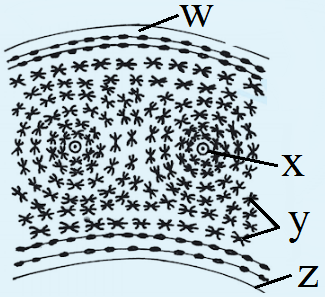
  1. Identify the figure.
  2. Label $W, X, Y$ and $Z$
  3. What is chemical composition of material of the figure
  4. What of the function of $X$?
What is fractional distillation? What is the use of fractionating column in fractional distillation?
Which contains more molecules, $10\ g$ of sulphur dioxide $\left(\mathrm{SO}_2\right)$ or $10\ g$ of oxygen $\left(\mathrm{O}_2\right) ? ($Atomic masses: $\mathrm{S}=32 \mathrm{u} ; \mathrm{O}= 16u)$
State the various postulates of Dalton’s atomic theory of matter.
a. How does a boat float in water$?$
b. A piece of steel has a volume of $12 cm^3$, and a mass of $96\ g .$ What is its density: $(i)$ in $g / cm ^3$ $(ii)$ in $kg / m ^3 ?$
An atom of an element $X$ may be written as $^{9}_4\text{X} $
  1. What does the figure $9$ indicate?
  2. What does the figure $4$ indicate?
  3. What is the number of protons in atom $X$?
  4. What is the number of neutrons in atom $X$?
  5. What is the number of electrons in atom $X$?
  6. How many electrons are there in the outermost shell of an atom of element $X$?
  7. Write the symbol of ion formed by an element $Z$ is $2, 8, 8$.