Question
Explain the cyclic structure of glucose.

Answer

self

Need a full question paper?

Generate a complete, print-ready paper with questions like this in minutes — across 16+ boards, with answer keys.
Start Generating Free

Similar questions

  1. Complete the following chemical equations for reactions:
i. $\text{MnO}_{4(aq)}^{-}+\text{S}_{2}\text{O}_{3(aq)}^{2-}+\text{H}_{2}\text{O}_{(l)}\rightarrow$
ii. $\text{Cr}_{2}\text{O}^{-}_{7(aq)}+\text{H}_{2}\text{S}_{(g)}+\text{H}^{+}_{(aq)}\rightarrow$
  1. Give an explanation for each of the following, observations:
  1. The gradual decrease in size (actinoid contraction) from element to element is greater among the .actinoids than that among the lanthanoids (lanthanoid contraction).
  2. The greatest number of oxidation states are exhibited by the members in the middle of a transition series.
  3. With the same d-orbital configuration $(d^4) Cr^{2+}$ ion is a reducing agent but $Mn^{3+}$ ion is an oxidising agent.
Explain oxidation and reduction reactions of carbonyl compounds.
(a) What is reverse osmosis? How is water purified through it? Explain.
(b) Write the applications of osmosis.
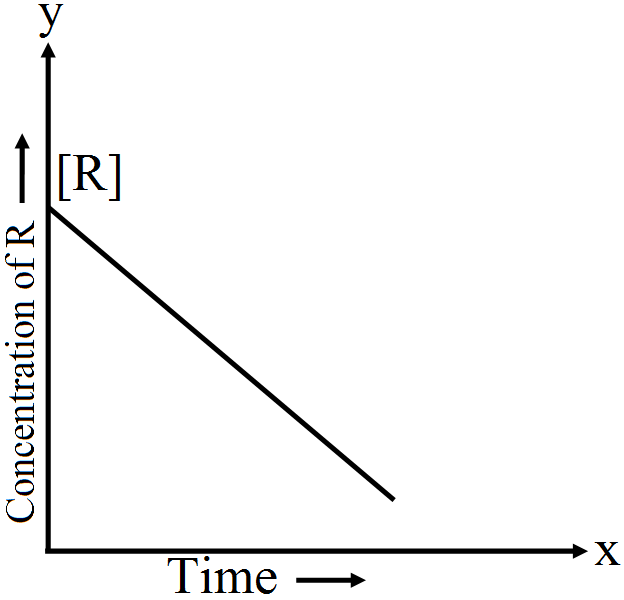
In the reaction
$Q + R \rightarrow $ Products
The time taken for $99\%$ reaction of $Q$ is twice the time taken for $90\%$ reaction of $R.$ The concentration of $R$ varies with time as shown in the figure given alongside.

What is the overall order of the reaction? Give the units of the rate constant for the same. Write the rate expression for the above reaction.
a. Amongst the following, the most stable complex is:
i. $\left[ Fe \left( H _2 O \right)_6\right]^{3+}$
ii. $\left[ Fe \left( NH _3\right)_6\right]^{3+}$
iii. $\left[ Fe \left( C _2 O _4\right)_3\right]^{3-}$
iv. $\left[ FeCl _6\right]^{3+}$
b. What will be the correct order for the wavelength of absorption in the visible region for the following:
$
\left[Ni\left(NO_2\right)_6\right]^{4-},\left[Ni\left(NH_3\right)_6\right]^{2+},\left[Ni\left(H_2 O\right)_6\right]^{2+}
$
Account for the following:
  1. When $NaBr$ is heated with conc. $H_2SO_4, Br_2$ is produced but when $NaCl$ is heated with conc. $H_2SO_4,$ $HCl$ is produced.
  2. $H_2S$ acts only as a reducing agent but $SO_2$ acts both as a reducing agent as well as an oxidising agent.
  3. The acid strength decreases in the order: $HCl > H_2S > PH_3.$
What do you understand by shape selective catalysis? Why are zeolites good shape selective catalysts?
How does colour appear in coordination compounds? Its explanation is based on crystal field theory.
After watching a programme on TV about the presence of carcinogens (cancer causing agents) Potassium bromate and Potassium iodate in bread and other bakery products, Veena, a class XII student, decided to make others aware about the adverse effects of these carcinogens in foods. She consulted the school principal and requested him to instruct the canteen contractor to stop selling sandwiches, pizzas, burgers and other bakery products to the students. The principal took an immediate action and instructed the canteen contractor to replace the bakery products with some proteins and vitamins-rich food like fruits, salads, sprouts, etc. The decision was welcomed by the parents and students.
After reading the above passage, answer the following questions:
  1. What are the values (at least two) displayed by Veena?
  2. Which polysaccharide component of carbohydrates is commonly present in bread?
  3. Write the two types of secondary structures of proteins.
  4. Give two examples of water soluble vitamins.
Match the items of Column I with items of Column II and assign the correct code:
 
Column I
 
Column II
$(A)$
Pendulum
$(1)$
Chrome steel
$(B)$
Malachite
$(2)$
Nickel steel
$(C)$
Calamine
$(3)$
$Na_3AlF_6$
$(D)$
Cryolite
$(4)$
$CuCO_3.Cu (OH)_2$
 
 
$(5)$
$ZnCO_3$
  1. $A (1) B (2) C (3) D (4)$
  2. $A (2) B (4) C (5) D (3)$
  3. $A (2) B (3) C (4) D (5)$
  4. $A (4) B (5) C (3) D (2)$