Question
Explain the D and L notation method of spatial arrangement with respect to glucose.

Answer

The letters 'D' or 'L' before the name of any compound indicate the relative configuration of a particular stereoisomer of a compound with respect to configuration of some other compound, configuration of which is known.
In the case of carbohydrates, this refers to their relation with a particular isomer of glyceraldehyde.
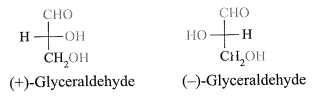
Glyceraldehyde contains one asymmetric carbon atom and exists in two enantiomeric forms as shown below
Image
(+) Isomer of glyceraldehyde has 'D' configuration it means that the -OH group lies on right hand side in the structure.
All those compounds which can be chemically correlated to D(+) isomer of glyceraldehyde are said to have D-configuration.
Where as those which can be correlated to L (-) isomer of glyceraldehyde are said to have L-configuration. In 'L(-)' isomer -OH group is on left hand side.
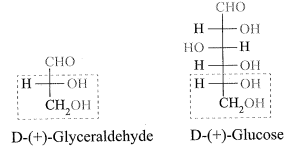
For assigning the configuration of monosaccharides it is the lowest asymmetric carbon atom (as shown below) which is compared. As in (+) glucose -OH on the lowest assymmetric carbon is on the right side which is compared to (+) glyceraldehyde. So, (+) glucose is assigned D-configuration.
Image
Other asymmetric carbon atoms of glucose are not considered for this comparison. Also, the structure of glucose and glyceraldehyde is written in a way that most oxidised carbon (in this case -CHO) is at the top.
Need a full question paper?

Generate a complete, print-ready paper with questions like this in minutes — across 16+ boards, with answer keys.

Start Generating Free

Similar questions

Read the passage given below and answer the following questions: Lucas test is a test to differentiate between primary, secondary and tertiary alcohols. This test consists of treating an alcohol with Lucas' reagent, and turbidity, due to the formation of insoluble alkyl chloride, is observed. Lucas test is based on the difference in reacting of three classes of alcohols with hydrogen chloride via $S_N1$ reaction. The different reactivity reflects the differing ease of formation of the corresponding carbocations. In these questions $($Q. No. $i-iv),$ a statement of assertion followed by a statement ofreason is given. Choose the correct answer out of the following choices.
  1. Assertion and reason both are correct statements and reason is correct explanation for assertion.
  2. Assertion and reason both are correct statements but reason is not correct explanation for assertion.
  3. Assertion is correct statement but reason is wrong statement.
  4. Assertion is wrong statement but reason is correct statement.
  1. Assertion: Equimolar mixture of cone. $\ce{HCI}$ and anhydrous $\ce{ZnCl_2}$ is called Lucas' reagent.
Reason: Lucas' reagent can be used to distinguish between methanol and ethanol.
  1. Assertion: $2-$Methyl$-2-$butanol gives no turbidity with Lucas' reagent at room temperature.
Reason: It is a $3^\circ$ alcohol.
  1. Assertion: Tertiary alcohols react fastest with Lucas' reagent by $S_N1$ mechanism.
Reason: $3^\circ$ carbocation is most stable.
  1. Assertion: Amongst the compounds, $\ce{H2C = CHCH_2OH (I), C_6H_5OH (II), CH_3CH_2CH_2OH (III)}$ and $\ce{(CH_3)_3COH (IV),}$ only $\ce{(IV)}$ reacts with Lucas' reagent at room temperature.
Reason: Tertiary alcohol gives turbidity immediately with Lucas' reagent.
  1. Assertion: Lucas test can be used to distinguish between $1-$propanol and $2-$propanol.
Reason: Lucas test is based upon the difference in reactivity of primary, secondary and tertiary alcohols with cone. $\ce{HCI}$ and anhyd. $\ce{ZnCl_2.}$
Read the passage given below and answer the following questions:
The unique behaviour of $Cu,$ having a positive $E^\circ$ accounts for its inability to liberate $H_2$ from acids. Only oxidising acids $($nitric and hot concentrated sulphuric acid$)$ react with $Cu,$ the acids being reduced. The stability of the half$-$filled $(d^5)$ subshell in $Mn^{2+}$ and the completely filled $(d^{10})$ configuration in $Zn^{2+}$ are related to their $\text{E}^\circ\frac{\text{M}^{3+}}{\text{M}^{2+}}$ values. The low value for $Sc$ reflects the stability of $Sc^{3+}$ which has a noble gas configuration. The comparatively high value for $Mn$ shows that $Mn^{2+}(d^5)$ is particularly stable, whereas a comparatively low value for $Fe$ shows the extra stability of $Fe^{3+}(d^5)$. The comparatively low value for $V/s$ related to the stability of $v^{2+} ($half$-$filled $t_{2g}$ level$)$.
The following questions are multiple choice questions. Choose the most appropriate answer :
  1. Standard reduction electrode potential of $\frac{\text{Zn}^{2+}}{\text{Zn}}$ is $0.76V$. This means
  1. $ZnO$ cannot be reduced to $Zn$ by $H_2$ under standard conditions.
  2. $Zn$ cannot liberate $H_2$ with concentrated acids.
  3. $Zn$ is generally the anode in an electrochemical cell.
  4. $Zn$ is generally the cathode in an electrochemical cell.
  1. $\text{E}^\circ$ values for the couples $\frac{\text{Cr}^{3+}}{\text{Cr}^{2+}}$ and $\frac{\text{Mn}^{3+}}{\text{Mn}^{2+}}$ are $-0.41$ and $+1.51$ volts respectively. These values suggest that.
  1. $Cr^{2+}$ acts as a reducing agent whereas $Mn^{3+}$ acts as an oxidizing agent.
  2. $Cr^{2+}$ is more stable th an $Cr^{3+}$ state.
  3. $Mn^{3+}$ is more stable than $Mn^{2+}$.
  4. $Cr^{2+}$ acts as an oxidizing agent whereas $Mn^{3+}$ acts as a reducing agent..
  1. The reduction potential values of $M, N$ and $O$ are $+2.46, -1.13$ and $-3.13V$ respectively. Which of the following order is correct regarding their reducing property?
  1. $O > N > M$
  2. $O > M > N$
  3. $M > N > O$
  4. $M > O > N$
  1. Which of the following statements are true?
  1. $Mn^{2+}$ compounds are more stable than $Fe^{2+}$ towards oxidation to $+3$ state.
  2. Titanium and copper both in the first series of transition metals exhibits $+1$ oxidation state most frequently.
  3. $Cu^+$ ion is stable in aqueous solutions.
  4. The $\text{E}^\circ$ value for the $\frac{\text{Mn}^{3+}}{\text{Mn}^{2+}}$ couple is much more positive than that for $\frac{\text{Cr}^{3+}}{\text{Cr}^{2+}}$ or $\frac{\text{Fe}^{3+}}{\text{Fe}^{2+}}.$.
  1. $(II)$ and $(III)$
  2. $(I)$ and $(IV)$
  3. $(I)$ and $(III)$
  4. $(II)$ and $(IV)$
  1. The stability of $\text{Cu}^{2+}_\text{(aq)}$ rather than $\text{Cu}^{+}_\text{(aq)}$ is due to.
  1. More negative $\Delta_\text{hyd}\text{H}^\circ$ of $\text{Cu}^{2+}_\text{(aq)}.$
  2. Less negative $\Delta_\text{hyd}\text{H}^\circ$ of $\text{Cu}^{2+}_\text{(aq)}.$
  3. More positive $\Delta_\text{hyd}\text{H}^\circ$ of $\text{Cu}^{2+}_\text{(aq)}.$
  4. Less positive $\Delta_\text{hyd}\text{H}^\circ$ of $\text{Cu}^{2+}_\text{(aq)}.$
For the reaction : $2\text{NO}_\text{(g)}+\text{Cl}_{2\text{(g)}}\rightarrow2\text{NOCl}_\text{(g)},$ the following data were collected. All the measurements were taken at $263K.$
Experiment No.
Initial $\ce{[NO] (M)}$
Initial $\ce{[Cl_2] (M)}$
Initial rate of disapp. of $\ce{Cl_2 (M/ min)}$
$1.$ $0.15$ $0.15$ $0.60$
$2.$ $0.15$ $0.30$ $1.20$
$3.$ $0.30$ $0.15$ $2.40$
$4.$ $0.25$ $0.25$ $?$
The following questions are multiple choice questions. Choose the most appropriate answer:
  1. The molecularity of the reaction is:
  1. $1$
  2. $2$
  3. $3$
  4. $4$
  1. The expression for rate law is:
  1. $\text{r}=\text{k}[\text{NO}][\text{Cl}_2]$
  2. $\text{r}=\text{k}[\text{NO}]^2[\text{Cl}_2]$
  3. $\text{r}=\text{k}[\text{NO}][\text{Cl}_2]^2$
  4. $\text{r}=\text{k}[\text{NO}]^2[\text{Cl}_2]^2$
  1. The overall order of the reaction is:
  1. $2$
  2. $0$
  3. $1$
  4. $3$
  1. The value of rate constant is:
  1. $150.32\ M^{-2}\ min^{-1}$
  2. $200.08\ M^{-1}\ min^{-1}$
  3. $177.77\ M^{-2}\ min^{-1}$
  4. $155.75\ M^{-1}\ min^{-1}$
  1. The initial rate of disappearance of $Cl_2$ in experiment $4$ is:
  1. $1.75\ M\ min^{-1}$
  2. $3.23\ M\ min^{-1}$
  3. $2.25\ M\ min^{-1}$
  4. $2.77\ M\ min^{-1}$
Read the passage given below and answer the following questions:
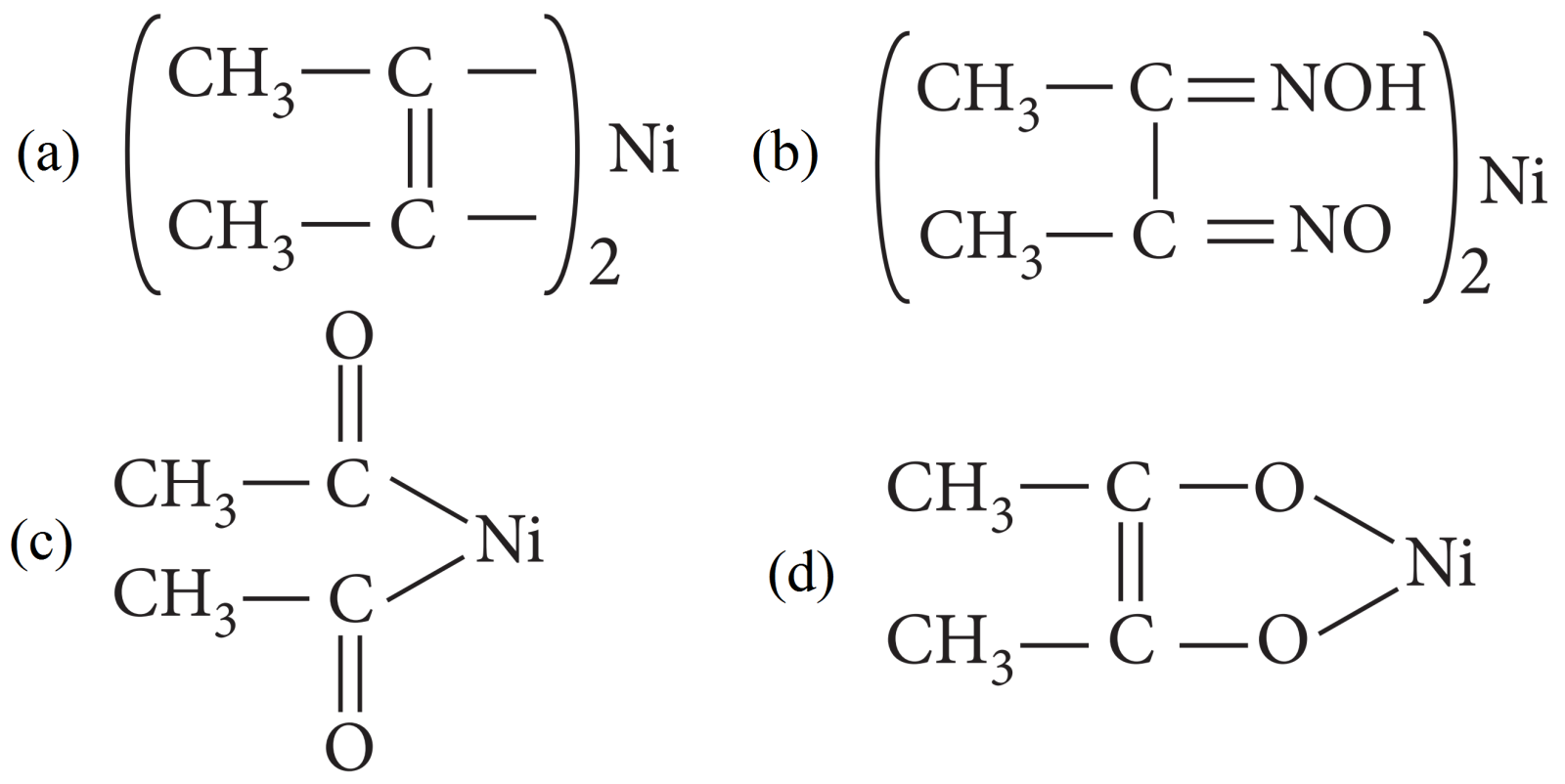
The molecular compounds which are formed from the combination of two or more simple stable compounds and retain their identity in the solid as well as in the dissolved state are called coordination compounds. Their properties are completely different from the constituents. ln coordination compounds, the central metal atom or ion is linked to a number ofions or neutral molecules, called ligands, by coordinate bonds. For example, Dimethylglyoxime $(\text{dmg})$ is a bid en date ligand chelating large amounts of metals. When dimethyl glyoxime is added to alcoholic solution of $\ce{NiCl_2}$ and ammonium hydroxide is slowly added to it, a rosy red precipitate of a complex is formed.
The following questions are multiple choice questions. Choose the most appropriate answer:
  1. The structure of the complex is:
  1. Oxidation number of $Ni$ in the given complex is:
  1. $+3$
  2. $+1$
  3. $+2$
  4. Zero
  1. Hybridisation and structure of the complex is:
  1. $\ce{Sp^3},$ tetrahedral.
  2. $\ce{dsp^2},$ square planar.
  3. $\ce{Sp^3},$ square planar.
  4. $\ce{Sp^3d},$ trigonal bipyramidal.
  1. Which of the following is true about this complex?
  1. It is paramagnetic, containing $2$ unpaired electrons.
  2. It is paramagnetic, containing $1$ unpaired electron.
  3. It is paramagnetic, containing $4$ unpaired electrons.
  4. It is diamagnetic with no unpaired electron.
  1. Which one will give test for $Fe^{3+}$ ions in the solution?
  1. $\ce{[Fe(CN)_6]^{3-}}$
  2. $\ce{[Fe(CN)_6]^{2-}}$
  3. $\ce{(NH_4)_2SO_4·FeSO_4·6H_2O}$
  4. $\ce{Fe_2(S0_4)_3}$
Decrease in concentration of reactant or increase in concentration of product per unit time is called rate of reaction. lt is of two types :
  1. Instantaneous rate of reaction : Rate of change of concentration of reactant or product at a particular time is called instantaneous rate of reaction.
$\text{r}_\text{inst.}=\frac{\text{dC}}{\text{dt}}$
where$, dC =$ infinitely small change in concentration
$dt =$ infinitely small change in time.
  1. Average rate of reaction : Ratio of change in concentration and time required for the change is average rate of reaction.
$\text{r}_\text{av}=\frac{\triangle\text{x}}{\triangle\text{t}}=\frac{\text{Change in concentration}}{\text{Time required for the change}}$
For a reaction of the type$, m_1A + m_2B \rightarrow n_1C + n_2D$
Rate of reaction is given as
$\frac{1}{\text{m}_1}\frac{\text{d[A]}}{\text{dt}}=-\frac{1}{\text{m}_2}\frac{\text{d[B]}}{\text{dt}}=+\frac{1}{\text{n}_1}\frac{\text{d[C]}}{\text{dt}}=+\frac{1}{\text{n}_2}\frac{\text{d[D]}}{\text{dt}}$
In these questions $(Q.$ No. $i-iv),$ a statement of assertion followed by a statement ofreason is given. Choose the correct answer out of the following choices.
  1. Assertion and reason both are correct statements and reason is correct explanation for assertion.
  2. Assertion and reason both are correct statements but reason is not correct explanation for assertion.
  3. Assertion is correct statement but reason is wrong statement.
  4. Assertion is wrong statement but reason is correct statement.
  1. Assertion: The kinetics of the reaction, $\text{mA}+\text{nB}+\text{pC}\rightarrow\text{m}'\text{ X}+\text{n}'\text{ Y}+\text{p}'\text{ Z}$ obey the rate expression as $\frac{\text{dx}}{\text{dt}}=\text{k}[\text{A}]^\text{m}[\text{B}]^\text{n}.$
Reason: The rate of the reaction does not depend upon the concentration of $C$.
  1. Assertion : Instantaneous rate of reaction is equal to $\frac{\text{dx}}{\text{dt}}.$
Reason : lt is the rate of reaction at any particular instant of time.
  1. Assertion : For the reaction, $\text{RCl}+\text{NaOH}\rightarrow\text{ROH}+\text{NaCl},$ the rate of reaction is reduced to half on reducing the concentration of $\ce{RCl}$ to half.
Reason : The rate of reaction is represented by $\ce{k[RCl}].$
  1. Assertion : ln rate law, unlike in the expression for equilibrium constants, the exponents for concentrations do not necessarily match the stoichiometric coefficients.
Reason: It is the mechanism and not the balanced chemical equation for the overall change that governs the reaction rate.
  1. Assertion : ln a reaction$, 2A + B \rightarrow A_2B,$ the reactant $B$ will disappear at twice the rate as $A$ will decrease.
Reason: The rate of disappearance of reactant will be $-\frac{1}{2}\frac{\text{d[A]}}{\text{dt}}=-\frac{\text{d[B]}}{\text{dt}}$
Read the passage given below and answer the following questions: Arrangement of ligands in order of their ability to cause splitting $(\Delta)$ is called spectrochemical series. Ligands which cause large splitting $($large $\Delta)$ are called strong field ligands while those which cause small splitting $($small $\Delta)$ are called weak field ligands. When strong field ligands approach metal atom/ ion, the value of $\Delta_0$ is large, so that electrons are forced to get paired up in lower energy $t_{2g}$ orbitals. Hence, a low$-$spin complex is resulted from strong field ligand. When weak field ligands approach metal atom/ ion, the value of $\Delta_0$ is small, so that electrons enter high energy egorbitals rather than pairing in low energy $t_{2g}$ orbitals. Hence, a high$-$spin complex is resulted from weak field ligands. Strong field ligands have tendency to form inner orbital complexes by forcing the electrons to pair up. Whereas weak field ligands have tendency to form outer orbital complex because inner electrons generally do not pair up. In these questions $(Q.$ No. $i-iv),$ a statement of assertion followed by a statement ofreason is given. Choose the correct answer out of the following choices.
  1. Assertion and reason both are correct statements and reason is correct explanation for assertion.
  2. Assertion and reason both are correct statements but reason is not correct explanation for assertion.
  3. Assertion is correct statement but reason is wrong statement.
  4. Assertion is wrong statement but reason is correct statement.
The following questions are multiple choice questions. Choose the most appropriate answer:
  1. Assertion: In tetrahedral coordination entity formation, the $d$ orbital splitting is inverted and is smaller as compared to the octahedral field splitting.
Reason : Spectrochemical series is based on the absorption of light by complexes with different ligands.
  1. Assertion: In high spin situation, configuration of $d^5$ ions will be $\text{t}^3_{2\text{g}}\text{e}^2_\text{g}.$
Reason : In high spin situation, pairing energy is less than crystal field energy.
  1. Assertion: $F^-$ ion is a weak field ligand and fonns outer orbital complex.
Reason : $F^-$ ion cannot force the electrons of $d_{z^2}$ and $d_{x^2-y^2}$ orbitals of the inner shell to occupy $d_{xy}, d_{yz}$ and $d_{zx} $orbitals of the same shell.
  1. Assertion: The crystal field model is successful in explaining the formation, structures, colour and magnetic properties of coordination compounds.
Reason: In spectrochemical series, ligands are arranged in a series of increasing field strength.
  1. Assertion: $NF_3$ is a weaker ligand than $N(CH_3)_3.$
Reason: $NF_3$ ionizes to give $F^-$ ions in aqueous solution.
Read the passage given below and answer the following questions: The order of reactivity towards $S_N1$ reaction depends upon the stability of carbocation in the first step. Greater the stability of the carbocation, greater will be its ease of formation from alkyl halide and hence faster will be the rate of the reaction. As we know $, 3^\circ$ carbocation is most stable, therefore, the tert $-$ alkyl that halides will undergo $S_N1$ reaction very fast. For example, it has been observed that the reaction $\ce{(CH_3)_3CBr}$ with $\ce{OH}^-$ ion to give $2-$ methyl $-2-$ propanol is about I million times as fast as the corresponding reaction of the methyl bromide to give methanol. The primary alkyl halides always react predominantly by $S_N2$ mechanism. On the other hand, the tertiary alkyl halides react predominantly by $S_N1$ mechanism. Secondary alkyl halides may react by either mechanism or by both the mechanisms without much preference depending upon the nature of the nucleophile and solvent. In these questions $(Q$. No. $i-tv),$ a statement of assertion followed by a statement of reason is given. Choose tile correct answer out of tile following choices.
  1. Assertion and reason both are correct statements and reason is correct explanation for assertion.
  2. Assertion and reason both are correct statements but reason is not correct explanation for assertion.
  3. Assertion is correct statement but reason is wrong statement.
  4. Assertion is wrong statement but reason is correct statement.
  1. Assertion : Low concentration of nudeophile favours $S_N1$ mechanism.
Reason : $2^\circ$ alkyl halides are less reactive than $1^\circ$ towards $S_N1$ reactions.​​​​​​​
  1. Assertion : Polar solvent slows down $S_N2$ reactions.
Reason : $\ce{CH_3-Br}$ is less reactive than $\ce{CH_3Cl}$.​​​​​​​
  1. Assertion : Benzyl bromide when kept in acetone $-$ water it produces benzyl alcohol.
Reason : The reaction follows $S_N2$ mechanism.
  1. Assertion : Rate of hydrolysis of methyl chloride to methanol is higher in $\text{DMF}$ than in water.
Reason : Hydrolysis of methyl chloride follows second order kinetics.
  1. Assertion : $S_N1$ reaction is carried out in the presence of a polar protic solvent.
Reason : A polar protic solvent increases the stability of carbocation due to solvation.

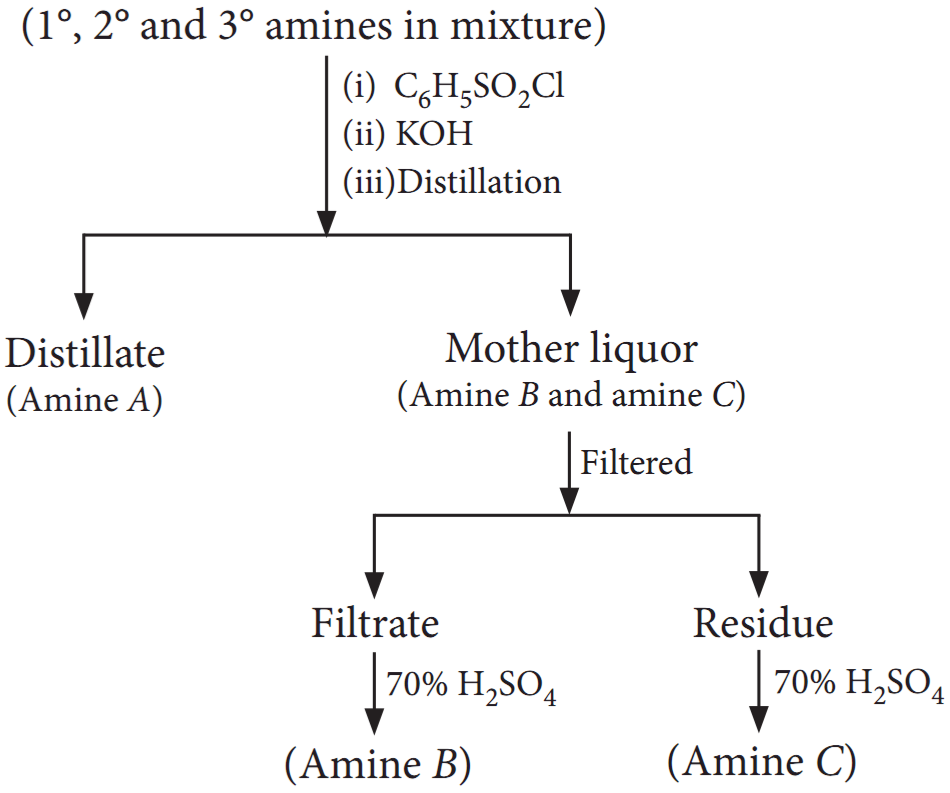
When the mixture contains the three amine salts (1º, 2º and 3º) along with quaternary salt, it is distilled with KOH solution. The three amines distill, leaving the quaternary salt unchanged in the solution. Then the mixture of amines is separated by fractional distillation, Hinsberg's method and Hoffmann's method.

The following questions are multiple choice questions. Choose the most appropriate answer:
  1. Hinsberg reagent is:
  1. Aliphatic sulphonyl chloride.
  2. Phthalamide.
  3. Aromatic sulphonyl chloride.
  4. Anhydrous ZnCl2 + cone. HCI.
  1. Primary amine with Hinsberg's reagent forms:
  1. N-alkyl benzene sulphonamide soluble in KOH solution.
  2. N-alkyl benzene sulphonamide insoluble in KOH solution.
  3. N, N-alkyl benzene sulphonamide soluble in KOH solution.
  4. N, N-alkyl benzene sulphonamide insoluble in KOH solution.
  1. Secondary amine with Hinsberg's reagent forms:
  1. N-alkyl benzene sulphonamide soluble in KOH solution.
  2. N-alkyl benzene sulphonamide insoluble in KOH solution.
  3. N,N-dialkyl benzene sulphonamide soluble in KOH solution.
  4. N,N-dialkyl benzene sulphonamide insoluble in KOH solution.
  1. To separate amines in a mixture Hoffmann's method is used. The Hoffman n's reagent is:
  1. Benzenesulphonyl chloride.
  2. Diethyl oxalate.
  3. Benzeneisocyanide.
  4. P-toulenesulphonic acid.
  1. 3º amines with Hinsberg's reagent give:
  1. No reaction.
  2. Product which is same as that of 1° amine.
  3. Product which is same as that of 2° amine.
  4. Products which is a quaternary salt.
For a first order reaction$, A \rightarrow$ Products$, \text{k}=\frac{2.303}{\text{t}}\log\frac{\text{a}}{\text{a}-\text{x}},$ where a is the initial concentration of $A$ and $(a - x)$ is the concentration of $A$ after time $t. k$ is rate constant. Its value is constant at constant temperature for a reaction. The time in which half of the reactant is consumed is called half$-$life period. Half$-$life period of a first order reaction is constant. Its value is independent of initial concentration or any other external conditions.In these questions $(Q.$ No. $i-iv),$ a statement of assertion followed by a statement ofreason is given. Choose the correct answer out of the following choices.
  1. Assertion and reason both are correct statements and reason is correct explanation for assertion.
  2. Assertion and reason both are correct statements but reason is not correct explanation for assertion.
  3. Assertion is correct statement but reason is wrong statement.
  4. Assertion is wrong statement but reason is correct statement.
  1. Assertion : Rate of reaction doubles when concentration of reactant is doubled if it is a first order reaction.
Reason : Rate constant also doubles.
  1. Assertion : For the first order reaction, half$-$life period is expressed as $\text{t}_\frac{1}{2}=\frac{2.303}{\text{k}}\log2.$
Reason : The half$-$life time of a first order reaction is not always constant and it depends upon the initial concentration of reactants.
  1. Reason : The half$-$life time of a first order reaction is not always constant and it depends upon the initial concentration of reactants.
Reason : Acid only acts as a catalyst whereas alkali acts as one of the reactants.
  1. Assertion : For a first order reaction, the concentration of the reactant decreases exponentially with time.
Reason : Rate of reaction at any time depends upon the concentration of the reactant at that time.
  1. Assertion : Half$-$life period for a first order reaction is independent of initial concentration of the reactant.
Reason : For a first order reaction, $\text{t}_\frac{1}{2}=\frac{0.693}{\text{k}},$ where $k$ is rate constant.
Read the passage given below and answer the following questions: Aniline activates the benzene ring by increasing electron density at ortho$-$and para$-$positions. Hence, it is $o-, p-$directing. $-NH-2$ group strongly activates the ring therefore it is difficult to stop the reaction at monosubstitution stage. Among electrophilic substitution reaction, direct nitration of aniline is not done to get $o-$ and $p-$nitroaniline because lone pair of electrons present at nitrogen atom will accept proton from nitrating mixture to give anilinium ion which is meta$-$directing. Aniline with $NaNO_2$ and $\text{HCI}$ forms benzene diazonium chloride at very low temperature. Aromatic amines react with nitrous acid to form a yellow oily liquid known as $N-$nitrosoamines. A statement of assertion followed by a statement of reason is given. Choose the correct answer out of the following choices.
  1. Assertion and reason both are correct statements and reason is correct explanation for assertion.
  2. Assertion and reason both are correct statements but reason is not correct explanation for assertion.
  3. Assertion is correct statement but reason is wrong statement.
  4. Assertion is wrong statement but reason is correct statement.
  1. Assertion: Nitrating mixture used for carrying out nitration of benzene consists of cone. $HNO_3 +$ cone. $H_2SO_4.$
Reason: In presence of $\ce{H_2SO_4, HNO_3}$ acts as a base and produces $\text{NO}^+_2$ ions.
  1. Assertion: Anilinium chloride is more acidic than ammonium chloride.
Reason: Anilinium ion is not resonance$-$stabilised.
  1. Assertion: Nitrobenzene can be prepared from benzene by using mixture of cone. $HNO_3$ and cone. $H_2SO_4.$
Reason: In the mixture, $H_2SO_4$ act as a acid.
  1. Assertion: In strongly acidic solution, aniline becomes less reactive towards electrophilic reagents.
Reason: The amino group being completely protonated in strongly acidic solution, the lone pair of electrons on the nitrogen is no longer available for resonance.
  1. Assertion: Nitration of aniline can be done conveniently by protecting $-NH_2$ group through acetylation.
Reason: Acetylation of aniline results in the increase of electron density in the benzene ring.