Questions

Case study (4 Marks)

Take a timed test

5 questions · self-marked practice — reveal the answer and mark yourself.

Question 14 Marks
Write detailed note on: Starch
Answer
$\rightarrow$ Starch is the main storage polysaccharide of plants.
$\rightarrow$ It is the most important dietary source for human beings.
$\rightarrow$ High content of starch is found in cereals, roots, tubers and some vegetables.
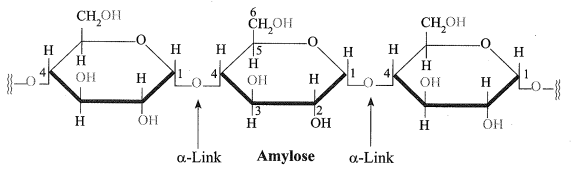
$\rightarrow$ It is a polymer of $a-$glucose and consists of two components amylose and amylopectin.
$\rightarrow$ Amylose is water soluble component which constitutes about $15-20\%$ of starch.
$\rightarrow$ Chemically amylose is along unbranched chain with $200-1000 \alpha-D-(+)-$glucose units held together by $C_1-C_4$ glycosidic linkage.
Image
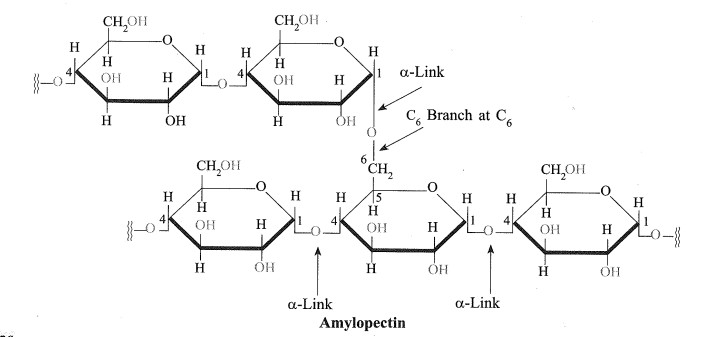
$\rightarrow$ Amylopectin is insoluble in water and constituents about $80-85\%$ of starch.
$\rightarrow$ It is a branched chain polymer of $\alpha-D-$ glucose units in which chain is formed by $C_1-C_4$ glycosidic linkage where as branching occurs by $C_1-C_6$ glycosidic linkage.
Image
View full question & answer
Question 24 Marks
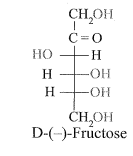
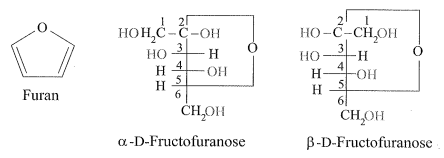
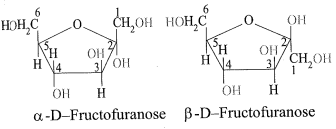
What is fructose? Explain the structure of fructose.
View full question & answer
Question 34 Marks
Describe detailed information on classification of carbohydrates.
Answer
Carbohydrates are classified on the basis of their behaviour on hydrolysis. They have been broadly divided into following 3 groups
(i) Monosaccharide compounds :
"A carbohydrate that can not be hydrolysed further to give simpler unit of polyhydroxy aldehyde or ketone is called a monosaccharide."
About 20 monosaccharides are known to occur in nature. Some common examples are glucose, fructose, ribose, etc.
(ii) Oligosaccharide compounds :
"Carbohydrates that yield two to ten monosaccharide units, on hydrolysis are called oligosaccharides."
They are further classified as disaccharides, trisaccharides, tetrasaccharides, etc., depending upon the number of monosaccharides they provide on hydrolysis.
Amongst these the most common are disaccharides. The two monosaccharide units obtained on hydrolysis of a disaccharide may be same or different.
For example, one molecule of sucrose on hydrolysis gives one molecule of glucose and one molecule of fructose where as maltose gives two molecules of only glucose.
(iii) Polysaccharide compounds:
"Carbohydrate which yield a large number of monosaccharide units on hydrolysis are called polysaccharides."
Some common examples are starch, cellulose, glycogen, gums etc. Polysaccharides are not sweet in taste. Hence, they are also called non- sugars.
View full question & answer
Question 44 Marks
Explain the D and L notation method of spatial arrangement with respect to glucose.
Answer
The letters 'D' or 'L' before the name of any compound indicate the relative configuration of a particular stereoisomer of a compound with respect to configuration of some other compound, configuration of which is known.
In the case of carbohydrates, this refers to their relation with a particular isomer of glyceraldehyde.
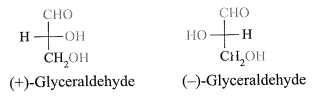
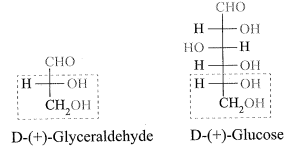
Glyceraldehyde contains one asymmetric carbon atom and exists in two enantiomeric forms as shown below
Image
(+) Isomer of glyceraldehyde has 'D' configuration it means that the -OH group lies on right hand side in the structure.
All those compounds which can be chemically correlated to D(+) isomer of glyceraldehyde are said to have D-configuration.
Where as those which can be correlated to L (-) isomer of glyceraldehyde are said to have L-configuration. In 'L(-)' isomer -OH group is on left hand side.
For assigning the configuration of monosaccharides it is the lowest asymmetric carbon atom (as shown below) which is compared. As in (+) glucose -OH on the lowest assymmetric carbon is on the right side which is compared to (+) glyceraldehyde. So, (+) glucose is assigned D-configuration.
Image
Other asymmetric carbon atoms of glucose are not considered for this comparison. Also, the structure of glucose and glyceraldehyde is written in a way that most oxidised carbon (in this case -CHO) is at the top.
View full question & answer
Question 54 Marks
Explain the structure of nucleic acid compounds.
Answer
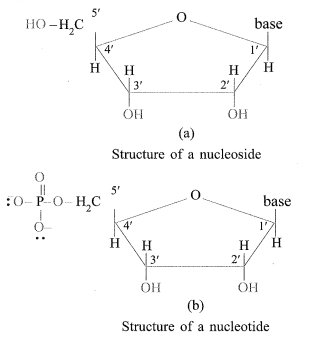
"A unit formed by the attachment of a base to 1' position of sugar is known as nucleoside."
In nucleosides the sugar carbons are numberd as 1', 2', 3' etc. In order to distinguish these from the bases - when nucleoside is linked to phosphoric acid at 5'-position of sugar moiety, we got a nucleotide.
Image
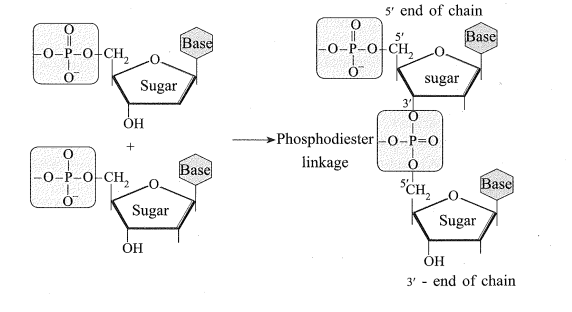
Nucleotides are joined together by phosphodiester linkage between 5' and 3' carbon atoms of the pentose sugar. The formation of a typical dinucleotide is shown in figure.

Image
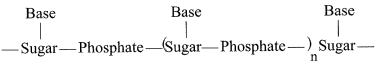
A simplified version of nucleic acid chain is as shown below.
Image
View full question & answer