Question
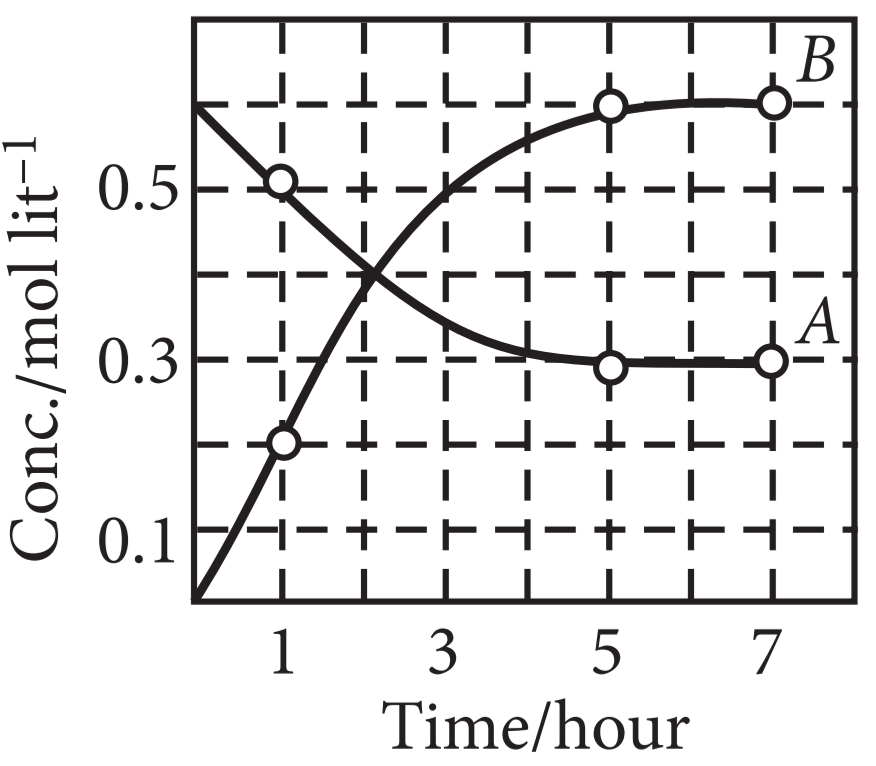
Decrease in concentration of reactant or increase in concentration of product per unit time is called rate of reaction. lt is of two types :
where$, dC =$ infinitely small change in concentration
$dt =$ infinitely small change in time.
For a reaction of the type$, m_1A + m_2B \rightarrow n_1C + n_2D$
Rate of reaction is given as
$\frac{1}{\text{m}_1}\frac{\text{d[A]}}{\text{dt}}=-\frac{1}{\text{m}_2}\frac{\text{d[B]}}{\text{dt}}=+\frac{1}{\text{n}_1}\frac{\text{d[C]}}{\text{dt}}=+\frac{1}{\text{n}_2}\frac{\text{d[D]}}{\text{dt}}$
In these questions $(Q.$ No. $i-iv),$ a statement of assertion followed by a statement ofreason is given. Choose the correct answer out of the following choices.
- Instantaneous rate of reaction : Rate of change of concentration of reactant or product at a particular time is called instantaneous rate of reaction.
where$, dC =$ infinitely small change in concentration
$dt =$ infinitely small change in time.
- Average rate of reaction : Ratio of change in concentration and time required for the change is average rate of reaction.
For a reaction of the type$, m_1A + m_2B \rightarrow n_1C + n_2D$
Rate of reaction is given as
$\frac{1}{\text{m}_1}\frac{\text{d[A]}}{\text{dt}}=-\frac{1}{\text{m}_2}\frac{\text{d[B]}}{\text{dt}}=+\frac{1}{\text{n}_1}\frac{\text{d[C]}}{\text{dt}}=+\frac{1}{\text{n}_2}\frac{\text{d[D]}}{\text{dt}}$
In these questions $(Q.$ No. $i-iv),$ a statement of assertion followed by a statement ofreason is given. Choose the correct answer out of the following choices.
- Assertion and reason both are correct statements and reason is correct explanation for assertion.
- Assertion and reason both are correct statements but reason is not correct explanation for assertion.
- Assertion is correct statement but reason is wrong statement.
- Assertion is wrong statement but reason is correct statement.
- Assertion: The kinetics of the reaction, $\text{mA}+\text{nB}+\text{pC}\rightarrow\text{m}'\text{ X}+\text{n}'\text{ Y}+\text{p}'\text{ Z}$ obey the rate expression as $\frac{\text{dx}}{\text{dt}}=\text{k}[\text{A}]^\text{m}[\text{B}]^\text{n}.$
- Assertion : Instantaneous rate of reaction is equal to $\frac{\text{dx}}{\text{dt}}.$
- Assertion : For the reaction, $\text{RCl}+\text{NaOH}\rightarrow\text{ROH}+\text{NaCl},$ the rate of reaction is reduced to half on reducing the concentration of $\ce{RCl}$ to half.
- Assertion : ln rate law, unlike in the expression for equilibrium constants, the exponents for concentrations do not necessarily match the stoichiometric coefficients.
- Assertion : ln a reaction$, 2A + B \rightarrow A_2B,$ the reactant $B$ will disappear at twice the rate as $A$ will decrease.
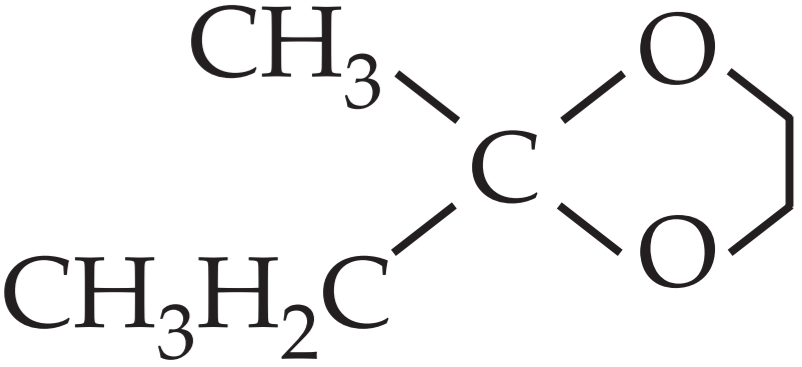
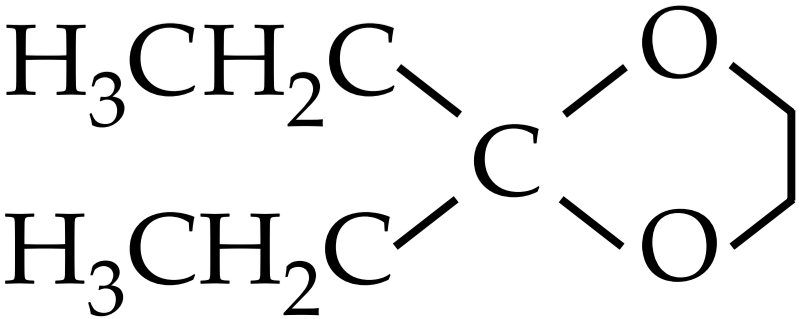
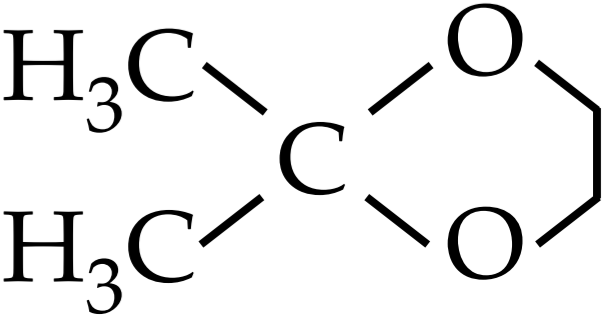
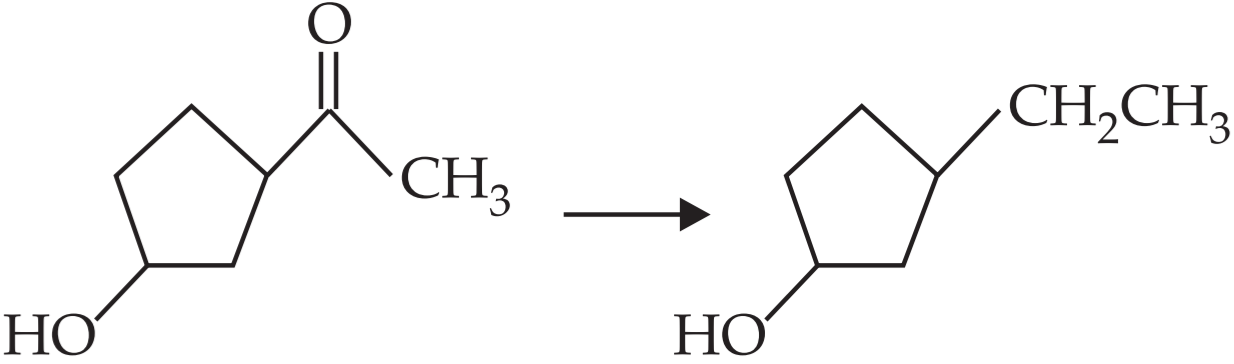
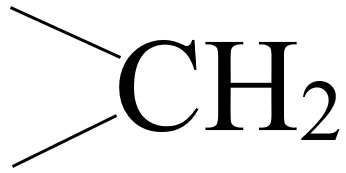 group on treatment with $\ce{Zn-Hg}$ and cone. $\text{HCl} \ ($Clemmensen reduction$)$ or with hydrazine followed by $\ce{NaOH}$ or $\text{KOH}$ in highly boiling solvent such as ethylene glycol $($Wolff $-$ Kishner reduction).Aldehydes differ from ketones in their oxidation reactions. Aldehydes are easily oxidised to carboxylic acids on treatment with $\ce{HNO_3, KMnO_4, K_2Cr_2O_7}$ etc. Even mild oxidising agents mainlyTollens' reagent and Fehling's solution also oxidise aldehydes. Ketones are generally oxidised under vigorous conditions i.e., strong oxidising agents and at elevated temperatures, to give mixture of carboxylic acids having lesser number of $C-$ atoms than the parent ketone.
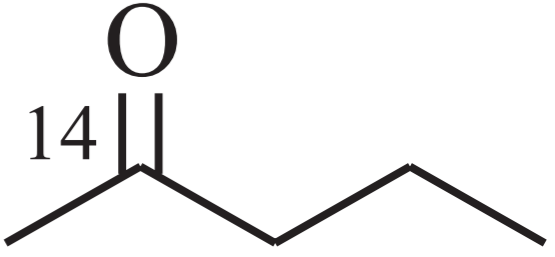 by acidified $\ce{K_2Cr_2O_7},$ the products are: