Question
Explain the difference between conductor, insulator and semiconductor on the basis of energy band in solids.

Answer

On the basis of energy band, the difference between conductor, insulator and semi-conductor is divided as follows :
(i) Conductors: Those substances for which the forbidden energy gap $\Delta E$ is almost zero, are called conductors. In these the valence band and conduction band overlap each other.
(ii) Insulators: Those substances for which the value of forbidden energy gap $\Delta E g$ situated between the valence band and conduction band is 6 eV or more, are called insulators or insulators.
(iii) Semiconductor : Those substances for which the value of forbidden energy gap between valence band and conduction band is around 1 eV , they are called semiconductor materials.

Need a full question paper?

Generate a complete, print-ready paper with questions like this in minutes — across 16+ boards, with answer keys.
Start Generating Free

Similar questions

An inductor 200 mH, capacitor 500 µF, resistor 10Ω are connected in series with a100 V, variable frequency a.c. source. Calculate the
  1. Frequency at which the power factor of the circuit is unity.
  2. Current amplitude at this frequency.
  3. Q-factor.
  1. A giant refracting telescope at an observatory has an objective lens of focal length 15 m. If an eyepiece of focal length 1.0 cm is used, what is the angular magnification of the telescope?
  2. If this telescope is used to view the moon, what is the diameter of the image of the moon formed by the objective lens? The diameter of the moon is $3.48 \times 10^6 \mathrm{~m}$, and the radius of lunar orbit is $3.8 \times 10^8 \mathrm{~m}$.
A 3cm tall object is placed at a distance of 7.5cm from a convex mirror of focal length 6cm. Find the location, size and nature of the image.
In Bohr’s theory of hydrogen atom, calculate the energy of the photon emitted during a transition of the electron from the first excited state to the ground state. Write in which region of the electromagnetic spectrum this transition lies.
Two particles, carrying charges -q and +q and having equal masses m each, are fixed at the ends of a light rod of length a to form a dipole. The rod is clamped at an end and is placed in a uniform electric field E with the axis of the dipole along the electric field. The rod is slightly tilted and then released. Neglecting gravity find the time period of small oscillations.
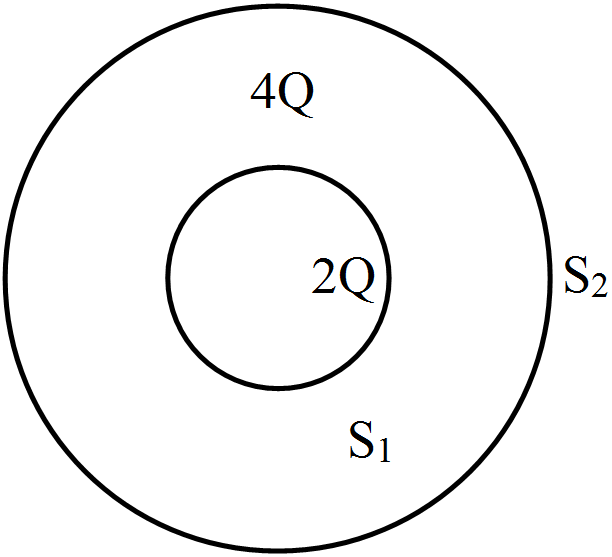
Consider two hollow concentric spheres, $S_1$ and $S_2$, enclosing charges 2Q and 4Q respectively as shown in the figure.
  1. Find out the ratio of the electric flux through them.
  2. How will the electric flux through the sphere $S_1$ change if a medium of dielectric constant $'\in_\text{r}'$ is introduced in the space inside $S_1$ in place of air? Deduce the necessary expression.
Consider the situation of the previous problem. Find the average electric field energy stored in the capacitor and the average magnetic field energy stored in the coil.
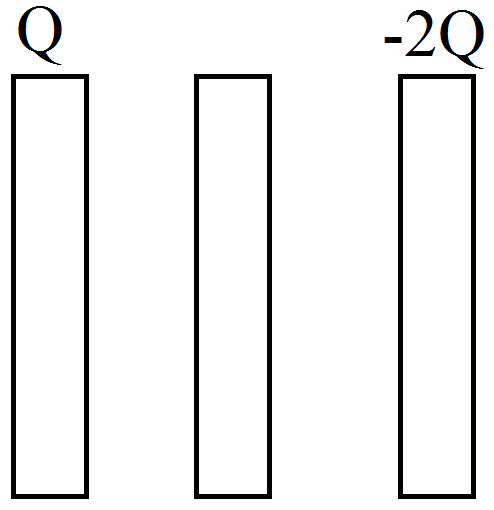
Three identical metal plates with large surface areas are kept parallel to each other as shown in figure. The leftmost plate is given a charge Q, the rightmost a charge -2Q and the middle one remains neutral. Find the charge appearing on the outer surface of the rightmost plate.
Does the force on a charge due to another charge depend on the charges present nearby?
In a pure semiconductor, the number of conduction electrons is $6 \times 10^{19}$ per cubic metre. How many holes are there in a sample of size 1cm × 1cm × 1mm?