Question
Does the force on a charge due to another charge depend on the charges present nearby?

Answer

Coulomb's Law states that the force between two charged particle is given by,$\text{F}=\frac{\text{q}_1\text{q}_2}{4\pi\in_0\text{r}^2}$
Where, $q_1$ and $q_2$ are the charges on the charged particles . r = separation between the charged particles.$\in_0$ = parmittivity of free space.
According to the Law of Superposition, the electrostatic force between two charged particles are unaffected due to the presence of other charges.

Need a full question paper?

Generate a complete, print-ready paper with questions like this in minutes — across 16+ boards, with answer keys.
Start Generating Free

Similar questions

A thin but long, hollow, cylindrical tube of radius r carries a current i along its length. Find the magnitude of the magnetic field at a distance $\frac{\text{r}}{2}$ from the surface (a) inside the tube (b) outside the tube.
Define nuclear fission reaction.
Draw a circuit diagram of a C.E. transistor amplifier. Briefly, explain its working and write the expression for (i) current gain, (ii) voltage gain of the amplifier.
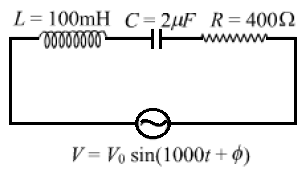
  1. Find the value of the phase difference between the current and the voltage in the series LCR circuit shown below. Which one leads in phase: current or voltage?
  2. Without making any other change, find the value of the additional capacitor $C_1,$ to be connected in parallel with the capacitor C, in order to make the power factor of the circuit unity.
Obtain the resonant frequency and Q-factor of a series LCR circuit with L = 3.0H, C = 27μF, and R = 7.4Ω. It is desired to improve the sharpness of the resonance of the circuit by reducing its ‘full width at half maximum’ by a factor of 2. Suggest a suitable way.
Give a circuit diagram of a common emitter amplifier using an n-p-n transistor. Draw the input and output waveforms of the signal. Write the expression for its voltage gain.
Obtain the resonant frequency ωr of a series LCR circuit with L = 2.0H, C = 32μF and R = 10Ω. What is the Q-value of this circuit?
  1. Define torque acting on a dipole of dipole moment $\overrightarrow{p}$ placed in a uniform electric field $\overrightarrow{\text{E}}$. Express it in the vector form and point out the direction along which it acts
  2. What happens if the field is non-uniform?
  3. What would happen if the external field $\overrightarrow{\text{E}}$ is increasing (i) parallel to $\overrightarrow{p}$ and (ii) anti-parallel to $\overrightarrow{p}$?
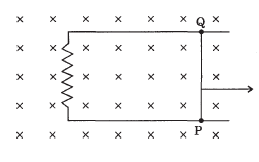
A 0’5 m long metal rod PQ completes the circuit as shown in the figure. The area of the circuit is perpendicular to the magnetic field of flux density 0-15 T. If the resistance of the total circuit is 3Ω, calcularod in the direction as indicated with a constant speed ofte the force needed to move the rod in the direction as indicated with a constant speed of 2ms−1.
An electron and photon have same energy 100eV. Which has greater associated wavelength?