Question
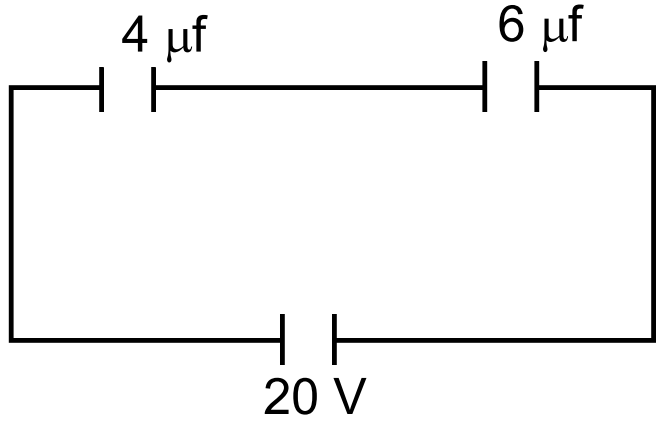
Two capacitors of capacitances $4.0\mu\text{F}$ and $6.0\mu\text{F}$ are connected in series with a battery of 20V. Find the energy supplied by the battery.
Answer


$\therefore\text{C}_1=4\mu\text{F},\ \text{C}_2=6\mu\text{F},\ \text{V}=20\text{V}$
Eq. capacitor $\text{C}_{\text{eq}}=\frac{\text{C}_1\text{C}_2}{\text{C}_1+\text{C}_2}=\frac{4\times6}{4+6}=2.4$
$\therefore$ The Eq Capacitance $\text{C}_{\text{eq}}=2.5\mu\text{F}$
$\therefore$ The energy supplied by the battery to each plate
$\text{E}=\Big(\frac{1}{2}\Big)\text{CV}^2$
$=\Big(\frac{1}{2}\Big)\times2.4\times20^2=480\mu\text{J}$
$\therefore$ The energy supplies by the battery to capacitor $=2\times480=960\mu\text{J}$

Need a full question paper?

Generate a complete, print-ready paper with questions like this in minutes — across 16+ boards, with answer keys.
Start Generating Free

Similar questions

A steel wire has a length of $12.0m$ and a mass of $2.10kg$. What should be the tension in the wire so that speed of a transverse wave on the wire equals the speed of sound in dry air at $20^\circ C = 343m s^{–1}$.
A steel wire of length $4.7m$ and cross-sectional area $3.0 \times 10^{-5}m^2$ stretches by the same amount as a copper wire of length $3.5m$ and cross-sectional area of $4.0 \times 10^{-5}m^2$​​​​​​​ under a given load. What is the ratio of the Young’s modulus of steel to that of copper?
One end of a string of length $l$ is connected to a particle of mass $m$ and the other to a small peg on a smooth horizontal table. If the particle moves in a circle with speed $v$ the net force on the particle $($directed towards the centre$)$ is : $T$ is the tension in the string. $[$Choose the correct alternative$].$
The time of flight of an object projected at an angle $\theta$ is T. What will be its time of flight, if the object be projected at an angle $(90-\theta)^\circ?$
Iceberg floats in water with part of it submerged. What is the fraction of the volume of iceberg submerged if the density of ice is $\rho_\text{i}=0.917\text{g cm}^{-3}?$
 An engine is attached to a wagon through a shock absorber of length $1.5 m$ . The system with a total mass of $50,000 kg$ is moving with a speed of $36 km h ^{-1}$ when the brakes are applied to bring it to rest. In the process of the system being brought to rest, the spring of the shock absorber gets compressed by $1.0 m$ . If $90 \%$ of energy of the wagon is lost due to friction, calculate the spring constant.
If several forces act on a particle, the total torque on the particle may be obtained by first finding the resultant force and then taking torque of this resultant. Prove this. Is this result valid for the forces acting on different particles of a body in such a way that their lines of action intersect at a common point?
Prove that the path of a projectile is a parabola.
Define kinetic energy. Prove that K.E. associated with a mass 'm' moving with velocity v $\frac{1}{2}\text{mv}^2$.
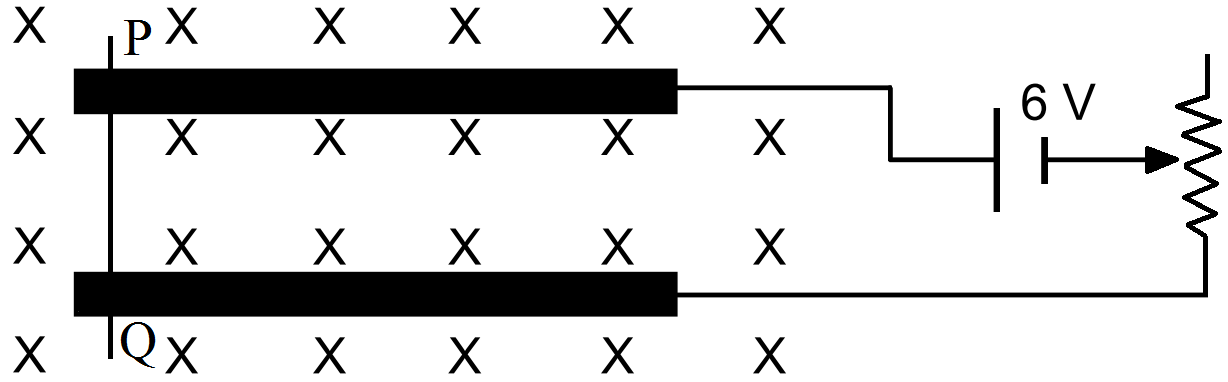
A metal wire PQ of mass 10g lies at rest on two horizontal metal rails separated by 4.90cm A vertically-downward magnetic field of magnitude 0.800T exists in the space. The resistance of the circuit is slowly decreased and it is found that when the resistance goes below 20.0Ω, the wire PQ starts sliding on the rails. Find the coefficient of friction.