Question
Explain the effect of electric potential (potential difference) on photoelectric current and derive the definition and formula of stopping potential.
Answer

Initially, plate C is illuminated with light keeping plate A at positive potential with respect to plate C and keeping the frequency (v) and intensity (I) of incident light constant. Due to the positive potential of $A$, some of the emitted photo electrons are attracted towards, plate A and form a photocurrent.
Now if the magnitude (value) of the positive potential of A is increased then more and more emitted electrons are attracted to A and form more photocurrent. Thus, photocurrent increases with voltage.
After some time, all the electrons emitted from plate C are collected by plate A and form the maximum photocurrent in the circuit. This value of current is saturated (maximum), meaning that on increasing the potential no longer increase the photocurrent. This maximum value of the photocurrent is called saturation current.
• Stopping Potential :
Now apply a negative potential to the plate A with respect to the plate $C$.
By doing this the electrons emitted from C will be repelled by A , so the electrons that have enough energy to overcome the repulsion of A will reach A and form a current in the circuit, so the photocurrent will decrease.
Now if the negative potential of A is increased i.e. made more negative, more and more electrons will be repelled and the number of electrons falling on A will decrease, so the photocurrent will also decrease rapidly.
For some minimum value of the negative potential of A , all electrons arriving at A will be stopped. i.e. the photocurrent in the circuit will be zero. This minimum value of negative potential of A is called the stopping potential or cut-off voltage.
Each electron emitted from C has a different energy (kinetic energy), so if the electron with the maximum kinetic energy is stopped by the repulsion of the plate A , all the electrons are stopped and the photocurrent in the circuit is stopped.
Suppose, maximum kinetic energy of electron is $K _{\max }$.
The energy provided by the repulsion of A to stop this electron $=e V_0$
Thus, photocurrent stops if $K _{\max }=e V_0$.
Here the voltage $V _0$ will be the stopping potential or cut-off voltage.
Image
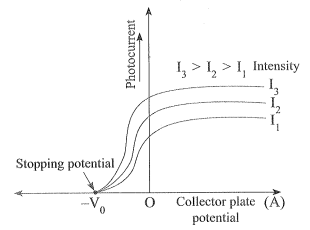
Now keeping the frequency of the incident light constant and increasing its intensity (i.e. intensity $I_2$ then $I _3$, where $I _3> I _2> I _1$ ) a graph of photocurrent versus collector plate can be drawn.
It is clear from this graph that by increasing the intensity of light the value of the maximum saturated photocurrent increases, So $I =\frac{q}{t}=$ $\frac{n e}{t}$ as the number of electrons emitted in 1 sec increases by $\left(\frac{n}{t}\right)$, but the value of the stopping potential does not change, so it can be said from
$K _{\max }=e V_0$, the maximum kinetic energy of emitted photoelectrons does not depend on the intensity of incident light.
$K _{\max }$ does not depend on the intensity of incident radiation.

Need a full question paper?

Generate a complete, print-ready paper with questions like this in minutes — across 16+ boards, with answer keys.

Start Generating Free

Similar questions

A light ray falling at an angle of 45° with the surface of a clean slab of ice of thickness 1m is refracted into it at an angle of 30°. Calculate the time taken by the light rays, to cross the slab. Speed of light in vacuum $= 3 \times 10^8m/s$
Visible light has wavelengths in the range of 400nm to 780nm. Calculate the range of energy of the photons of visible light.
A p-n photodiode is fabricated from a semiconductor with band gap of 2.8 eV. Can it detect a wavelength of 6000 nm?
Suppose, one wishes to construct a 1.0 farad capacitor using circular discs. If the separation between the discs be kept at 1.0mm, what would be the radius of the discs?
A flywheel of moment of inertia $5.0kg-m^2$ is rotated at a speed of 60rad/s. Because of the friction at the axle, it comes to rest in 5.0 minutes. Find:
  1. The average torque of the friction.
  2. The total work done by the friction.
  3. The angular momentum of the wheel 1 minute before it stops rotating.
  1. Define self-inductance. Write its SI units.
  2. A long solenoid with 15 turns per cm has a small loop of area $2.0\ cm^2$ placed inside the solenoid normal to its axis. If the current carried by the solenoid changes steadily from 2.0 A to 4.0 A in 0.1 s, what is the induced emf in the loop while the current is changing?
A lens forms a real image of an object. The distance from the object to the lens is u cm and the distance of the image from the lens is v cm. The given graphs shows variation of v with u.
  1. What is the nature of the lens?
  2. Using the graph, find the focal length of this lens.
An inductor 200 mH, capacitor 500 µF, resistor 10Ω are connected in series with a100 V, variable frequency a.c. source. Calculate the
  1. Frequency at which the power factor of the circuit is unity.
  2. Current amplitude at this frequency.
  3. Q-factor.
An electron microscope uses electrons accelerated by a voltage of 50 kV. Determine the de Broglie wavelength associated with the electrons. If other factors (such as numerical aperture, etc.) are taken to be roughly the same, how does the resolving power of an electron microscope compare with that of an optical microscope which uses yellow light?
The radius of innertmost orbit of hydrogen atom is $5.3 \times 10^{-11} m$. What is the radius of second excited state?