Question
Explain the factors which necessitated systematic accounting.

Answer

The factors that necessitated systematic accounting are given below.
  • Only financial transactions are recorded− Those events that are financial in nature are only recorded in the books of accounts. For example, salary of an employee is recorded in the books but his/ her educational qualification is not recorded.
  • Transactions are recorded in monetary terms− Only those transactions which can be expressed in monetary terms are recorded in the books. For example, if a business has two buildings and four machines, then their monetary values is recorded in the books, i.e. two buildings costing ₹ 2,00,000, four machines costing ₹ 8,00,000. Thus the total value of assets is ₹ 10,00,000.
  • Art of recording− Transactions are recorded in the order of their occurrence.
  • Classification of transaction− Business transactions of similar nature are classified and posted under their respective accounts. For example, all the transactions relating to machinery will be posted in the Machinery Account.
  • Summarising of data− All business transactions are summarised in the form of Trial Balance, Trading Account, Profit and Loss Account and Balance Sheet that provides necessary information to various users.
  • Analysing and interpreting data− Systematic accounting records enable users to analyse and interpret the accounting data in a proper and appropriate manner. These accounting data and information are presented in form of graphs, statements, charts that leads to easy communication and understandability by various users. Moreover, these facilitates in decision making and future predictions.

Need a full question paper?

Generate a complete, print-ready paper with questions like this in minutes — across 16+ boards, with answer keys.
Start Generating Free

Similar questions

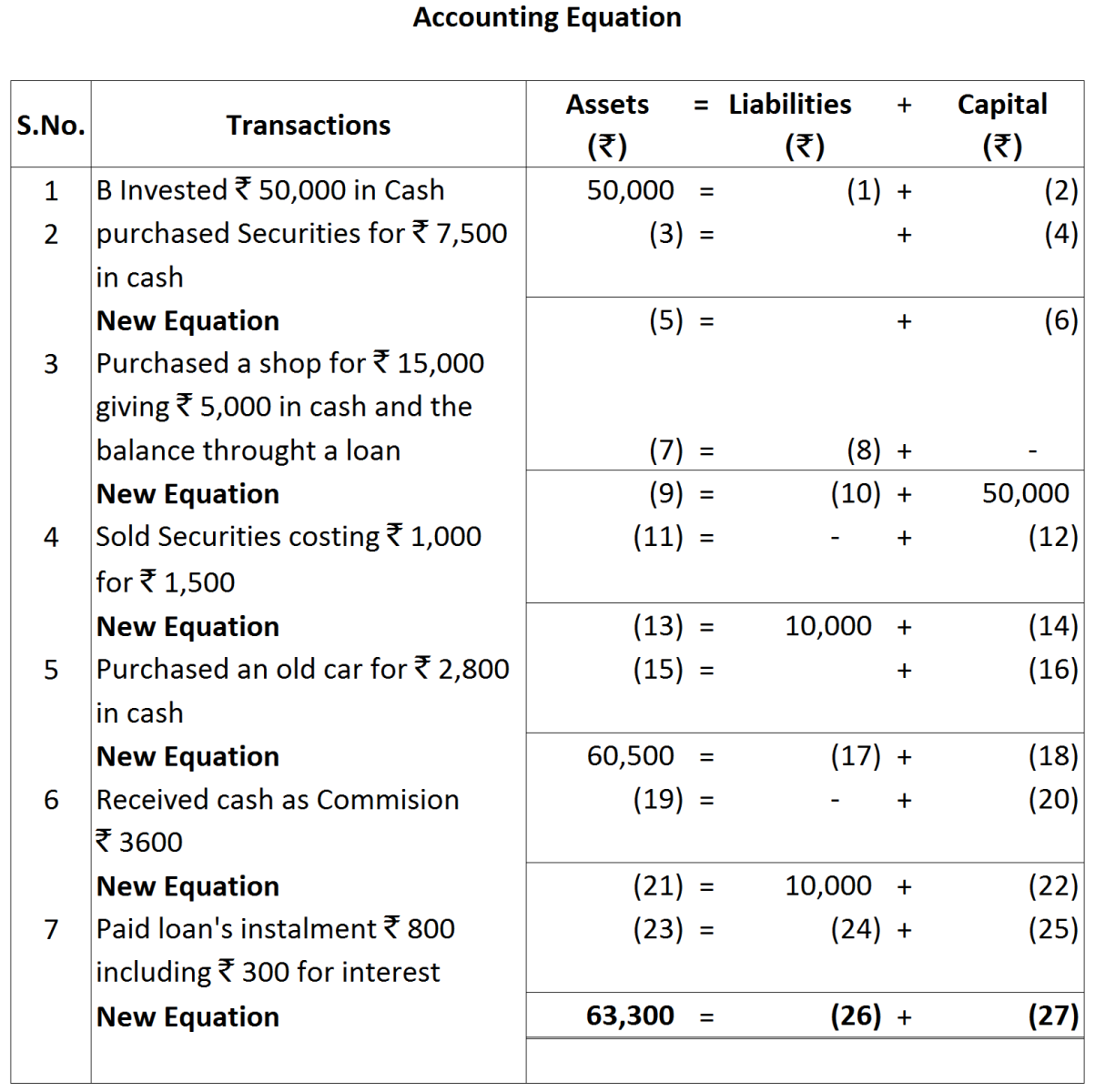
Complete the following Accounting Equation by filling the missing amounts:
Enter the following transactions in a Single Column Cash Book of M/s Suchitra Sen & Co.:
2017
 
(₹)
March 1
Cash in Hand
1,20,000
March 2
Bought machinery for ₹ 60,000 and paid carriage
2,000
March 4
Bought goods for ₹ 25,000 and paid carriage
1,000
March 5
Bought goods from Ravi Das
15,000
March 6
Cash received from sale of Motor bike
5,000
March 8
Sold goods for cash less 5% cash discount
20,000
March 10
Sold goods
40,000
March 12
Paid to Ravi Das on account
10,000
March 15
Bought goods from Suresh for cash less 4% cash discount
30,000
March 20
Paid to Ravi Das
4,500
Discount received
500
March 25
Cash collected from Ashok (Debtor)
10,000
March 28
Purchased postal stamps
500
March 28
Salary paid to accountant
15,000
Record the following transactions of M/s Mahipal Bros. in Proper Subsidiary Books, post them into the Ledger and take out a Trial Balance:
2017
 
Jan. 1
Commenced business with Cash ₹ 2,00,000
Jan. 2 Deposited into U.T.I Bank ₹ 1,75,000
Jan. 4
Purchased goods from Dilip for ₹ 40,000. Trade Discount 20%
Jan. 6
Gave a cheque to Dilip for ₹ 16,800 and discount allowed by him ₹ 200
Jan. 8 Goods bought from Nilesh for Cash ₹ 14,000
Jan. 10 Accepted a bill at 2 months for ₹ 15,000 drawn by Dilip
Jan. 11 Bought goods from Suresh ₹ 75,000
Jan. 13 Paid to Suresh a Cheque for ₹ 58,800 after receiving discount of 2%
Jan. 15 Cash sales made to Jyoti Parshad ₹ 8,000
Jan. 16 Sold goods to Mohinder for ₹ 20,000
Jan. 17 Goods returned by Mohinder for ₹ 1,500
Jan. 18 Received from Mohinder ₹ 7,900 after allowing a discount of 1.25%
Jan. 20 Goods sold to Banerjee ₹ 50,000
Jan. 21 Deposited into Bank ₹ 20,000
Jan. 25 Goods taken for personal use ₹ 2,000
Jan. 25 Purchased furniture ₹ 40,000 and Typewriter ₹ 10,000 for office use
Payment for both the items is made by Cheque
Jan. 25 Sold goods to Anubhav ₹ 30,000
Jan. 27 Goods returned by Anubhav ₹ 5,000
Jan. 27 Received full payment from Banerjee by Cheque, sent it to Bank, Discount allowed 2%
Jan. 28 Acceptance received from Anubhav at 30 days for the amount due from him
Jan. 28 Paid for stationery ₹ 400 and for Postage ₹ 200
Jan. 31 Rent of proprietor's house paid by Cheque ₹ 2,500
Explain the nature of Accounting Standards.
Show the effect of the following transactions and also prepare a Balance Sheet:
  1. Started business with cash ₹ 60,000.
  2. Rent received ₹ 2,000.
  3. Accrued interest ₹ 500.
  4. Commission received in advance ₹ 1,000.
  5. Amount withdrawn ₹ 5,000.
[Hint: Capital = Opening Capital ₹ 60,000 + Rent Received ₹ 2,000 + Accrued Interest ₹ 500 - Drawings ₹ 5,000 = ₹ 57,500.]
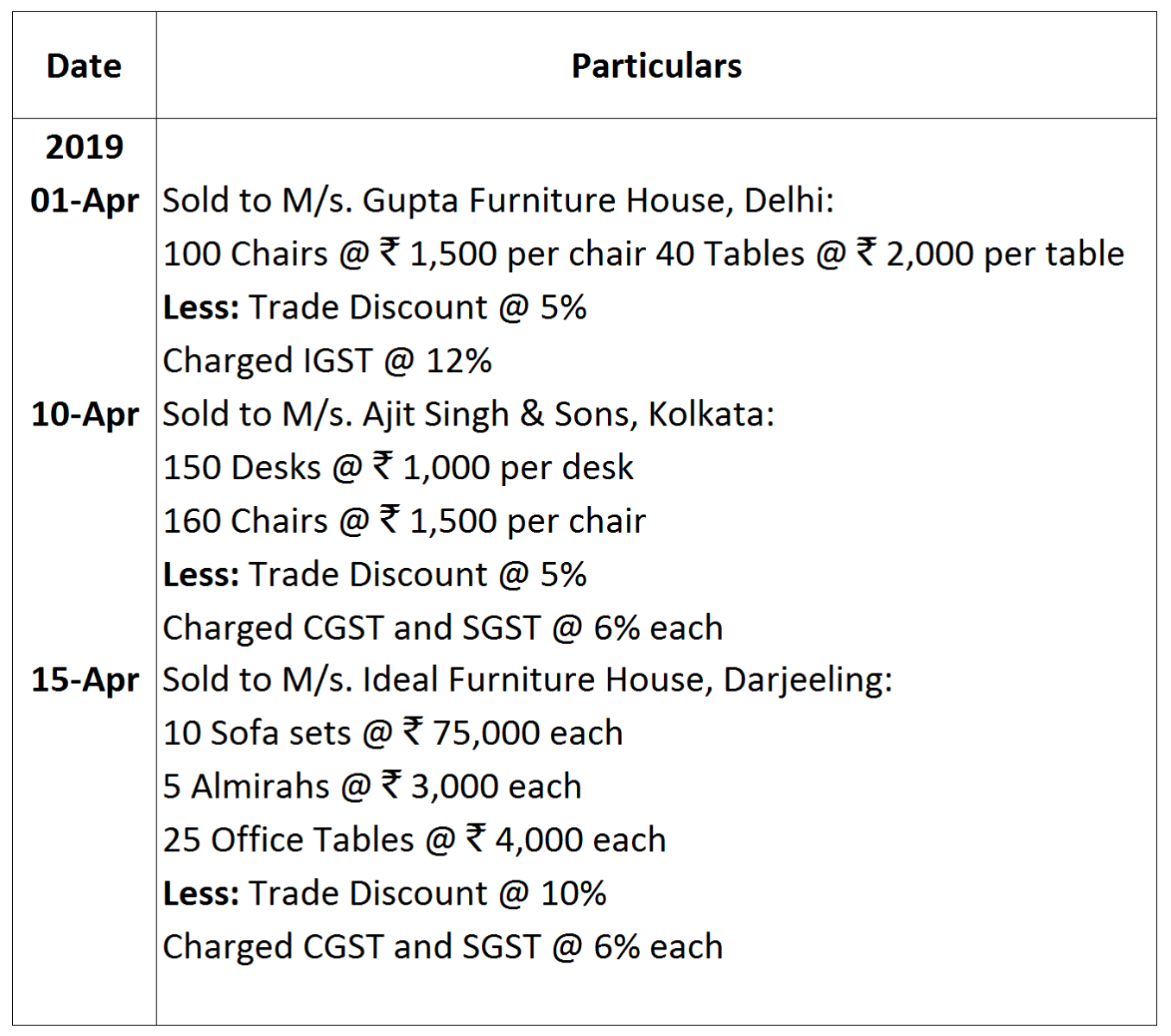
Prepare Sales Book from the following transactions of Hema Traders, Kolkata dealing in furniture. Open the Ledger Accounts also:
Briefly state the rules of debiting and crediting accounts classified on the basis of Accounting Equation.
“Is Trial Balance merely a proof of Arithmetical accuracy”? Explain the errors which are not disclosed by a Trial Balance.
What are types of Accounting?
Prepare Accounting Equation from the following:
  1. Started business with cash ₹ 75,000 and goods ₹ 25,000.
  2. Paid for Rent ₹ 2,000.
  3. Bought goods for cash ₹ 30,000 and on credit for ₹ 44,000.
  4. Goods costing ₹ 50,000 sold at a profit of 25%, out of which ₹ 27,500 received in Cash.
  5. Purchased a Motor-cycle for personal use ₹ 20,000.