Question
Explain the features / characteristics of Utility.
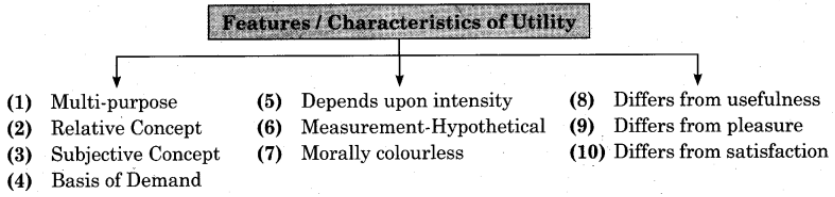
(1) Multi-purpose : Utility is said to be multi-purpose because a commodity can be used to satisfy several wants. It can satisfy wants of more than one person at a time. E.g. milk has multi-purpose utility. It can be used to make coffee, ice- cream, milk-shake, tea, etc. Similarly, in case of commodities like coal, electricity, etc. utility is multi-purpose. (2) Relative Concept : Utility is a relativeconcept because it is related to time, place and person. It changes from time to time, place to place and from person to person. E.g. fan has greater utility in summer than winter, sweater has greater utility in cold regions. (3) S ubjective Concept: Utility is a subjective term. It varies from person to person. It differs on the basis of taste and preferences, habits, likes, dislikes, profession, situation, etc. e.g. chalk has utility for teachers and not for doctors. Fish has utility for non¬vegetarian person etc. (4) Basis of Demand : A person will demand only those commodities which give him utility. No utility means no demand, so utility is the basis of demand. E.g. a student demands a book because he has utility of a book. Thus, utility creates demand for a product. (5) Intensity of Want: Utility of a commodity is greater if a want is most urgent, whereas, utility is less if the intensity of want is less. Utility diminishes when the urgency of want declines. E.g. a thirsty person gets more utility from the first sip of water than the next one. (6) Measurement of Utility : Utility is a psychological concept. So utility cannot be measured cardinally, that is, in numbers. Ordinal measurement, i.e. higher or lower level of utility can be measured. E.g. a hungry person may experience higher or lower utility after having food. However, X it is assumed that cardinal measurement of i utility is possible, for the validity of the law 5 of diminishing marginal utility. (7) Utility is morally Colourless : Utility is ethically neutral concept. It has no moral consideration. It is morally colourless. It does not consider whether a want is good or bad, moral or immoral, desirable or undesirable. A commodity can be used to satisfy any kind of want. It can be useful or harmful. E.g. a knife can be used to cut vegetables, as well as, it can be also used to harm somebody. Thus, utility does not have ? ethical consideration. (8) Utility differs from Usefulness : Utility and usefulness are different concepts. Utility means want satisfying capacity of a commodity whereas usefulness means use value of a commodity. Some commodities have both, utility and usefulness. E.g. watch, pen, etc. However, some commodities have utility but no usefulness. e.g. cigarette has utility for those who smoke but it is not at all useful as it has an adverse effect on human health. (9) Utility differs from Pleasure : There is a difference between utility and pleasure, Certain commodities which possess utility, may not give pleasure. E.g. a course of injections given to patient, has utility because it cures him however, it may not give pleasure or happiness as it is a painful experience. (10) Utility differs from Satisfaction : Utility and satisfaction, interrelated concepts but, utility is not same as satisfaction. Utility refers to power of a good to a satisfy human want. Satisfaction is a state of mind to feel happy. Utility arises before the consumption of a commodity. However, satisfaction is received after the consumption of a commodity. It is because, utility is anticipated satisfaction, whereas, satisfaction is actual realisation. Utility is related to commodity but satisfaction is experienced by a person.
Generate a complete, print-ready paper with questions like this in minutes — across 16+ boards, with answer keys.