Question
Explain the following along with their advantages:
  1. Ready to use accounting software.
  2. Customised accounting software.
  3. Tailored accounting software.

Answer

  1. ​​​​​​Ready to use accounting software.
A variety of readymade softwares is available in the market. These softwares are for users at large and are not developed according to the requirements of any specific user. Most popular ready made softwares available in the market are Tally, Ex. Busy etc.
Advantages:
  1. These softwares are developed by a group of highly experienced group of professionals. Hence, they take care of the problems areas which may be overlooked if a particular software is developed for some specific user.
  2. Since these softwares are used by a large number of users, accounting personnel well versed with these softwares are easily available.
  3. They are easy to learn and their training is sometimes offered free by the vendor.
  4. Because of their use by a large number of users, they have better after sales maintenance service.
  5. Because they are available off-the-shelf, time required in developing a tailor made software is saved.
  6. The cost of installation is low.
  1. Customised accounting software.
The term 'Customised Software' means making changes in the ready to use software so as to suit the specific requirements of the user. Any readymade software can be changed according to the needs and specifications of the user. However, the cost of installation of customised softwares are high because the cost of change is to be paid by the user.
Advantages:
  1. These softwares are designed to suit the specific requirements of the users. Hence, they are used by a large number of large and medium size business enterprises.
  2. Level of secrecy for the data is higher.
  3. Linkage to other information systems is available on the basis of need of the enterprise.
  4. Tailored accounting software.
The term “tailor-made software means developing a software according to the needs and specifications of the user. These softwares are not available off-the-shelf.
Advantages:
  1. It being developed according to the specifications of the user, takes care of the specific needs of the enterprise.
  2. The level of secrecy of data and authenticity checks are robust in such softwares.
  3. They can be effectively linked to some other information systems.

Need a full question paper?

Generate a complete, print-ready paper with questions like this in minutes — across 16+ boards, with answer keys.

Start Generating Free

Similar questions

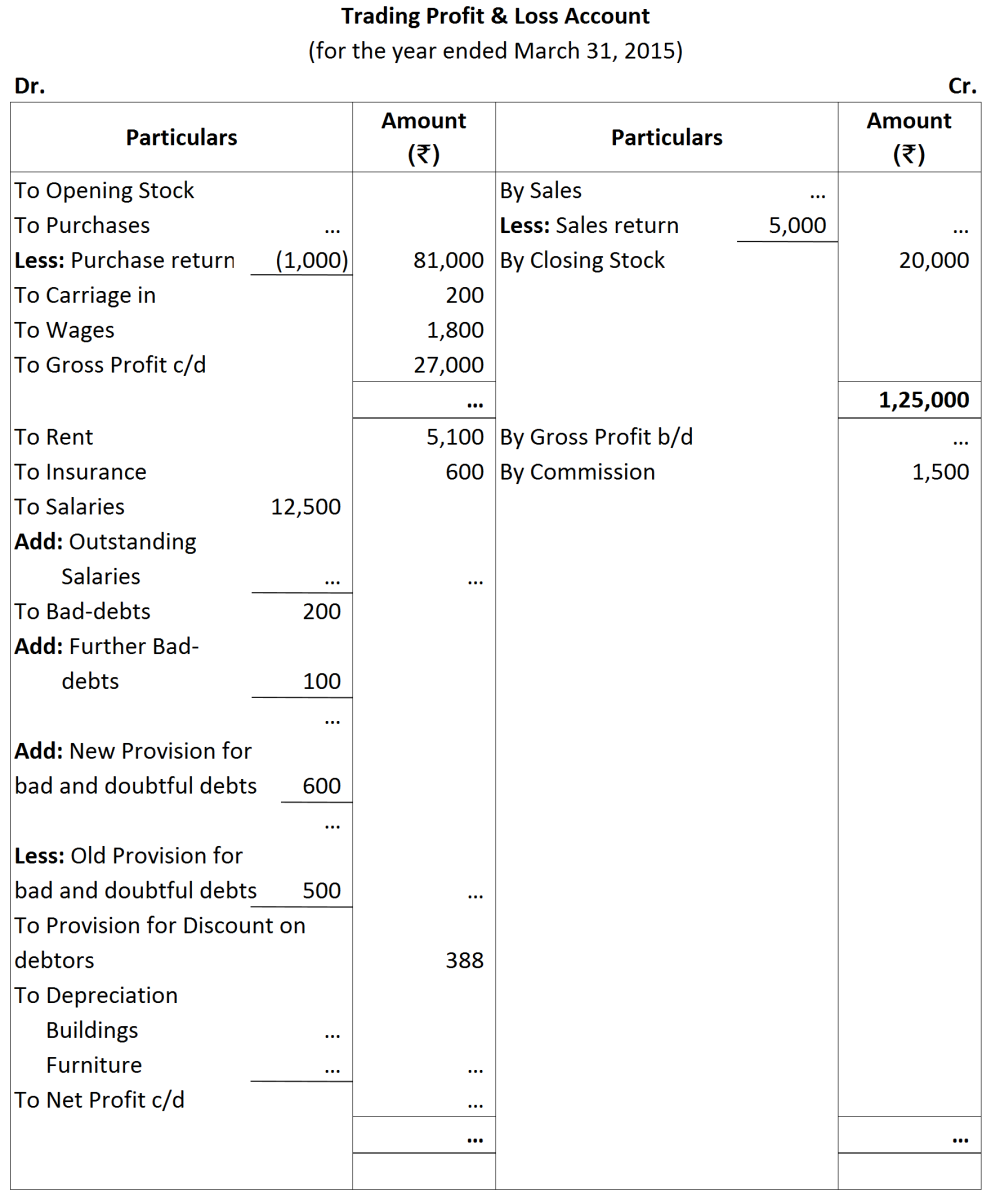
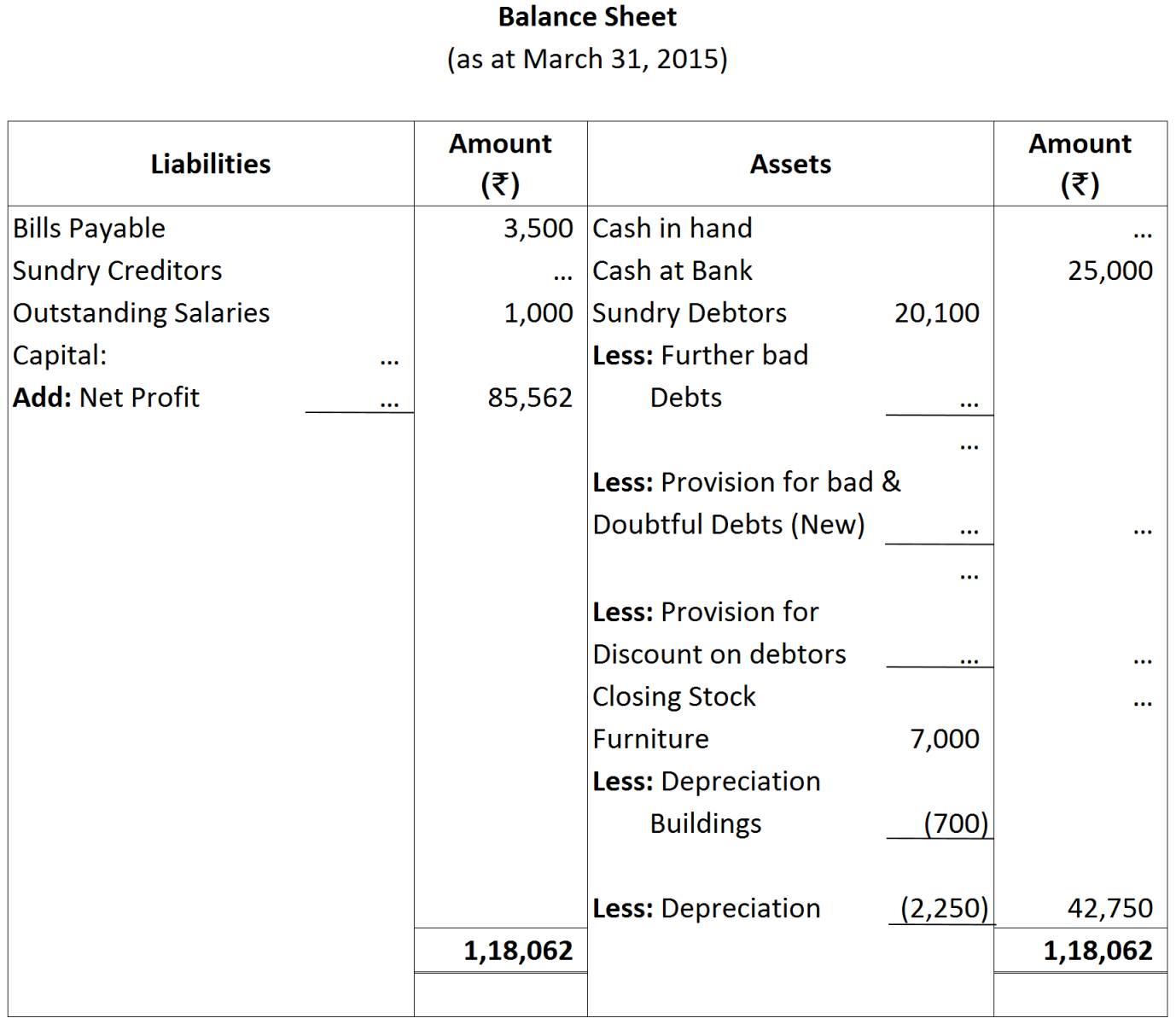
Fill in the missing figures in the following:
From the following information, prepare Bank Reconciliation Statement as on 31st March, 2019:
 
 
(i)
Bank overdraft as per Pass Book.
36,000
(ii)
Cheques issued but not presented for payment.
19,700
(iii)
Cheques deposited with bank but not collected.
25,000
(iv)
Cheques entered in Cash Book but not banked.
9,000
(v)
Directly deposited to bank by a customer.
11,000
Prepare Trading and Profit and Loss Account for the year ended $31^{\text {st }}$ March, 2023 and Balance Sheet as at that date from the given Trial Balance after the following adjustments:
i. Stock on $31^{\text {st }}$ March, 2023 was valued at ₹ 14,000 . Closing Stock includes goods costing ₹ 10,000 which were sold and recorded as sales but not delivered to the customer.
ii. Plant and Machinery includes a machine purchased for ₹ 20,000 on $1^{\text {st }}$ October, 2022.
iii. Outstanding liabilities for Wages ₹ 1,200 and Salaries ₹ 2,800 .
iv. Depreciation @ $5 \%$ p.a. on is to be provided on all fixed assets.
v. Write off bad debts ₹ 1,500 .
vi. Insurance premium paid in advance ₹ 400 .
vii. $80 \%$ of the commission earned was received and credited to Commission Account during the year.

Debit Balances

Credit Balances

Stock on $1^{s t}$ April, 2022

50,000

Capital

3,20,000

Furniture

16,000

Creditors

80,000

Building

1,60,000

Purchases Return

2,000

Debtors

60,000

Commission

6,000

Drawings

20,000

Sales

4,65,600

Plant and Machinery

1,40,000

Bad Debts Recovered

1,400

Wages

24,000


Salaries

40,000


Bad Debts

2,000


Purchases

2,40,000


Electricity Charges

12,000


Telephone Charges

4,800


Sales Return

1,800


Insurance Premium

3,000


Cash in Hand

6,400


Cash at Bank

95,000


8,75,000


8,75,000

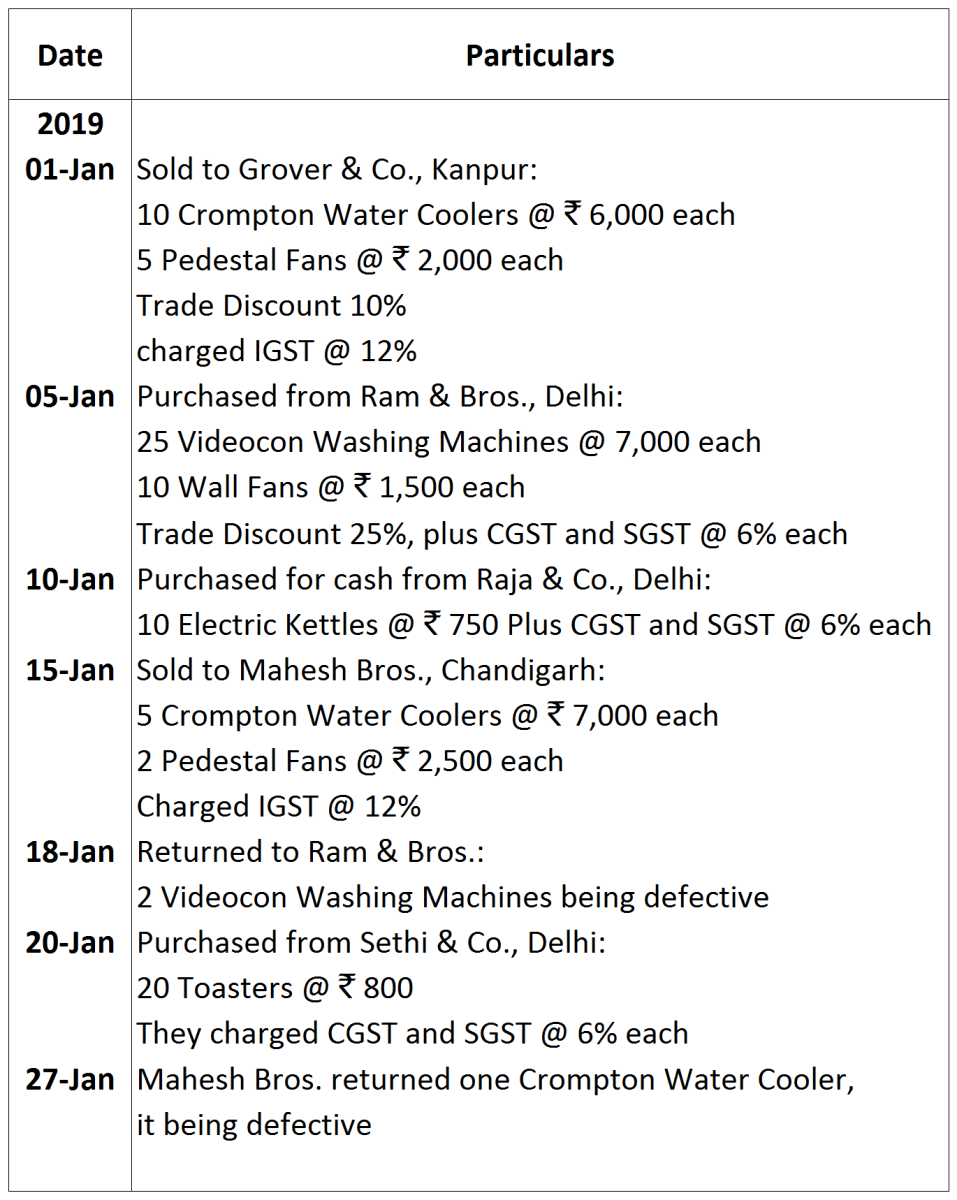
​Record the following transactions of Prabhat Electric Co., Delhi in the proper subsidiary books:
Give any three points of distinction between Capital Expenditure and Revenue Expenditure.
From the following information prepare financial Statements of M/s Raj & Bros, for the year ending March 31, 2017.

Additional Information:
  1. Depreciation on Plant and Machinery @ 10% p.a., a Machine has been purchased on July 01, 2016 for ₹ 12,000.
  2. The manager is entitled to a commission of 10% of the net profit before charging such commission.
  3. Closing stock in trade is valued at ₹ 6,000 (cost), ₹ 6,200 (Market Price).
  4. Rent outstanding ₹ 5,000.
There was an error in the Trial Balance of Ram Gopal on 31st March, 2018 and the difference in books was carried to the Suspense Account. On going through the books, you find that:
  1. ₹ 540 received from Mayank was posted to the debit side of his account.
  2. ₹ 100 being purchases return was posted to the debit of the Purchases Account.
  3. Discount of ₹ 300 received was posted to the debit of the Discount Account.
  4. ₹ 374 paid for motor car repairs was debited to the Motor Car Account as ₹ 174.
  5. ₹ 400 paid to Naman was debited to the account of Manan.
Pass the Journal entries to rectify the above errors and state what amount was carried to the Suspense Account.
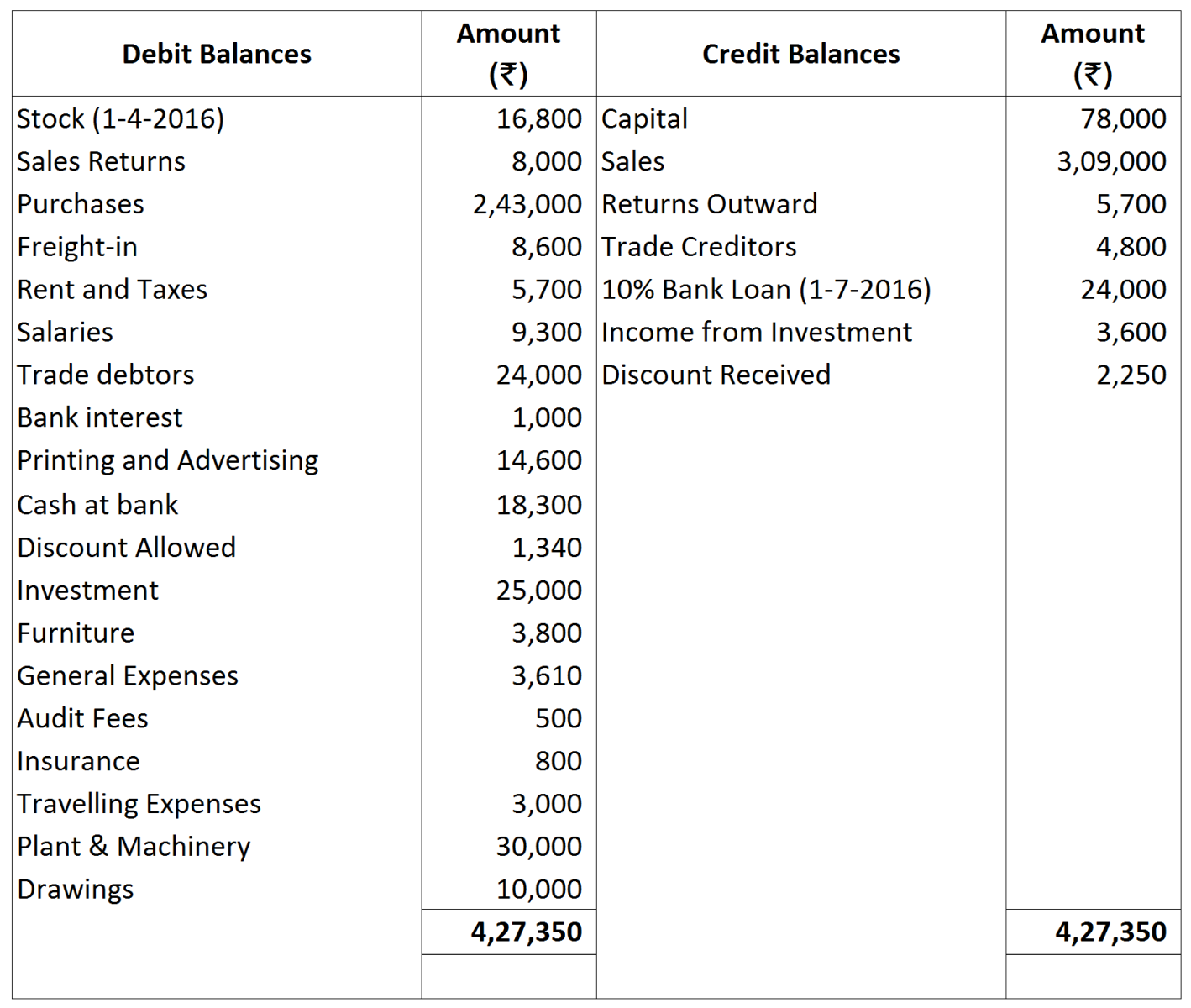
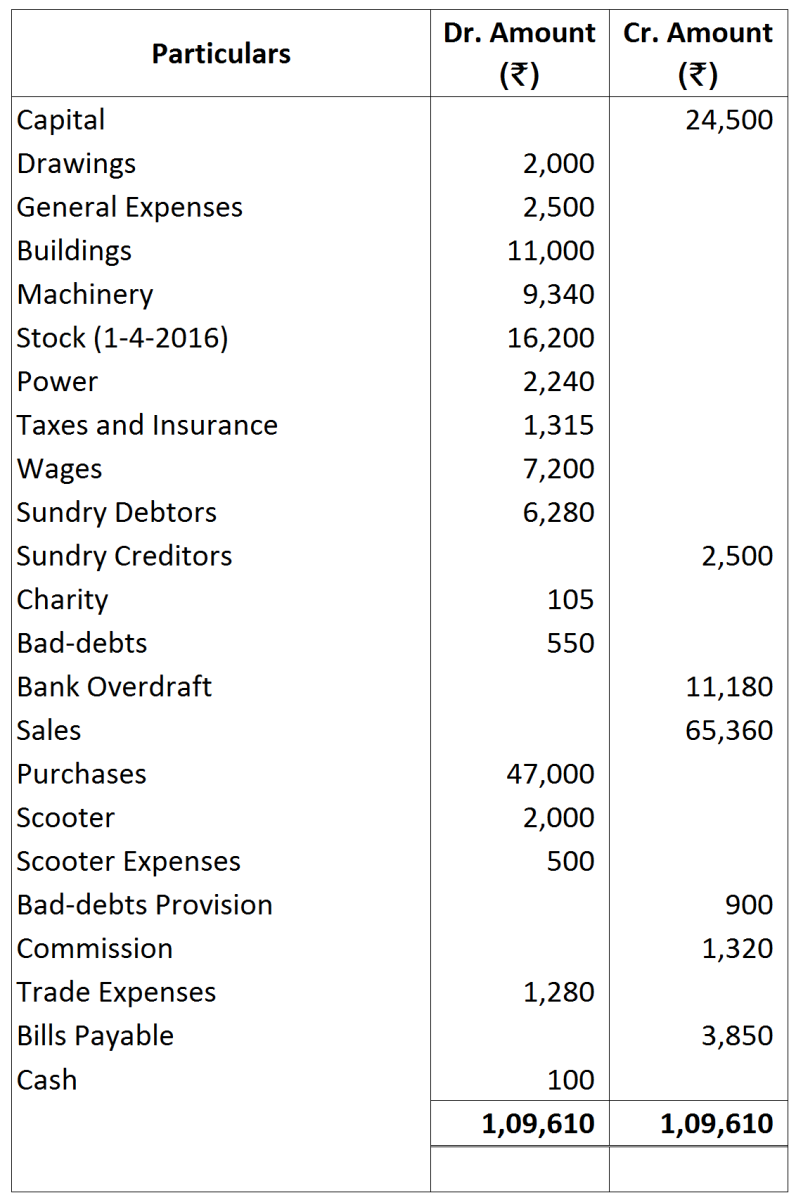
The following balances were extracted from the books of Shri Krishan Kumar as at 31st March, 2017:

Adjustments:
  1. Stock on 31st March, 2017 was valued at ₹ 23,500.
  2. $\frac{1}{5}\text{th}$ of general expenses and taxes & insurance to be charged to factory and the balance to the office.
  3. Write off a further Bad-debts of ₹ 160 and maintain the provision for Bad-debts at 5% on Debtors.
  4. Depreciate Machinery at 10% and Scooter by ₹ 240.
  5. Provide ₹ 700 for outstanding interest on Bank Overdraft.
  6. Prepaid Insurance is to the extent of ₹ 50.
  7. Provide for Manager's Commission at 10% on the Net Profit after charging such Commission.
Prepare final accounts for the year ended 31st March, 2017 after giving effect to the above adjustments.
Leena sold goods to Meena on 1st March, 2009 for ₹ 68,000 and drew two Bills of Exchange of the equal amount upon Meena payable after three months. Leena immediately discounted the first bill with her bank at 12% p.a. The bill was dishonoured by Meena and Bank paid ₹ 55 as noting charges.
The second bill was retired on 4th May, 2009 under a rebate of 6% p.a. with mutual agreement.
Journalise the above in the books of Leena and Meena.
Sharma & Co. whose books are closed on 31st March, purchased a machinery for ₹ 1,50,000 on 1st April, 2016, Additional machinery was acquired for ₹ 50,000 on 1st October, 2016. Certain machinery which was purchased for ₹ 50,000 on 1st October, 2016 was sold for ₹ 40,000 on 30th September, 2018.
Prepare the Machinery Account and Accumulated Depreciation Account for all the years up to the year ended 31st March, 2019. Depreciation is charged @ 10% p.a. on Straight Line Method. Also, show the Machinery Disposal Account.