Question
Explain the following :
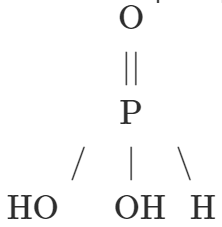
$H_3PO_3$ is not a tribasic acid .

Answer

$H _3 PO _3$ is not a tribasic acid because in oxyacids of phosphorus, hydrogen atoms which are attached to oxygen atoms are replaceable. Hydrogen atoms directly bonded to phosphorus atoms are not replaceable
Image

Need a full question paper?

Generate a complete, print-ready paper with questions like this in minutes — across 16+ boards, with answer keys.
Start Generating Free

Similar questions

The following question refer to the extraction of aluminium and iron from their ores:
What is the most important chemical process in the extraction of any metal? State how this essential step is carried out in the extraction of: i. iron, and ii. Aluminium.
What is meant by the term "electrovalency"? State why sodium (at. no. 11] has electrovalency +1 and chlorine (at. no. 17) has electrovalency of -1.
Define the term 'basicity' of an acid. Give the basicity of : nitric acid, sulphuric acid, phosphoric acid?
4.5 moles of calcium carbonate are reacted with dilute hydrochloric acid. What mass of calcium chloride is formed? (Relative molecular mass of calcium chloride is 111)
Three test tubes contain calcium nitrate solution, zinc nitrate solution and lead nitrate solution.Describe the effect of Adding ammonium hydroxide to each portion in turn till it is in excess.
Draw electron dot structure of the following:
$MgCl_2$
State one relevant observation for each of the following reactions :
(i) Excess of ammonium hydroxide solution is added to lead nitrate solution.
(ii) Sodium hydroxide solution is added to ferric chloride solution at first a little and then in excess.
(iii) Ammonium hydroxide solution is added to copper (II) nitrate solution in small quantities and then in excess.
Draw the structural formulae of the two isomers of Butane. Give the correct IUPAC name of each of the isomer.
The following question is pertaining to the laboratory pertaining hydrogen chloride gas.
Name the drying agent used and justify your choice
Give the names and the structural formula of the first three members of the homologous series of alkanes.