Questions

[3 Mark Question Answer]

🎯

Test yourself on this topic

33 questions · timed · auto-graded

Question 13 Marks
(a) What are the terms defined by the following?
(i) A salt containing a metal ion surrounded by other ions or molecules.
(ii) A base which is soluble in water.
(b) Making use only of substances chosen from those given below:
Dilute sulphuric acidSodium Carbonate
Zinc Sodium sulphite
Lead Calcium carbonate
Give equations for the reactions by which you could obtain :
(i) Hydrogen
(ii) Sulphur dioxide
(iii) Carbon dioxide
(iv) Zinc carbonate (two steps required)
Answer
(i) Complex salts
(ii) Alkali
(i) $Zn + H _2 SO _4 \longrightarrow ZnSO _4+ H _2$
(ii) $Na _2 SO _3 \longrightarrow Na _2 O + SO _2$
(iii) $Na _2 CO _3+ H _2 SO _4 \longrightarrow Na _2 SO _4+ H _2 O + CO _2$ )
(iv) $Zn + H _2 SO _4 \longrightarrow ZnSO _4+ H _2$
$
ZnSO _4+ Na _2 CO _3 \longrightarrow Na _2 SO _4+ ZnCO _3
$
View full question & answer
Question 23 Marks
Name the acidic anhydride of the following acids:
(i) sulphurous acid
(ii) nitric acid
(iii) phosphoric acid
(iv) carbonic acid
Answer
The anhydride of following acids are:
(i) Sulphurous acid: $SO_2$
(ii) Nitric acid: $N_2O_5$
(iii) Phosphoric acid: $P_2O_5$
(iv) Carbonic acid : $CO_2$
View full question & answer
Question 33 Marks
Define the term 'basicity' of an acid. Give the basicity of : nitric acid, sulphuric acid, phosphoric acid?
Answer
Basicity : The basicity of an acid is defined as the number of hydronium ions $(H_3O^+)$ that can be produced by the ionization of one molecule of that acid in aqueous solution.
The basicity of following compounds are :
Nitric acid : Basicity = $1$
Sulphuric acid : Basicity =$2$
Phosphoric acid : Basicity =$3$
View full question & answer
Question 43 Marks
How is an acid prepared from a Non-metal
Give an equation for it.
Answer
Acids are prepared from non-metals by their oxidation.
For example :Sulphur or phosphorus is oxidized by conc. Nitric acid to form sulphuric acid or phosphoric acid.
$S + 6HNO_3 \rightarrow H_2SO_4 + 2H_2O + 6NO_2$
$P + 5HNO_3 \rightarrow H_3PO_4 + H_2O + 5NO_2$
View full question & answer
Question 53 Marks
Explain the following :
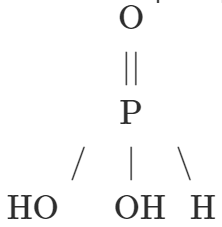
$H_3PO_3$ is not a tribasic acid .
Answer
$H _3 PO _3$ is not a tribasic acid because in oxyacids of phosphorus, hydrogen atoms which are attached to oxygen atoms are replaceable. Hydrogen atoms directly bonded to phosphorus atoms are not replaceable
Image
View full question & answer
Question 63 Marks
Explian the following :
Dil. HCl acid is stronger than highly concentrated acetic acid.
Answer
Strength of an acid is the measure of concentration of hydronium ions it produces in its aqueous solution. Dil. HCl produces high concentration of hydronium ion compared to that of concentrated acetic acid. Thus, dil. HCl is stronger acid than highly concentrated acetic acid.
View full question & answer
Question 73 Marks
How can this impurity be removed?
Answer
The impurity can be removed by passing a current of dry hydrogen chloride gas through a saturated solution of the affected salt. Pure sodium chloride is produced as a precipitate which can be recovered by filtering and washing first with a little water and finally with alcohol.
View full question & answer
Question 83 Marks
why does common salt get wet during the rainy season?
Answer
Table salt turns moist and ultimately forms a solution on exposure to air especially during the rainy season. Although pure sodium chloride is not deliquescent, the commercial version of the salt contains impurities (such as magnesium chloride) which are deliquescent substances.
View full question & answer
Question 93 Marks
Distinguish between drying and dehydrating agent.
Answer
Drying agentDehydrating agent
(a) They remove moisture from other substances.
(b) They are used to dry gases like chlorine, Sulphur dioxide. They are used in desiccators to keep substances dry.
(c) They represent physical change
i. They remove chemically combined elements of water in the ratio of 2:1 from a compound.
ii. They prepare substances like carbon monoxide, sugar charcoal etc.
iii. They represent chemical change
View full question & answer
Question 103 Marks
Explain clearly how conc, $H_2SO_4$ is used as dehydrating as well as drying agent.
Answer
Conc. sulphuric acid is hygroscopic in nature and can remove moisture from other substances; therefore, it is used as a drying agent.
It is also used as a dehydrating agent because it has a strong affinity for water and thus absorbs water quickly from compounds.
View full question & answer
Question 113 Marks
Give reason for the following:
Anhydrous calcium chloride is used in a desiccator.
Answer
Desiccating agents are used to absorb moisture. Anhydrous calcium chloride $(CaCl_2)$ has the capacity of absorbing moisture as it is hygroscopic in nature. So, it is used in a desiccator.
View full question & answer
Question 123 Marks
Give reason for the following:
Sodium hydrogen sulphate is not an acid but it dissolves in water to give hydrogen ions, according to the equation
$NaHSO_4 ⇆ H^+ + Na^+ + SO_4^{2-}$​​​​​​​
Answer
Sodium hydrogen sulphate $\left[ NaHSO _4\right]$ is an acid salt and is formed by the partial replacement of the replaceable hydrogen ion in a dibasic acid $\left[ H _2 SO _4\right]$. The $[ H ]$ atom in $NaHSO _4$ makes it behave like an acid. So, on dissolving in water, it gives hydrogen ions.
View full question & answer
Question 133 Marks
State your observation when the following are exposed to the atmosphere.
(a) Washing soda crystals
(b) Iron (III) chloride salts
Answer
(a) When washing soda $\left( Na _2 CO _3 \cdot 10 H _2 O \right)$ is exposed to air, it loses 9 molecules of water to form a monohydrate.
$
Na _2 CO _3 \cdot 10 H _2 O \xrightarrow{\text { air }} Na _2 CO _3 \cdot H _2 O +9 H _2 O
$
(b) It absorbs moisture from the atmosphere and becomes moist and ultimately dissolves in the absorbed water, forming a saturated solution.
View full question & answer
Question 143 Marks
define deliquescence. Give examples.
Answer
Water-soluble salts which on exposure to the atmosphere absorb moisture from the atmosphere and dissolve in the same and change into a solution. The phenomenon is called deliquescence and the salts are called deliquescent.
Examples: $CaCl_2, MgCl_2, ZnCl_2$
View full question & answer
Question 153 Marks
Define efflorescence. Give examples.
Answer
Crystalline hydrated salts which on exposure to the atmosphere lose their water of crystallisation partly or completely and change into a powder. This phenomenon is called efflorescent and the salts are called efflorescent.
Examples: $CuSO_4.5H_2O, MgSO_4.7H_2O, Na_2CO_3.10H_2O$
View full question & answer
Question 163 Marks
Give four substances which contain water of crystallization and write their common names.
Answer
Common name Chemical name Formula
Washing soda Sodium carbonate decahydrate $Na_2CO_3.10H_2O$
Epsom salt Magnesium sulphate heptahydrate $MgSO_4. 7H_2O$
Potash alum Hydrated potassium aluminium sulphate $K_2SO_4.Al(SO_4)_3.24H_2O$
Gypsum Hydrated calcium sulphate $CaSO_4.2H_2O$
View full question & answer
Question 173 Marks
Name the salt which on hydrolysis forms
(a) Acidic
(b) Basic acid
(c) Neutral solution. Give a balanced equation for each reaction.
Answer
(a) Iron chloride $\left( FeCl _3\right)$
$FeCl_3+3 H_2 O \rightarrow 3 HCl+Fe(OH)_3$
(b) Ammonium acetate $\left( CH _3 COONH _4\right)$
$CH_3 COONH_4+H_2 O \rightarrow CH_3 COOH+NH_4 OH$
(c) Sodium chloride
$NaCl_{(s)}+H_2 O \rightarrow Na_{(aq)}^{+} OH_{(aq)}^{-}+H_2 O$
View full question & answer
Question 183 Marks
The following is a list of methods for the preparation of salts.
A – direct combination of two elements
B – reaction of a dilute acid with a metal.
C – reaction of a dilute acid with an insoluble base.
D – titration of a dilute acid with a solution of soluble base.
E – reaction of two solutions of salts to form a precipitate.
Choose from the above list A to E, the best method of preparing the following salts by giving a suitable equation in each case:
1. Anhydrous ferric chloride,
2. Lead chloride,
3. Sodium sulphate.
4. Copper sulphate.
Answer
1. Anhydrous ferric chloride: - A (Direct combination of two elements)
$2 Fe+3 Cl_2 \longrightarrow 2 FeCl_3$
2. Lead chloride: - E (Reaction of two solutions of salts to form a precipitate
$Pb\left(NO_3\right)_2+2 HCl \longrightarrow PbCl_2+2 HNO_3$
3. Sodium sulphate: - D (Titration of dilute acid with a solution of soluble base)
$2 NaOH+H_2 SO_4 \rightarrow Na_2 SO_4+2 H_2 O$
4. Copper sulphate:- C (reaction of dilute acid with an insoluble base)
$Cu(OH)_2+H_2 SO_4 \rightarrow CuSO_4+2 H_2 O$
View full question & answer
Question 193 Marks
How would you prepare :
Calcium sulphate from calcium carbonate
Answer
Dissolving $CaCO_3$ in sulphuric acid $(H_2SO_4)$ solution, you'll get $CaSO_4$ salt
$CaCO_3 (s) + H_2SO_4 (aq) → CaSO_4 (s) + CO_2 (g) + H_2O (l)$
Calcium is a very strong reducing agent, its reduction potential is $2.87 V$. Reduction potential of Hydrogen is $0 V$
So calcium will displace hydrogen ions from suplhuric acid.
View full question & answer
Question 203 Marks
How would you prepare :
sodium hydrogen carbonate crystals.
Answer
Sodium hydrogen carbonate crystals :
Dissolve $5$ grams of anhydrous sodium carbonate in about 25 ml of distilled water in a flask. Cool the solution by keeping the flask in a freezing mixture. Pass carbon dioxide gas in the solution. Crystals of sodium bicarbonate will precipitate out after sometime. Filter the crystals and dry it in folds of filter paper.
Reaction : $Na_2CO_3 + CO_2 + H_2O ⟶ 2NaHCO_3$
View full question & answer
Question 213 Marks
Choose the most appropriate answer from $( SO_2 , SiO_2 , Al_2O3 , CO , MgO , Na_2O )$
(a) A covalent oxide of a metalloid.
(b) An oxide which when dissolved in water form acid .
(c) A basic oxide
(d) An amphoteric oxide.
Answer
a) Silicon is a metalloid. The covalent oxide is $SiO_{​2}$_
b) Acidic oxide - gives acid with water - $SO_2$​​​​​​​_
$SO_2 + H_2O ----> H_2SO_3$​​​​​​​_
c) Basic oxide - gives base with water -$Na_2O$
$Na_2O + H_2O -----> 2 NaOH$​​​​​​​
d) An amphoteric oxide - Shows both acidic and basic property
$Al_2O_3$
View full question & answer
Question 223 Marks
From the formula listed below, choose one, in each case, corresponding to the salt having the given description: $AgCl, CuCO_3, CuSO_4.5H_2O, KNO_3, NaCl, NaHSO_4, Pb(NO_3)_2, ZnCO_3, ZnSO_4,7H_2O.$
  1. an acid salt
  2. an insoluble chloride
  3. on treating with concentratedsulphuric acid, this salt changes from blue to white
  4. on heating, this salt changes from green to black
  5. this salt gives nitrogen dioxide on heating
Answer
  1. $NaHSO_4$
  2. $AgCl$
  3. $CuSO_4.5H_2O$
  4. $CuCO_3$
  5. $Pb(NO_3)_2$
View full question & answer
Question 233 Marks
Choosing only substances from the list given in the box below, write equations for the reactions which you would use in the laboratory to obtain:
  1. Sodiumsulphate
  2. Coppersulphate
  3. Iron(II)sulphate
  4. Zinc carbonate
Dilute sulphuric acid Copper Copper carbonate
  Iron Sodium carbonate
  Sodium  
  Zinc  
Answer
$a. Na_2CO_3 + H_2SO_4 (dil) \rightarrow Na_2SO_4 + H_2O + CO_2$
$b. CuCO_3 + H_2SO_4 (dil) \rightarrow CuSO_4 + H_2O + CO_2$
$c. Fe + H_2SO_4 (dil) \rightarrow FeSO_4 + H_2$
$d. Zn + H_2SO_4 (dil) \rightarrow ZnSO_4 + H_2$
$ZnSO_4 + Na_2CO_3 \rightarrow ZnCO_3 + Na_2SO_4$
View full question & answer
Question 243 Marks
For each of the salt: $A, B, C$ and $D,$ suggest a suitable method of its preparation.
  1. $A$ is a sodium salt.
  2. $B$ is an insoluble salt.
  3. $C$ is a soluble salt of copper.
  4. $D$ is a soluble salt of zinc.
Answer
a. By neutralisation:
$NaOH + HCl \rightarrow NaCl + H_2O$​​​​​​​
b. By precipitation:
$Pb(NO_3)_2 + 2NaCl \rightarrow PbCl_2 + 2NaNO_3$
$c. CuCO_3 + H_2SO_4\rightarrow CuSO_4 + H_2O + CO_2​​​​​​​$
d. Simple displacement:
$Zn + H_2SO_4\rightarrow ZnSO_4 + H_2​​​​​​​$​​​​​​​
View full question & answer
Question 253 Marks
You are provided with the following chemicals : $NaOH, Na_2CO_3, H_2O, Zn(OH)_2, CO_2, HCI, Fe, H_2SO_4, CI_2, Zn$. Using the suitable chemicals from the given list only, state briefly how you would prepare:
(a) iron (III) chloride,
(b) sodium sulphate,
(c) sodium zincate
(d) iron (II) sulphate,
(e) sodium chloride?
Answer
(a) Iron (III) Chloride: Iron chloride is formed by direct combination of elements. $2Fe + 3Cl_2 ⟶ 2FeCI_3$
(b) Sodium sulphate: By neutralization of caustic soda with dilute sulphuric acid $2NaOH + H_2SO_4 ⟶ Na_2SO_4 + 2H_2O$
(c) Sodium zincate: By the action of metals with alkalis
$Zn + 2NaOH ⟶ Na_2ZnO_2 + H_2$
(d) Iron (II) sulphate: Iron sulphate is prepared by the action of dilute acid on an active metal. $Fe + H_2SO_4 ⟶ FeSO_4 + H_2$
(e) Sodium chloride: By the neutralization reaction of strong acid with strong base $NaOH + HCI ⟶ NaCI + H_2O$
View full question & answer
Question 263 Marks
Define the term neutralization, if one mole of a strong acid reacts with one mole of a strong base, the heat produced is always the same. Why?
Answer
Neutralization is the process by which $H^+$ ions of an acid react completely with the $[OH]^-$ ions of a base to give salt and water only.
Neutralization is simply a reaction between $H^+$ ions given by strong acid and $OH^-$ ions given by strong base. In case of all strong acids and strong bases, the number of $H^+$ and $OH^-$ ions produced by one mole of a strong acid or strong base is always same. Hence the heat of neutralization of a strong acid with strong base is always same.
View full question & answer
Question 273 Marks
Choosing only substances from the list given in the box below, write equations for the reactions which you would use in the laboratory to obtain:
  1. Sodiumsulphate
  2. Coppersulphate
  3. Iron(II)sulphate
  4. Zinc carbonate
Dilute sulphuric acid Copper Copper carbonate
  Iron Sodium carbonate
  Sodium  
  Zinc  
Answer
Zinc Sulphate – Displacement
$Zn(OH)_2 + H_2SO_4 ⟶ ZnSO_4 + 2H_2O$
Ferrous sulphide – synthesis
$Fe + S ⟶ FeS$
Barium sulphate – Precipitation
$BaCI_2+H_2SO_4 ⟶ BaSO_4 + 2HCI$
Ferric sulphate – Oxidation
$Fe + H_2SO_4 ⟶ FeSO_4 + H_2$
Sodium sulphate – Neutralisation
$2NaOH + H_2SO_4 ⟶ Na_2SO_4 + 2H_2O$
View full question & answer
Question 283 Marks
When you use universal indicator, you see that solutions of different acids produce different colours. Indeed, solution of the same acid with different concentrations will also give different colours. Why?
Answer
A universal indicator is a mixture of dyes which identify a gradual change of various colours over a wide range of pH, depending on the strength of the acid. When we use a universal indicator, we see solutions of different acids produce different colours. Indeed, solutions of the same acid with different concentration give different colours.
The more acidic solutions turn universal indicator bright red. A less acidic solution will only turn it orange-yellow. Colour differences can also be observed in case of vinegar which is less acidic and battery acid which is more acidic.
View full question & answer
Question 293 Marks
How does tooth enamel get damaged? What should be done to prevent it?
Answer
Substances like chocolates and sweets are degraded by bacteria present in our mouth. When the p H falls to 5.5 tooth decay starts. Tooth enamel is the hardest substance in our body and it gets corroded. The saliva produced by salivary glands is slightly alkaline, it helps to increase the p H , to some extent, but tooth paste which contain basic substance is used to neutralize excess acid in the mouth.
View full question & answer
Question 303 Marks
Distinguish between acidity of bases and basicity of acids.
Answer
The acidity of bases and basicity of acids
The acidity of bases: The number of hydroxyl ions which can be produced per molecule of the base in aqueous solution.
Basicity of acid: The basicity of an acid is defined as the number of hydronium ions that can be produced by the ionization of one molecule of that acid in aqueous solution.
View full question & answer
Question 313 Marks
Distinguish between a common acid base indicator and a universal indicator.
Answer
A common acid base indicator and a universal indicator:
Acid base indicator like litmus tells us only whether a given substance is an acid or a base. Universal indicator gives an idea as to how acidic or basic a substance is. An universal indicator gives different colours with solutions of different p H values.
View full question & answer
Question 323 Marks
You are supplied with five solutions: $A, B, C, D$ and $E$ with Ph values as follows: $A= 1.8, B = 7, C= 8.5, D = 13$, and $E=5$
Classify these solutions as neutral, slightly or strongly acidic and slightly or strongly alkaline.
Which solution would be most likely to liberate hydrogen with:
(a) magnesium powder,
(b) powdered zinc metal. Give a word equation for each reaction.
Answer
$A =$ Strongly acidic
$B =$ neutral
$C =$ Weakly alkaline
$D =$ Strongly alkaline
$E =$ Weakly acidic
(a) Solution A (acidic solution) $+ Mg \rightarrow H_2 + Mg$ salt
(b) Solution A (acidic solution) $+ Zn \rightarrow H_2 + Zn$ salt
View full question & answer
Question 333 Marks
Complete the table:
Indicator Neutral Acidic Alkaline
Litmus Phenolphthalein Purple Colourless
Answer
Indicator Neutral Acidic Alkaline
Litmus Phenolphthalein Purple Colourless Blue to red Colourless Red to blue Pink
View full question & answer
[3 Mark Question Answer] - Chemistry STD 10 Questions - Vidyadip