Question
Explain the following terms with example: Covalent bond.

Answer

The chemical bond formed by sharing of two valence electrons between the two atoms is called covalent bond.
Example:
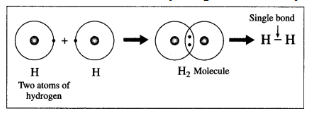
$1.$ Hydrogen molecule formation: The atomic number of hydrogen is $1,$ its atom contains 1 electron in K shell. It requires one more electron to complete the $K$ shell and attain the configuration of helium $(He). $ To meet this requirement two hydrogen atoms share their electrons with each other to form $H_2$ molecule. One covalent bond, i.e. a single bond is formed between two hydrogen atoms by sharing of two electrons.
Image
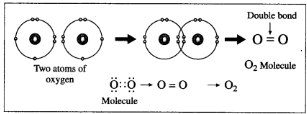
$2.$ Formation of oxygen molecule:
$(1)$ The atomic number of oxygen is $8.$ The electronic configuration of oxygen is $(2, 6)$. Oxygen has $6$ electrons in the outermost shell.
$(2)$ It requires $2$ electrons to complete the L shell and attain the configuration of neon $(Ne).$
$(3)$ Each oxygen atom shares its valence electron with the valence electron of another oxygen atom to give two shared pairs of electrons which results in the formation of oxygen molecule.
$(4)$ Thus, two electron pairs are shared between two oxygen atoms, forming double covalent bond $(=).$
Image

Need a full question paper?

Generate a complete, print-ready paper with questions like this in minutes — across 16+ boards, with answer keys.

Start Generating Free

Similar questions

The pH values of five solutions A, B, C, D and E are given below:
  1. 1
  2. 5
  3. 7
  4. 11
  5. 13
Which solution is:
  1. Weakly alkaline.
  2. Neutral.
  3. Strongly acidic.
  4. Strongly alkaline, and.
  5. Weakly acidic?
A man bought a device X which could cook pulses, vegetables and rice without using any fuel like wood, coal, kerosene or LPG, etc. This device did not work at night. It also took a lot of time for cooking.
  1. Name the device X.
  2. What is the source of energy which cooks food in this device?
  3. What is the name of the process which traps energy in this device?
  4. State one advantage (other than saving on fuel) or using such a device for cooking food.
When ethanoic acid reacts with sodium hydrogencarbonate, then a salt $X$ is formed and a gas $Y$ is evolved.
Name the salt $X$ and gas $Y.$ Describe an activity with the help of a labelled diagram of the apparatus used to prove that the evolved gas is the one which you have named. Also write the chemical equation of the reaction involved.
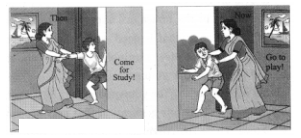
Two caricatures presenting the situations of the year 1998 and 2017 about playing on playground are given below. Observe those caricatures. Express your opinion about arising of such different situations.
Image
Write short note: Blue Revolution.
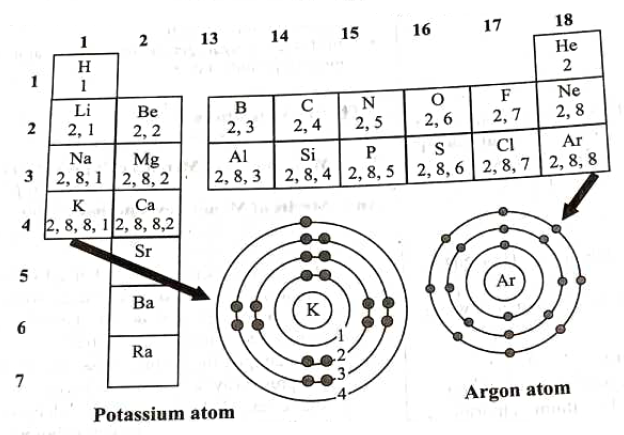
Observe the following diagram and write the answers of the following questions:
Image
i. Write the atomic numbers of first two elements in the second group.
ii. Write the number of valence electrons of the elements in the halogen group.
iii. Draw the diagram of electronic configuration of magnesium atom.
iv. After completion of a period, what change does take place in the electronic configuration of the next element?
v. Write the names of any two elements from the diagram which do not take part in chemical reaction.
What are the different types of tropisms? Define each type of tropism. Write the name of stimulus in each case.
The proportion of carbon atoms in ethanol $(C_2H_5OH)$ and napthalene $(C_{10}H_8)$
With a neat labelled diagram, explain the construction and working of a compound microscope.
A small part of the shoot of a plant is removed with a sharp knife. When the lower end of this small part of the shoot is buried in moist soil, it gradually develops roots and shoots and grows to become a new plant.
  1. What is the name of this method of propagating plants?
  2. What care should be taken while removing a small part of the shoot from the parent plant with a knife?
  3. Name any two plants which provide us with food directly or indirectly and are grown by this method.
  4. Give one advantage of this method of producing new plants.
  5. State whether it is a sexual method of reproduction or an asexual method. Why?
  6. What special name can be given to the genetically identical new plants produced by this technique?