Question
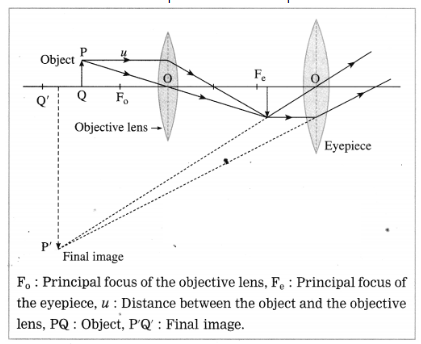
With a neat labelled diagram, explain the construction and working of a compound microscope.
Answer

Construction of a compound microscope:
Image

(1) A compound microscope consists of a metal tube fitted with two convex lenses at the two ends. These lenses are called the objective lens (the lens directed towards the object) and the eyepiece (the lens directed towards the eye). Both the lenses are small in size, but the cross section of the objective lens is less than that of the eyepiece. The objective lens has a short focal length. The focal length of the eyepiece is more than that of the objective lens.

(2) The metal tube is mounted on a stand. The principal axes of the objective lens and the eyepiece are along the same line. The distance between the object and the objective lens can be changed with a screw. It is possible to change the distance between the objective lens and the eyepiece.

Working :
(1) The object to be observed is illuminated and placed in front of the objective lens, slightly beyond the focal length of the objective lens. Its real, inverted and enlarged image is formed by the objective lens on the other side.

(2) This intermediate image lies within the focal length of the eyepiece. It serves as an object for the eyepiece. The eyepiece works as a simple microscope. The final image is virtual, highly enlarged and inverted with respect to the original object. It can be formed at the minimum distance of distinct vision from the eyepiece. The final image is observed by keeping the eye close to the eyepiece.

Need a full question paper?

Generate a complete, print-ready paper with questions like this in minutes — across 16+ boards, with answer keys.
Start Generating Free

Similar questions

With the help of suitable diagrams, explain the mitosis in detail.
Write short notes: Sacred Groves.
Write all the capital letters of the alphabet which look the same in a plane mirror.
What are the possible blood groups likely to be inherited by children born to a group $A$ mother and a group $B$ father? Explain your reasoning.
What is an electric motor? With the help of a labelled diagram, describe the working of a simple electric motor.
State the importance of Newton’s universal law of gravitation.
Explain the role of latent heat in the change of state of a substance.
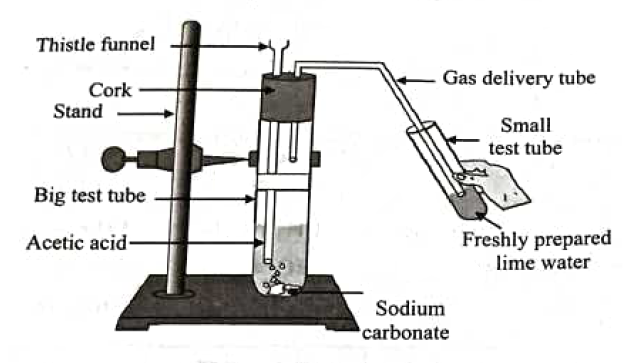
Observe the diagram given below and answer the questions:
Image
i. Name the reactants in this reaction.
ii. Which gas comes out as effervescence in the bigger test tube?
iii. What is the colour change in the lime water?
iv. In the above experiment instead of sodium carbonate which chemical can be used to get same product?
v. Write the use of acetic acid.
A metal X forms a water soluble salt $XNO_3$. When an aqueous solution of $XNO_3$​​​​​​​ is added to common salt solution, then a white precipitate of compound Y is formed alongwith sodium nitrate solution. Metal X is said to be the best conductor of electricity and it does not evolve hydrogen when put in dilute hydrohloric acid.
  1. What is metal $X$?
  2. What is salt $XNO_3$​​​​​​​?
  3. Name the compound Y.
  4. Write the chemical equation of the reaction which takes place on reacting $XNO_3​​​​​​​$​​​​​​​solution and common salt solution giving the physical states of all the reactants and products.
  5. What type of chemical reaction is illustrated by the above equation?
How will you explain the following statements with the help of the anomalous behaviour of water?
(1) In regions with cold climate, the aquatic plants and animals can survive even when the atmospheric temperature goes below 0 °C.
(2) In cold regions in winter the pipes for water supply break and even rocks crack.