Chemical Bonding — Chemistry STD 11 Science — Question
Maharashtra BoardEnglish MediumSTD 11 ScienceChemistryChemical Bonding4 Marks
Question
Explain the formation of ionic bond in sodium chloride $(NaCl).$
✓
Answer
Formation of sodium chloride $(NaCl):$
$i.$ The electronic configurations of sodium and chlorine are:
$Na (Z = 11): 1s^2 \ 2s^2 \ 2p^6 \ 3s^1 \ or \ (2, 8, 1)$
$Cl (Z = 17): 1s^2 \ 2s^2 \ 2p^6 \ 3s^2 \ 3p^5 \ or \ (2, 8, 7)$
$ii.$ Sodium has one electron in its valence shell. It has tendency to lose one electron to acquire the electronic configuration of the nearest inert gas, neon $(2, 8).$
$iii.$ Chlorine has seven electrons in its valence shell. It has tendency to gain one electron and thereby acquire the electronic configuration of the nearest inert gas, argon $(2, 8, 8).$
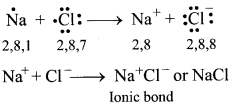
$iv.$ During the combination of sodium and chlorine atoms, the sodium atom transfers its valence electron to the chlorine atom.
$v.$ Sodium atom changes into $Na+$ ion while the chlorine atom changes into $Cl^–$ ion. The two ions are held together by strong electrostatic force of attraction.
$vi.$ The formation of ionic bond between $Na$ and $Cl$ can be shown as follows:
Need a full question paper?
Generate a complete, print-ready paper with questions like this in minutes — across 16+ boards, with answer keys.