Question
Explain the Highland or Mountain type climate.

Answer

  1. This type of climate is found in all latitudes where there are mountains or highlands.
  2. The main areas are mountainous area of Asia, Central Europe, Western North and South America and highlands of Africa.
  3. Climate of these regions depend upon the altitude of mountains, highlands, their location on forward and windward slope, their slopes facing the sun etc.
  4. In general, mountain/highland region has low temperature since temperature decreases with increase in height.
  5. Most of the mountains receive orographic rainfall specially if they are near the coastline. For example, Western Ghats in India receive orographic rainfall by South West monsoon winds.
  6. In general, there is snowfall on higher part or slopes of mountains. There is permanent snow cover on the top of mountain. For example, Himalayas are snow covered in their upper part.
  7. Generally coniferous forests grow on the upper slopes of mountains that is below snow line. The lower slopes are covered with evergreen or deciduous forests depending on amount of rainfall.
  8. Main occupation is animal rearing with the help of pastures on mountain slopes. Due to beautiful scenery of the region tourism is developed in most of the mountainous areas. Agriculture is practiced on terraces slopes.

Need a full question paper?

Generate a complete, print-ready paper with questions like this in minutes — across 16+ boards, with answer keys.

Start Generating Free

Similar questions

Study the following schematic diagram. It shows the relationship between speed of material and moisture content. Read the index, and answer the following questions.

Image
(A) Fast (B) Slow (C) Dry (D) Wet
(1) Creep (2) Slide (3) Fall (4) Flow
(1)What will happen when the weather conditions are dry?
(2)When will a flow occur?
(3)When will a creep occur?
(4)Now can you enumerate the factors which affect mass wasting?

Take the given hypothetical data in the table. The data shows the time of arrival of P-waves and S-waves at 3 seismograph stations. Assume the scale of the map as 1 cm : 18 km. See fig. 1.11.
Recording Station P-wave arrival time (IST)S-wave arrival time
Jalana11 : 06 : 0611 : 06 : 19
Washim11 : 06 : 4611 : 07 : 03
Aurangabad11 : 07 : 0611 : 07 : 24
Find out about the role of the military and paramilitary forces in disaster management of India.
Explain different types of faults.
Can animals and plants also influence weathering? Will that be physical or chemical weathering? Which type of weathering does stone quarrying cause?
Classify the above components of disaster management into pre-disaster and post-disaster.
Look for the names of the tribes dependent on this biome in India including Maharashtra along with their habitats and show them on a map of India.
Write in detail about the depositional features formed by glaciers.
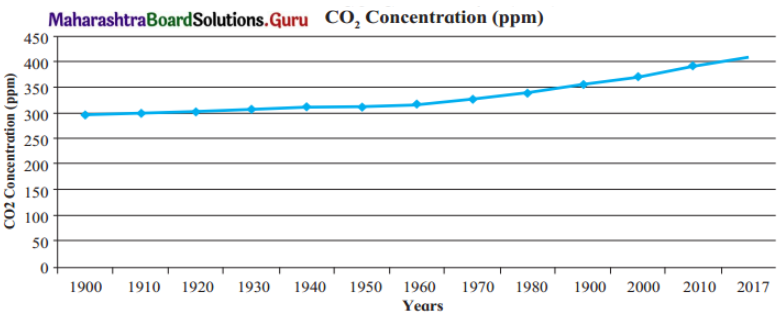
Look at the graph and answer the questions.Image
(1)What does this graph show?
(2)What does ppm mean?
(3)Since which year has the increase been phenomenal?
(4)Can you think of the reasons behind the increase in carbon dioxide?
Explain in detail the importance of Indian Ocean to India.