Question
Match the columns in the following table and explain them:
Column 1 Column 2 Column 3
Farsightedness Nearby object can be seen clearly Bifocal lens
Presbyopia Faraway object can be seen clearly Concave lens
Nearsightedness Problem of old age Convex lens

Answer

Column 1 Column 2 Column 3
Farsightedness Faraway object can be seen clearly Convex lens
Presbyopia Problem of old age Bifocal lens
Nearsightedness Nearby object can be seen clearly Concave lens
1. Farsightedness:
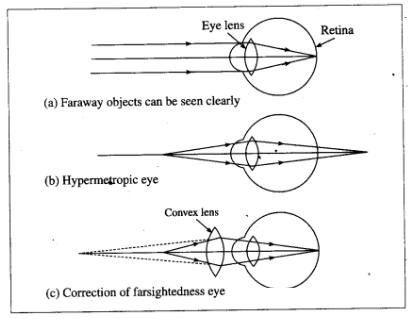
Hypermetropia or farsightedness is the defect of vision in which a human eye can see distant objects clearly but is unable to see nearby objects clearly.
In this case the image of a nearby object would fall behind the retina instead of on the retina. Possible reasons for hypermetropia:
(1) Curvature of the cornea and the eye lens decreases. Hence, the converging power of the eye lens becomes less.
(2) The distance between the eye lens and retina decreases (relative to the normal eye) and the focal length of the eye lens becomes very large due to the flattening of the eyeball.
Image
2. Presbyopia:
Presbyopia is the defect of vision in which aged people find it difficult to see nearby objects
comfortably and clearly without spectacles. Reason of presbyopia: The power of accommodation of eye usually decreases with ageing. The muscles near the eye lens lose their ability to change the focal length of the lens. Therefore, the near point of the eye lens shifts rarther from the eye, This defect is corrected using a. convex lens of appropriate power. The lens converges light rays before they fall on the eye lens such that the action of the eye lens forms the image on the retina. 3. Nearsightedness:
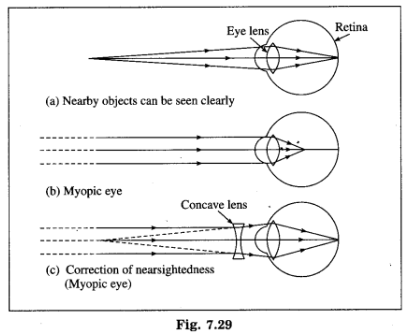
Myopia or nearsightedness is the defect of vision in which a human eye can see nearby objects distinctly but is unable to see distant objects clearly as they appear indistinct.
In this case the image of a distant object is formed in front of the retina instead of on the retina.
[Figs. 7.29 (a), 7.29 (b)] Possible reasons for myopia:
(1) The curvature of the cornea and the eye lens increases. The muscles near the lens cannot relax so that the converging power of the lens remains large. (2) The distance between the eye lens and the retina increases as the eyeball elongates. Myopia is corrected using a suitable concave lens. Light rays are diverged by the concave lens before they strike the eye lens. A concave lens of proper focal length is chosen to produce the required divergence. Hence, after the converging action of the eye lens, the image is formed on the retina. [Fig. 7.29 (c)]
Image

Need a full question paper?

Generate a complete, print-ready paper with questions like this in minutes — across 16+ boards, with answer keys.

Start Generating Free

Similar questions

P is a cell (or group of cells) in the human body which is sensitive to a particular type of stimulus and conveys the messages to CNS through nerves Q. On the other hand, R is a part of the human body which can respond to a stimulus according to the instructions sent from the CNS through nerves S.
  1. What is P? Name five organs which contain cells (or group of cells) like P.
  2. Name the nerves Q.
  3. What is R? Give two examples of R.
  4. Name nerves S.
  5. How do messages travel through the nerves Q and S?
Reproduction is the process by which the living species continues its existence. Lower organisms carry out asexual reproduction while higher plants and animals always show sexual reproduction. Plants reproduce asexually by methods such as fragmentation, vegetative propagation, budding, spore formation. For sexual reproduction they form gametes. In animal kingdom, budding, fission of different types and parthenogenesis are some of the methods that do not require both the sexes. Though regeneration also forms new individual, it is not considered to be a reproductive process because, basically it is a repair process. The ability to regenerate is lost in higher phyla. In human beings | it is restricted only to wound healing. Sexual reproduction is also undergoing lots of experimentation such as cloning which may make females capable of producing their own baby without intervention of any male.
Questions and Answers:
(1) How do living species continue their existence?
(2) Which are asexual methods of reproduction in kingdom Animalia?
(3) Why is regeneration not true method of reproduction?
(4) What are methods of reproduction in plants?
(5) What is the modern method of reproduction aimed at in higher organisms?
(Cultural, agriculture, fire, brain, Cro-Magnon, Homo sapiens, Neanderthal)
Evolution of upright man continued in the direction of developing its ………. for the period of about 1 lakh years and meanwhile he discovered the ………. Brain of man, 50 thousand years ago had been sufficiently evolved to the extent that it could be considered as member of the species ………… Neanderthal man can be considered as the first example of wise-man. The ……….. man evolved about 50 thousand years ago and afterwards, this evolution had been faster than the earlier. About 10 thousand years ago, wise-man started to practise the ………. It started to rear the cattle-herds and established the cities. ………..development took place later.
Write short notes on the following: Tinning.
Write evolutionary history of modern man.
 Who will spend more electrical energy? 500 W TV set in 30 mins, or 600 W heater in 20 mins?
Explain the reaction given in the figure.
The diagram shows female reproductive system. Name the parts labelled A to D.
  1. In which part do the sperms enter?
  2. Which part releases the egg?
  3. In which part does fertilisation take place?
  4. In which part does the foetus develop?
Sketch, label and classify the following organisms: Liverfluke.
What is the reaction called when oxidation and reduction take place simultaneously? Explain with one example.