Question
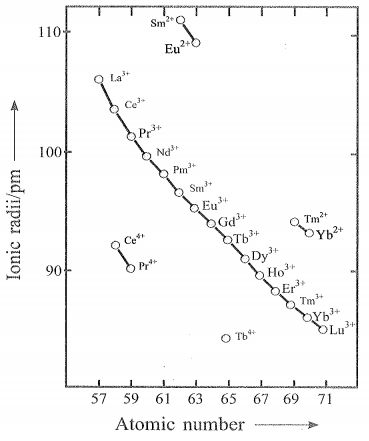
Explain the lanthanoid contraction.
Answer

$\rightarrow$ As we move along the lanthanoid series, the atomic number increases gradually by one. This means that the number of electrons and protons present in an atom also increases by one.
$\rightarrow$ As electrons are being added to the same shell, the effective nuclear charge increases.
$\rightarrow$ This happens because the increase in nuclear attraction due to the addition of proton is more pronounced than the increase in the interelectronic repulsions due to the addition of electron.
$\rightarrow$ Also, with the increase in atomic number, the number of electrons in the $4f$ orbital also increases. The $4f$ electrons have poor shielding effect.
$\rightarrow$ Therefore, the effective nuclear charge experienced by the outer electrons increases. Consequently, the attraction of the nucleus for the outermost electrons increases.
$\rightarrow$ This results in a steady decrease in the size of lanthanoids with the increase in the atomic number. This is termed as lanthanoid contraction.
Image
$\rightarrow$ Consequences of lanthanoid contraction
$\rightarrow$ There is similarity in the properties of second and third transition series.
$\rightarrow$ Separation of lanthanoids is possible due to lanthanoid contraction.
$\rightarrow$ It is due to lanthanoid contraction that there is variation in the basic strength of lanthanoid hydroxides. $($Basic strength decreases from $La(OH)_3to Lu(OH)_3.)$

Need a full question paper?

Generate a complete, print-ready paper with questions like this in minutes — across 16+ boards, with answer keys.

Start Generating Free

Similar questions

Write a note on chemical composition of nucleic acid compounds.
For the reaction
$2NO_{(g)} + Cl_{2(g)} \rightarrow 2 NOCl_{(g)}$
The following data were collected. All the measurements were taken at $263K$:
Experiment. No. Initial $[NO] (M)$ Initial $[Cl_2] (M)$ Initial rate of disappearance of $Cl_2$(M/min)
$1$ $0.15$ $0.15$ $0.60$
$2$ $0.15$ $0.30$ $1.20$
$3$ $0.30$ $0.15$ $2.40$
$4$ $0.25$ $0.25$ ?
  1. Write the expression for rate law.
  2. Calculate the value of rate constant and specify its units.
  3. What is the initial rate of disappearance of $Cl_2$ in exp. $4$?
Write the products formed when $(CH_3)_3 C-CHO$ reacts with the following reagents:
$i. \ CH_3COCH_3$ in the presence of dilute $NaOH$
$ii. \text {HCN}$
$iii. NaOH$
Explain the bromination of Aniline. State what is done if Mono substituted derivative of aniline is to be formed by this process.
Describe the following$:$
$i.$ Acetylation
$ii.$ Cannizzaro reaction
$iii.$ Cross aldol condensation
$iv.$ Decarboxylation
A monomer of a polymer upon ozonolysis gives one mole of methylglyoxal and two moles of formaldehyde.
  1. Identify the monomer of the polymer.
  2. Give its free radical mode of addition polymerisation.
Explain molecular asymmetry, chirality and enantiomers.
Calculate the boiling point of solution when $4\ g$ of $MgSO_4\ (M = 120\ g\ mol^{-1})$ was dissolved in $100\ g$ of water, assuming $MgSO_4$ undergoes complete ionization.
$(K_b$ for water$=0.52\ K\ kg\ mol^{-1}).$
What is carbonyl group? Give information about the functional groups containing carbonyl group with their structures.
$a.$ Write the formulation for the galvanic cell in which the reaction $C u(s)+2 A g^{+}(a q) \rightarrow C u^{2+}(a q)+2 A g(s)$ takes place.
Identify the cathode and the anode reactions in it.
$b.$ Write Nernst equation and calculate the emf of the following cell: $Sn ( s )\left| Sn ^{2+}(0.04 M ) \| H ^{+}(0.02 M )\right|$ $H _2(g) \mid \operatorname{Pt}( s )$
$\left(\right.$ Given $\left.E_{S n^{2+} / S n}=-0.14 V\right)$