Questions

[4 Mark Questions]

🎯

Test yourself on this topic

9 questions · timed · auto-graded

Question 14 Marks
Explain the types of alloys.
Answer
Based on the presence or absence of Iron, alloys can be classified into: 1. Ferrous alloys: Contain Iron as a major component. A few examples of ferrous alloys are Stainless Steel, Nickel Steel etc. 2. Non – ferrous alloys: These alloys do not contain Iron as a major component. For example, Aluminium alloy, Copper alloy etc.
Copper Alloys (Non - ferrous) :
AlloysUses
Brass (Cu,Zn)Electrical fittings, medal, decorative items, hardware
Bronze (Cu, Sn)Statues, coins, bells, gongs
Aluminium Alloys (Non - Ferrous) :
AlloysUses
Duralumin (Al, Mg, MAircraft tools, pressure cookers
Magnalium (Al, Mg)Aircraft, scientific instruments
Iron Alloys (Ferrous) :
AlloysUses
Stainless steel (Fe, C, Ni, Cr )Utensils, cutlery, automobile parts
Nickel steel (Fe,C,Ni)Cables, aircraft parts, propeller
View full question & answer
Question 24 Marks
Explain the metallurgy of iron.
Answer
 Iron is chiefly extracted from haematite ore $\left( Fe _2 O _3\right)$ :
(i) Concentration by Gravity Separation: The powdered ore is washed with steam of water. As a result, the lighter sand particles and other impurities are washed away and the heavier ore particles settle down.(ii) Roasting and Calcination: The concentrated ore is strongly heated in a limited supply of air in a reverberatory furnace. As a result, moisture is driven out and sulphur, arsenic and phosphorus impurities are oxidized off.
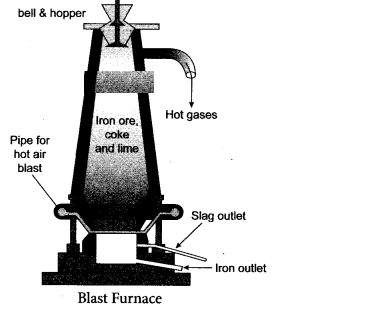
(iii) Smelting (in a Blast Furnace): The charge consisting of roasted ore, coke and limestone in the ratio $8: 4: 1$ is smelted in a blast furnace by introducing it through the cup and cone arrangement at the top. There are three important regions in the furnace.

Image
a. The Lower Region (Combustion Zone):
The temperature is at $1500^{\circ} C$. In this region, coke bums with oxygen to form $CO _2$ when the charge comes in contact with a hot blast of air.
$C + O _2 \underset{\Delta}{\stackrel{1500^{\circ} C }{\longrightarrow}} CO _2+\text { Heat }$
It is an exothermic reaction since heat is liberated.
b. The Middle Region (Fusion Zone):
The temperature prevails at $1000^{\circ} C$. In this region, $CO _2$ is reduced to $CO$.
$CO _2+ C \underset{\Delta}{\stackrel{1000^{\circ} C }{\longrightarrow}} 2 CO -\text { Heat }$
Limestone decomposes to calcium oxide and $CO _2$
$CaCO _3 \underset{\Delta}{ \longrightarrow } CO _2-\text { Heat }$
These two reactions are endothermic due to absorption of heat. Calcium oxide combines with silica to form calcium silicate slag.
$CaO + SiO _2 \rightarrow CaSiO _3$
c. The Upper Region (Reduction Zone): The temperature prevails at $400^{\circ} C$. In this region carbon monoxide reduces ferric oxide to form a fairly pure spongy iron.
$Fe _2 O _3+3 CO \stackrel{400^{\circ} C }{\longrightarrow} 2 Fe +3 CO _2$
The molten iron is collected at the bottom of the furnace after removing the slag. The iron thus formed is called pig iron. It is remelted and cast into different moulds. This iron is called cast iron.

 
View full question & answer
Question 34 Marks
Explain the extraction of copper from copper pyrites.
Answer
Extraction of copper from copper pyrites involves the following steps:
(i) The concentration of ore: The ore is crushed and then concentrated by froth floatation process.
(ii) Roasting: The concentrated ore is roasted in excess of air. During the process of roasting, the moisture and volatile impurities are removed. Sulphur, phosphorus, arsenic and antimony are removed as oxides. Copper pyrite is partly converted into sulphides of copper and iron. $2 CuFeS _2+ O _2 \rightarrow Cu _2 S +2 FeS + SO _2 \uparrow$
(iii) Smelting: The roasted ore is mixed with powdered coke and sand and is heated in a blast furnace to obtain matte $\left( Cu _2 S + FeS \right)$ and slag. The slag is removed as waste.
(iv) Bessemerisation: The molten matte is transferred to the Bessemer converter in order to obtain blister copper. Ferrous sulphide from matte is oxidized to ferrous oxide, which is removed as slag using silica.
$
\begin{array}{c}
2 FeS +3 O _2 \rightarrow 2 FeO +2 SO _2 \uparrow \\
FeO + SiO _2 \rightarrow FeSiO _3 \text { (slag) }
\end{array}
$
(Iron silicate)
$
\begin{array}{c}
2 Cu _2 S +3 O _2 \rightarrow 2 Cu _2 O +2 SO _2 \uparrow \\
2 Cu _2 O + Cu _2 S \rightarrow 6 Cu + SO _2 \uparrow
\end{array}
$
(Blister copper)

(v) Refining: Blister copper contains 98% of pure copper and 2% of impurities and is purified A by electrolytic refining. This method is used to get metal of a high degree of purity. For electrolytic refining of copper, we use:
Cathode: A thin plate of pure copper metal.
Anode: A block of impure copper metal.
Electrolyte: Copper sulphate solution acidified with sulphuric acid.
When an electric current is passed through the electrolytic solution, pure copper gets deposited at the cathode and the impurities settle at the bottom of the anode in the form of sludge called anode mud.

View full question & answer
Question 44 Marks
How will you extract aluminium from its ore?
Answer
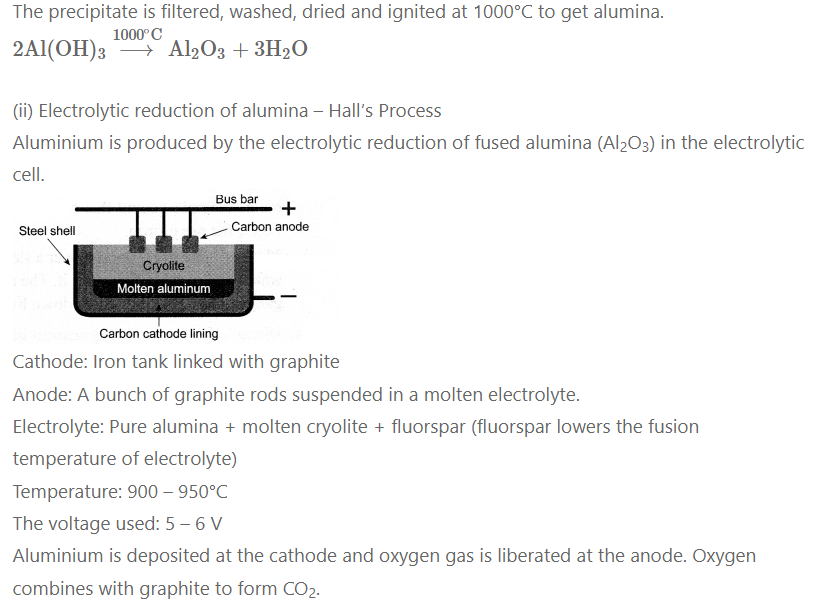
The extraction of aluminium from bauxite involves two steps:
(i) Conversion of bauxite into alumina – Baeyer’s Process
The conversion of Bauxite into Alumina involves the following steps:
Bauxite ore is finely ground and heated under pressure with a solution of concentrated caustic soda solution at 150° C to obtain sodium metal aluminate.
On diluting sodium meta aluminate with water, a precipitate of aluminium hydroxide is formed.

Image

View full question & answer
Question 54 Marks
Explain the froth floatation process.
Answer
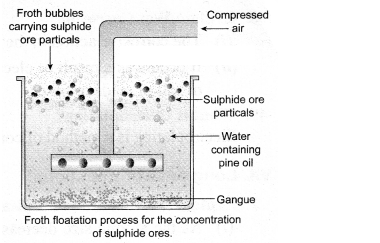
Froth floatation Process:
Principle: This process depends on the preferential wettability of the ore with oil (pine oil) and the gangue particles by water. Lighter ores, such as sulphide ores, are concentrated by this method, e.g., Zinc blende (ZnS).

Image
Method: The crushed ore is taken in a large tank containing oil and water and agitated with a current of compressed air. The ore is wetted by the oil and gets separated from the gangue in the form of froth. Since the ore is lighter, it comes on the surface with the froth and the impurities are left behind, e.g., Zinc blende (ZnS).

View full question & answer
Question 64 Marks
Discuss the magnetic separation methods.
Answer
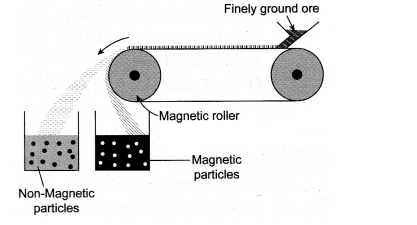
Magnetic separation method:
Principle: The magnetic properties of the ores from the basis of separation. When either the ore or the gangue is magnetic, this method is employed, e.g., Tinstone $SnO _2$, the ore of tin.

Image

Method: The crushed ore is placed over a conveyer belt which rotates around two metal wheels, one of which is magnetic. The magnetic particles are attracted to the magnetic wheel and fall separately apart from the nonmagnetic particles.
View full question & answer
Question 74 Marks
Explain Gravity separation method.
Answer
 Gravity Separation (or) Hydraulic method:
1. Principle: The difference in the densities or specific gravities of the ore and the gangue is the main principle behind this method. Oxide ores are purified by this method,
e.g., Haematite $Fe _2 O _3$ the ore of iron.
2. Method: The ore is poured over a sloping, vibrating corrugated table with grooves and a jet of water is allowed to flow over it. The denser ore particles settle down in the grooves and lighter gangue particles are washed down by the water.
View full question & answer
Question 84 Marks
Explain the electrolytic refining of copper.
Answer
Cathode: A thin plate of pure copper metal.
Anode: A block of impure copper metal.
Electrolyte: Copper sulphate solution + dilute $H _2 SO _4$
When an electric current is passed through the electrolytic solution, pure copper gets deposited at the cathode and the impurities are settled at the bottom of the anode as anode mud.
View full question & answer
Question 94 Marks
Explain the variation of ionisation energy along the group and period.
Answer
  • As the atomic size decreases from left to right in a period, more energy is required to remove the electrons. So, the ionisation energy increases throughout the period.
  • Down the group, the atomic size increases and hence the valence electrons are loosely bound. They require relatively less energy for the removal. Thus, ionisation energy decreases down the group in the periodic table.
View full question & answer