Question
Explain the method to determine distance of a planet from the Earth.

Answer

    • Parallax method is used to determine distance of different planets from the Earth.
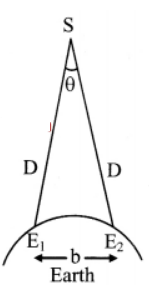
    • $E1$ and $E2$ are separated by distance $‘b \ ’$ shown in figure.
      $\therefore E1E3 = b$
      Image
    • The angle between the two directions along which the planet is viewed, can be measured. It is parallax angle, which in this case is $L \angle E1E2 = \theta$
    • The planet is far away from the $($Earth$)$ observers, hence
      $b << D$
      $\therefore \frac{b}{D}<<1$ and ' $\theta$ ' is also very small.
      Hence, $E_1 E_2$ can be considered as arc of length $b$ of circle with $S$ as centre and $D$ as radius.
      $\therefore E _1 S= E _2 S= D$
      $\therefore \theta=\frac{b}{D} \ldots(\theta$ is taken in radian$)$
      $\therefore D =\frac{b}{\theta}$
      Thus, the distance $'D \ '$ of a far away planet ' $S$ ' can be determined using the parallax method.
    • The planet should be visible from $E_1$ and $E_2$ observatories simultaneously i.e. at the same time.
    • To measure the distance $‘D \ ’$ of a far distant planet $S,$ select two different observatories $(E_1$ and $E_2).$

Need a full question paper?

Generate a complete, print-ready paper with questions like this in minutes — across 16+ boards, with answer keys.
Start Generating Free

Similar questions

Explain how acceleration and initial velocity decides trajectory of a motion.
Explain ‘mirage’ as an illustration of refraction.
A particle is projected with speed v0 at angle θ to the horizontal on an inclined surface making an angle Φ (Φ < θ) to the horizontal. Find the range of the projectile along the inclined surface.
A network of resistors is connected to a $14 V$ battery with internal resistance $1 Q$ as shown in the circuit diagram.
$i.$ Calculate the equivalent resistance,
$ii.$ Current in each resistor,
$iii.$ Voltage drops $V_{A B}, V_{B C}$ and $V_{D C}$.
Image
A ball of mass $100\ g$ dropped on the ground from $5\ m$ bounces repeatedly. During every bounce $64 \%$ of the potential energy is converted into kinetic energy. Calculate the following:
(a) Coefficient of restitution.
(b) Speed with which the ball comes up from the ground after third bounce.
(c) Impulse given by the ball to the ground during this bounce.
(d) Average force exerted by the ground if this impact lasts for $250\ ms$.
(e) Average pressure exerted by the ball on the ground during this impact if contact area of the ball is $0.5\ cm^2$.
[Ans: $0.8, 5.12 m/s, 1.152N s, 4.608 N, 9.216 \times 104 N/m^2$]
Two bodies undergo one$-$dimensional, inelastic, head$-$on collision. Obtain an expression for the magnitude of impulse.
Explain the Gauss’ law for magnetic fields.
Discuss the following as special cases of elastic collisions and obtain their exact or approximate final velocities in terms
of their initial velocities.
(i) Colliding bodies are identical.
(ii) A very heavy object collides on a lighter object, initially at rest.
(iii) A very light object collides on a comparatively much massive object, initially at rest.
Using expression for change in potential energy, show that gravitational potential energy of the system of object of mass $m$ and the Earth with separation of $r$ is, $-\frac{ GMm }{r}$
State and explain Kepler’s law of orbits.