Question
Explain the nomenclature of phenols by giving examples.

Answer

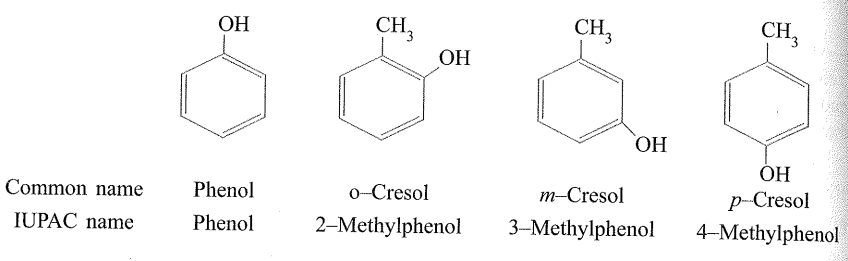
→ The simplest hydroxyl derivative of benzene is phenol. It is its common name and also an accepted IUPAC name. As structure of phenol involves a benzene ring, in its substituted compounds the term ortho (1,2- disubstituted), meta (1,3- disubstituted) and para (1,4- disubstituted) are often used in the common names.
Example:
Image
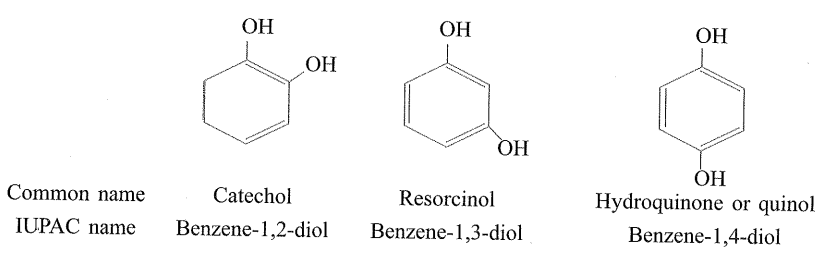
→ Dihydroxy derivatives of benzene are known as 1, 2, 1, 3- and 1, 4-benzenediol.
Image

Need a full question paper?

Generate a complete, print-ready paper with questions like this in minutes — across 16+ boards, with answer keys.

Start Generating Free

Similar questions

  1. For the complex $\ce{[Fe(H_2O)_6]^3}^+,$ write the hybridization, magnetic character and spin of the complex. $($At. number: $\ce{Fe = 26)}$
  2. Draw one of the geometrical isomers of the complex $\ce{[Pt(en)_2Cl_2]^{2+}}$ which is optically inactive.
  1. Draw the structures of all isomeric alcohols of molecular formula $\ce{C_5H_{12}O}$ and give their $\ce{IUPAC}$ names.
  2. Classify the isomers of alcohols in question $11.3 (i)$ as primary, secondary and tertiary alcohols.
The mechanism of the reaction $2 NO + Br _2 \rightarrow 2 NOBr$ is :
(i) $NO + Br _2 \rightleftharpoons NOBr _2$ (fast term)
(ii) $NOBr _2+ NO \rightarrow 2 NOBr$ (slow term)
Write the rate equation for this reaction.
Explain the bonding in coordination compounds in terms of Werner’s postulates.
A solution containing $30\ g$ of non-volatile solute exactly in $90\ g$ of water has a vapour pressure of $2.8\ kPa$ at $298\ K.$ Further, $18\ g$ of water is then added to the solution and the new vapour pressure becomes $2.9\ kPa$ at $298\ K.$ Calculate:
  1. Molar mass of the solute.
  2. Vapour pressure of water at $298\ K.$
How is benzaldehyde prepared from (i) Toluene, (ii) Benzoic acid?
What happens when:
(i) Chlorine gas reacts with NaOH solution.
(ii) Nitric acid reacts with Zn or Cu in different concentrations.
When a steady current of $2A$ was passed through two electrolytic cells $A$ and $B$ containing electrolytes $ZnSO_4$ and $CuSO_4$ connected in series, $2g$ of $Cu$ were deposited at the cathode of cell $B.$ How long did the current flow? What mass of $Zn$ was deposited at cathode of cell $A$?
$[$Atomic mass: $Cu = 63.5 g \text{mol}^-¹, Zn = 65 \text{ g mol}^{-1}; 1F = 96500\  C \text{ mol}^-¹]$
Short note on: Maltose
Compare the chemistry of actinoids with that of the lanthanoids with special reference to: Chemical reactivity