Explain why the reactance offered by an inductor increases with increasing frequency of an alternating voltage.
Download our app for free and get started
The inductive reactance is given by $\text{X}_\text{L}=2\pi\text{fL}$, $X_L$ is proportional to the frequency and current is inversely proportional to the reactance. An inductor opposes the flow of current through it by developing a back emf according to Lenz’s law. If the current is decreasing, the polarity of the induced emf will be so as to increase the current and vice-versa.
Since, the induced emf is proportional to the rate of change of current.
Since, the induced emf is proportional to the rate of change of current.

Download our appand get started for free
Experience the future of education. Simply download our apps or reach out to us for more information. Let's shape the future of learning together!No signup needed.*
Similar Questions
- 1View SolutionIn the given diagram, a coil B is connected to low voltage bulb L and placed parallel to another coil A as shown. Explain the following observations:
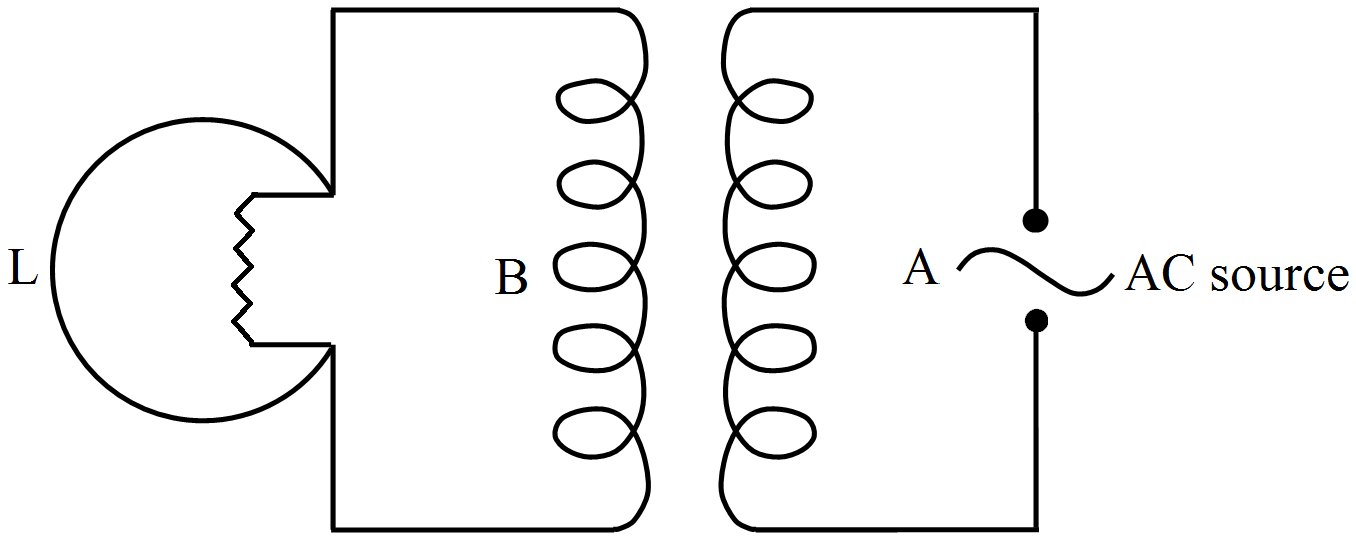
- Bulb lights.
- Bulb gets dimmer if the coil B moves upwards.
- 2Two capacitors of capacitance $10\mu\text{F}$ and $20 \mu\text{F}$ are connected in series with a 6 V battery. After the capacitors are fully charged, a slab of dielectric constant (K) is inserted between the plates of the two capacitors. How will the following be affected after the slab is introduced:View Solution
- The electric field energy stored in the capacitors.
- The charges on the two capacitors.
- The potential difference between the plates of the capacitors.
- 3View SolutionState Ampere's circuital law. Use this law to find magnetic field due to straight infinite current carrying wire. How are the magnetic field lines different from the electrostatic field lines?
- 4View SolutionIn what way is Gauss’s law in magnetism different from that used in electrostatics? Explain briefly. The Earth’s magnetic field at the Equator is approximately 0.4 G. Estimate the Earth’s magnetic dipole moment. Given: Radius of the Earth = 6400 km.
- 5View SolutionFind the electric field intensity due to a uniformly charged spherical shell at a point (i) outside the shell and (ii) inside the shell. Plot the graph of electric field with distance from the centre of the shell.
- 6View SolutionDraw a circuit diagram to study the input and output characteristics of an n-p-n transistor in common emitter configuration. Explain briefly how this arrangement is used to obtain the typical input/output characteristics of a transistor. Draw the graphs showing the nature of input/output curves.
- 7Use Bohr's postulates hydrogen atom to deduce the expression for the kinetic energy (K.E.) of the electron revolving in the $\mathrm{n}^{\text {th }}$ orbit and show that, K.E. $\frac{\mathrm{e}^2}{8 \pi \varepsilon_0 e_n}$, where $r_n$ is the radius of the $n^{\text {th }}$ orbit. How is the orbit. How is the potential energy in the orbit related to the orbital radius orbit related to the orbital radius $r_n$ ?View Solution
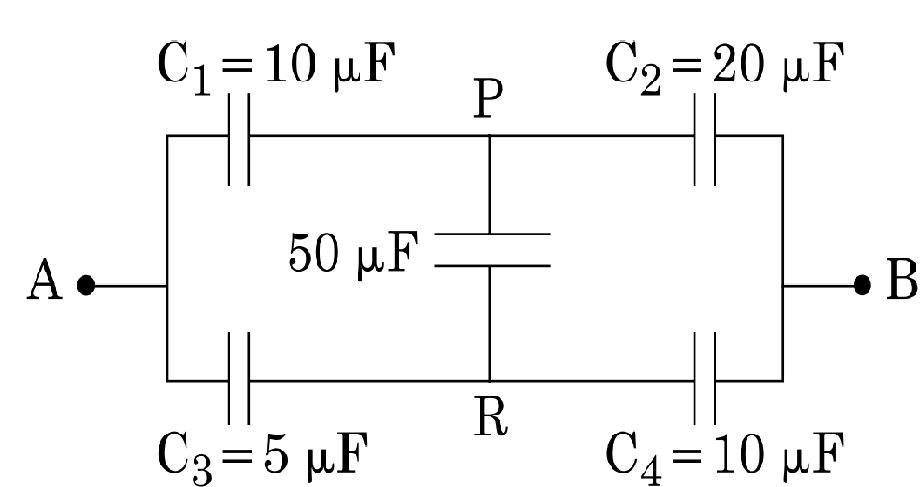
- 8View SolutionCalculate the equivalent capacitance between points A and B in the circuit below. If a battery of 10 V is connected across A and B, calculate the charge drawn from the battery by the circuit.
- 9A resistor R and an inductor L are connected in series to a source $\text{V}=\text{V}_0\sin\omega\text{t}.$View Solution
Find:- Peak value of the voltage drops across R and across L,
- Phase difference between the applied voltage and current. Which of them is ahead?
- 10A coil of inductance 5.0mH and negligible resistance is connected to the oscillator of the previous problem. Find the peak currents in the circuit for $\omega=100\text{s}^{-1},500\text{s}^{-1},1000\text{s}^{-1}.$View Solution