Question
Explain the preparation of silicones.

Answer

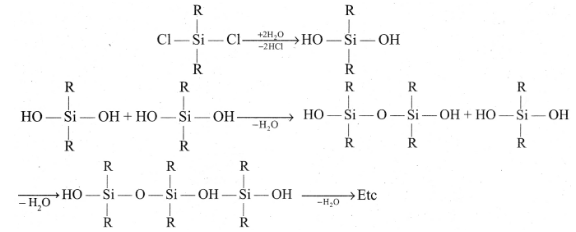
Generally silicones are prepared by the hydrolysis of dialkyldichiorosilanes $\left( R _2 SiCl _2\right)$ or diaryldichlorosilanes $Ar _2 SiCl _2$, which are prepared by passing vapours of RCl or ArCl over siliconat 570 K with copper as a catalyst.
$2 RCl+\underset{\longrightarrow}{Si C u / 570 k R_2 SiCl_2}$
The hydrolysis of dialkvlchloro silanes $R _2 SiCl _2$ yields to a straight chain polymer which grown from both the sides
Image
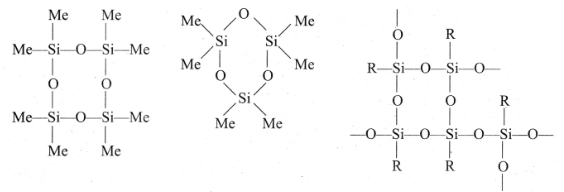
The hydrolysis of monoalkylchloro silanes $RSiCl_3$, yields to a very complex cross linked polymer Linear silicones can be converted into cyclic or ring silicones when water molecules is removed
Image

Need a full question paper?

Generate a complete, print-ready paper with questions like this in minutes — across 16+ boards, with answer keys.
Start Generating Free

Similar questions

What is corrosion? Explain about the electrochemical mechanism of corrosion.
Explain about the geometrical isomerism in complexes having coordination number 4.
An organic compound (A) of molecular formula $C _6 H _6 O$ gives white precipitate with bromine water. (A) on reaction with NaOH gives (B). (B) reacts with methyl iodide in presence of dry ether gives (C) of molecular formula $C _7 H _8 O$ which will not liberate $H _2$ gas with metallic Na . (C) on reaction with acetvl chloride gives ( D ) and $( E )$ of formula which are position isomers. Identify $A , B , C , D \& E$ and explain the reaction.
Explain about the magnetic properties of transition elements.
Explain about the factors that affecting the reaction rate.
Complete the reaction.
(i) $H _3 BO _3 \stackrel{373 K }{\longrightarrow} A + H _2 O$
(ii) $A \stackrel{413 K }{\longrightarrow} B + H _2 O$
(iii) $B \stackrel{\text { Red hot }}{\longrightarrow} C + H _2 O$
Explain
  1. Perkin’s reaction
  2. Knocvenagal reaction.
Explain $\left[ CO \left( NH _3\right)_6\right]^{3+}$ is an inner orbital complex whereas $\left[ Ni \left( NH _3\right)_6\right]^{2+}$ is an outer orbital complex.
Complete the following reactions,
1. $Cr _2 O _3+ A 1 \underset{\rightarrow}{\Delta}$ ?
2. $B _2 O _2+ Na \underset{\rightarrow}{\Delta}$ ?
3. $ThO _2+ Ca \underset{\rightarrow}{\Delta}$ ?
4. $Mn _3 O _4+ C \underset{\rightarrow}{\Delta}$ ?
5. $Ag _2 O + H _2 \stackrel{\Delta}{\rightarrow}$ ?
Starting from Benzene diazonium chloride, how would you prepare
(i) Biphenyl
(ii) Phenyl hydrazine
(iii) p – hydroxy azo benzene
(iv) p – amino azo benzene