Question
Explain the principle of moments.

Answer

self

Need a full question paper?

Generate a complete, print-ready paper with questions like this in minutes — across 16+ boards, with answer keys.
Start Generating Free

Similar questions

Calculate the increase in the internal energy of 10 g of water when it is heated from $0^{\circ} \mathrm{C}$ to $100^{\circ} \mathrm{C}$ and converted into steam at 100 kPa . The density of steam $=0.6 \mathrm{~kg} / \mathrm{m}^{-3}$. Specific heat capacity of water $=4200 \mathrm{~J} / \mathrm{kg}^{-10} \mathrm{C}^{-1}$ and the Jatent heat of vaporization of water $=2.25 \times 10^6 \mathrm{~J} / \mathrm{kg}^{-1}$.
From a uniform disk of radius R, a circular hole of radius $\frac{\text{R}}{2}$ is cut out. The centre of the hole is at $\frac{\text{R}}{2}$ from the centre of the original disc. Locate the centre of gravity of the resulting flat body.
Explain Doppler effect in sound. Obtain an expression for apparent frequency of sound when source moves and listener is at rest.
A projectile, launched with a speed v at an angle $\theta$ to the horizontal, hits a plane inclined at an angle a to the horizontal $(\alpha<\theta)$ and passing through the point of launching. Obtain an expression for the range r of the projectile on this inclined plane. When does the projectile hit this plane?
A laser light bean sent to the moon takes 2.56s to return after reflection at the Moon's surface. Calculate the radius of the lunar orbit around the earth.
i. Pick out only the vector quantities from the following: Temperature, pressure, impulse, time, power, charge.
ii. Show by drawing a neat diagram that the flight of a bird is an example of composition of vectors.
iii. A man is travelling at $10.8 km h ^{-1}$ in a topless car on a rainy day. He holds his umbrella at an angle $37^{\circ}$ to the vertical to protect himself from the rain which is falling vertically downwards. What is the velocity of the rain? $\left[\right.$ Given $\cos 37^{\circ}=\frac{4}{5}$ ]
A body covers $12m$ in $2^{nd}$ second and $20m$ in $4^{th}$ second. Find what distance the body will cover in $4$ second after $5^{th}$ second.
Calculate the angular momentum and rotational kinetic energy of earth about its own axis. How long could this amount of energy supply one kilowatt power to each of the $3.5 \times 10^9$ persons on earth? (Mass of earth = $6.0 \times 1024kg$ and radius = $6.4 \times 10^{24}km)$.
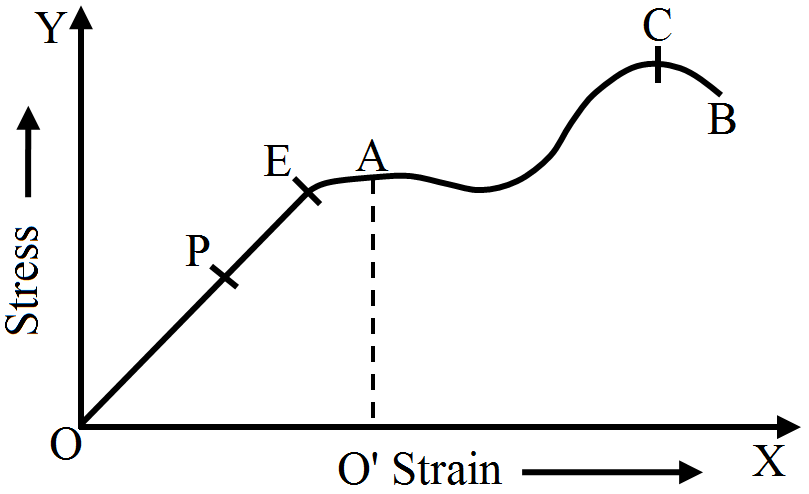
The Stress-Strain graph for a metal wire is shown in the figure upto the point E. The wire returns to its original state O along the curve EPO when it is gradually unloaded. Point B corresponds to the fracture of the wire:
  1. Upto what point of the curve is Hooke's law obeyed?
  2. Which point on the curve corresponds to the elastic limit or yield point of the wire?
  3. Indicate the elastic and plastic regions of the Stress-Strain graph.
  4. Describe what happens when the wire is loaded upto a stress corresponding to the point A on the graph, and then unloaded gradually. In particular, explain, the dotted curve.
  5. What is peculiar about the portion of the Stress-Strain graph from C to B? Upto what stress can the wire be subjected without causing fracture?
A point object is thrown vertically upwards at such a speed that it returns to the thrower after 6 seconds. With what speed was it thrown up and how high did it rise? Plot speed time graph for the object and use it to find the distance travelled by it in the last second of its journey.