Calculate the angular momentum and rotational kinetic energy of earth about its own axis. How long could this amount of energy supply one kilowatt power to each of the $3.5 \times 10^9$ persons on earth? (Mass of earth = $6.0 \times 1024kg$ and radius = $6.4 \times 10^{24}km)$.
Download our app for free and get started
Here we assume the earth to be a solid sphere. We know that the moment of inertia of a solid sphere about its axis is $\text{I}=\frac{2}{5}\text{MR}^2=\frac{2}{5}\times(6.0\times10^{24}\text{kg})$
$\times(6.4\times10^6\text{m})^2$
$=9.8\times10^{37}\text{kg}-\text{m}^2$ In onhe day (= $24 \times 60 \times 60sec$.) the earth completes one revolution. i.e., traces an angle of $2\pi$ radian. Hence its angular velocity is given by $\omega=\frac{2\pi}{24\times6\times60}$
$=7.27\times10^{-5}\text{rad/sec.}$
$\therefore$ Angular momentum, $\text{I}\omega=(98\times10^{37}\text{kg}-\text{m}^2)(7.27\times10^{-5}\text{s}^{-1})$
$=7.1\times10^{33}\text{kg}-\text{m}^2\text{sec.}$ The rotatinal energy $\frac{1}{2}\text{I}\omega^2=\frac{1}{2}(9.8\times10^{37}\text{kg}-\text{m}^2)(7.27\times10^{-5}\text{s}^{-1})^2$
$=2.6\times10^{29}\text{joule.}$ power supplied by this energy, $\text{p}=\frac{\text{Energy}}{\text{Time}}=\frac{2.6\times10^{29}}{\text{t}}\text{watt}$
$=\frac{2.6\times10^{29}}{10^3\text{t}}\text{kilowatt.}$ Power required by $3.5 \times 10^9$ persons = $3.5 \times 10^9 \times 1$ kilowatt. $\therefore\frac{2.6\times10^{29}}{10^3\text{t}}=3.5\times10^9$
$\text{or }\text{t}=\frac{2.6\times10^{29}}{10^3\times3.5\times10^9\times365\times24\times60\times60}\text{year}$
$=2.35\times10^6\text{years.}$
$\times(6.4\times10^6\text{m})^2$
$=9.8\times10^{37}\text{kg}-\text{m}^2$ In onhe day (= $24 \times 60 \times 60sec$.) the earth completes one revolution. i.e., traces an angle of $2\pi$ radian. Hence its angular velocity is given by $\omega=\frac{2\pi}{24\times6\times60}$
$=7.27\times10^{-5}\text{rad/sec.}$
$\therefore$ Angular momentum, $\text{I}\omega=(98\times10^{37}\text{kg}-\text{m}^2)(7.27\times10^{-5}\text{s}^{-1})$
$=7.1\times10^{33}\text{kg}-\text{m}^2\text{sec.}$ The rotatinal energy $\frac{1}{2}\text{I}\omega^2=\frac{1}{2}(9.8\times10^{37}\text{kg}-\text{m}^2)(7.27\times10^{-5}\text{s}^{-1})^2$
$=2.6\times10^{29}\text{joule.}$ power supplied by this energy, $\text{p}=\frac{\text{Energy}}{\text{Time}}=\frac{2.6\times10^{29}}{\text{t}}\text{watt}$
$=\frac{2.6\times10^{29}}{10^3\text{t}}\text{kilowatt.}$ Power required by $3.5 \times 10^9$ persons = $3.5 \times 10^9 \times 1$ kilowatt. $\therefore\frac{2.6\times10^{29}}{10^3\text{t}}=3.5\times10^9$
$\text{or }\text{t}=\frac{2.6\times10^{29}}{10^3\times3.5\times10^9\times365\times24\times60\times60}\text{year}$
$=2.35\times10^6\text{years.}$

Download our appand get started for free
Experience the future of education. Simply download our apps or reach out to us for more information. Let's shape the future of learning together!No signup needed.*
Similar Questions
- 1A mass m is allowed to roll down an inclined plane $(\theta)$ If the vertical height is h, find.View Solution
- Acceleration along the inclined plane.
- Velocity down the plane.
- 2View SolutionA wheel in uniform motion about an axis passing through its centre and perpendicular to its plane is considered to be in mechanical (translational plus rotational) equilibrium because no net external force or torque is required to sustain its motion. However, the particles that constitute the wheel do experience a centripetal acceleration directed towards the centre.How do you reconcile this fact with the wheel being in equilibrium? How would you set a half-wheel into uniform motion about an axis passing through the centre of mass of the wheel and perpendicular to its plane? Will you require external forces to sustain the motion?
- 3A car weighs $1800kg$. The distance between its front and back axles is $1.8m$. Its centre of gravity is $1.05m$ behind the front axle. Determine the force exerted by the level ground on each front wheel and each back wheel.View Solution
- 4A disc of radius R is rotating with an angular speed $\omega_\text{o}$ about a horizontal axis. It is placed on a horizontal table. The coefficient of kinetic friction is $\mu_\text{k}{:}$View Solution
- What was the velocity of its centre of mass before being brought in contact with the table?
- What happens to the linear velocity of a point on its rim when placed in contact with the table?
- What happens to the linear speed of the centre of mass when disc is placed in contact with the table?
- Which force is responsible for the effects in (b) and (c).
- What condition should be satisfied for rolling to begin?
- Calculate the time taken for the rolling to begin.
- 5View SolutionA cylinder is suspended by two strings wrapped around the cylinder near each end, the free ends of the string being attached to hooks on the ceiling, such that the length of the cylinder is horizontal. From the position of rest, the cylinder is allowed to roll down as suspension strings unwind. Calculate: (i) the downward linear acceleration of the cylinder and (ii) tension in the strings. Mass of cylinder is 12kg.
- 6View SolutionDefine radius of gyration and give the physical significance of moment of inertia.
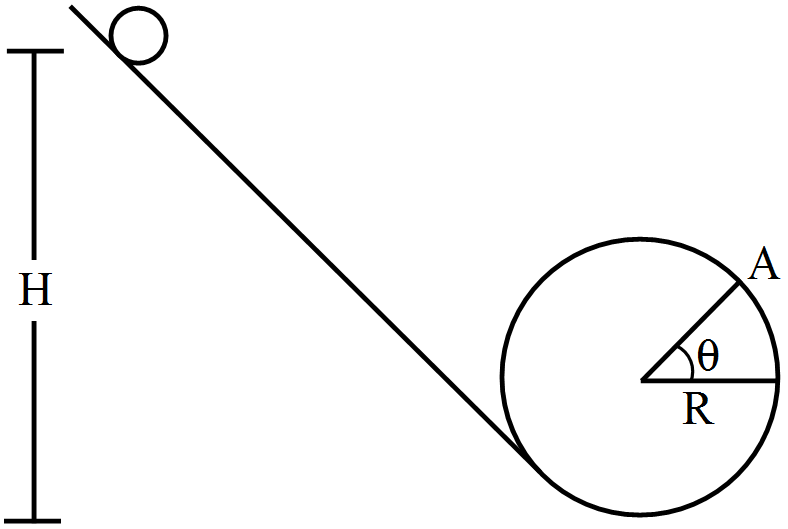
- 7Figure shows a small spherical ball of mass m rolling down the loop track. The ball is released on the linear portion at a vertical height H from the lowest point. The circular part shown has a radius R.View Solution
- Find the kinetic energy of the ball when it is at a point A where the radius makes an angle $\theta$ with the horizontal.
- Find the radial and the tangential accelerations of the centre when the ball is at A.
- Find the normal force and the frictional force acting on the ball if H = 60cm, R = 10cm, $\theta=0 $ and m = 70g.
- 8A uniform wheel of radius R is set into rotation about its axis at an angular speed $\omega.$ This rotating wheel is now placed on a rough horizontal surface with its axis horizontal. Because of friction at the contact, the wheel accelerates forward and its rotation decelerates till the wheel starts pure rolling on the surface. Find the linear speed of the wheel after it starts pure rolling.View Solution
- 9A solid disc and a ring, both of radius $10cm$ are placed on a horizontal table simultaneously, with initial angular speed equal to $10 π$ rad $s^{-1}$. Which of the two will start to roll earlier? The co-efficient of kinetic friction is $\mu_\text{k}=0.2$View Solution
- 10Three point masses m,, m, and m, are located at the vertices of an equilateral triangle of side length a. What is the moment of inertia about an axis along the altitude of the triangle passing through $m_1$?View Solution