From a uniform disk of radius R, a circular hole of radius $\frac{\text{R}}{2}$ is cut out. The centre of the hole is at $\frac{\text{R}}{2}$ from the centre of the original disc. Locate the centre of gravity of the resulting flat body.
Exercise
Download our app for free and get started
$\frac{\text{R}}{6},$ from the original centre of the body and opposite to the centre of the cut portion. Mass per unit area of the original disc $=\sigma$ Radius of the original disc = R Mass of the original disc, $\text{M}=\pi\text{R}^2\sigma$ The disc with the cut portion is shown in the following figure: 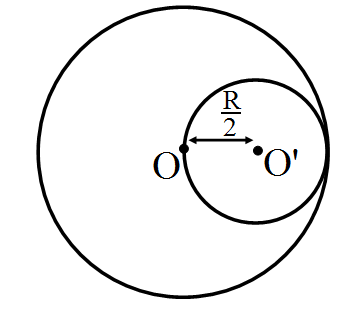 Radius of the smaller disc $=\frac{\text{R}}{2}$ Mass of the smaller disc, $\text{M}'=\pi\Big(\frac{\text{R}}{2}\Big)^2\sigma=\frac{\pi\text{R}^2\sigma}{4}=\frac{\text{M}}{4}$ Let O and O′ be the respective centres of the original disc and the disc cut off from the original. As per the definition of the centre of mass, the centre of mass of the original disc is supposed to be concentrated at O, while that of the smaller disc is supposed to be concentrated at O′. It is given that, $\text{OO}'=\frac{\text{R}}{2}$ After the smaller disc has been cut from the original, the remaining portion is considered to be a system of two masses. The two masses are, M (concentrated at O), and $-\text{M}'=\Big(\frac{\text{M}}{4}\Big)$ concentrated at O′ (The negative sign indicates that this portion has been removed from the original disc). Let x be the distance through which the centre of mass of the remaining portion shifts from point O. The relation between the centres of masses of two masses is given as, $\text{x}=\frac{(\text{m}_1\text{r}_1+\text{m}_2\text{r}_2)}{(\text{m}_1+\text{m}_2)}$ For the given system, we can write, $\text{x}=\frac{\big[\text{M}\times0-\text{M}'\times\big(\frac{\text{R}}{2}\big)\big]}{(\text{M}+\text{M}'))}=\frac{-\text{R}}{6}$ (The negative sign indicates that the centre of mass gets shifted toward the left of point O).
Radius of the smaller disc $=\frac{\text{R}}{2}$ Mass of the smaller disc, $\text{M}'=\pi\Big(\frac{\text{R}}{2}\Big)^2\sigma=\frac{\pi\text{R}^2\sigma}{4}=\frac{\text{M}}{4}$ Let O and O′ be the respective centres of the original disc and the disc cut off from the original. As per the definition of the centre of mass, the centre of mass of the original disc is supposed to be concentrated at O, while that of the smaller disc is supposed to be concentrated at O′. It is given that, $\text{OO}'=\frac{\text{R}}{2}$ After the smaller disc has been cut from the original, the remaining portion is considered to be a system of two masses. The two masses are, M (concentrated at O), and $-\text{M}'=\Big(\frac{\text{M}}{4}\Big)$ concentrated at O′ (The negative sign indicates that this portion has been removed from the original disc). Let x be the distance through which the centre of mass of the remaining portion shifts from point O. The relation between the centres of masses of two masses is given as, $\text{x}=\frac{(\text{m}_1\text{r}_1+\text{m}_2\text{r}_2)}{(\text{m}_1+\text{m}_2)}$ For the given system, we can write, $\text{x}=\frac{\big[\text{M}\times0-\text{M}'\times\big(\frac{\text{R}}{2}\big)\big]}{(\text{M}+\text{M}'))}=\frac{-\text{R}}{6}$ (The negative sign indicates that the centre of mass gets shifted toward the left of point O).
Download our appand get started for free
Experience the future of education. Simply download our apps or reach out to us for more information. Let's shape the future of learning together!No signup needed.*
Similar Questions
- 1View SolutionExplain why friction is necessary to make the disc in roll in the direction indicated.
- Give the direction of frictional force at B, and the sense of frictional torque, before perfect rolling begins.
- What is the force of friction after perfect rolling begins?
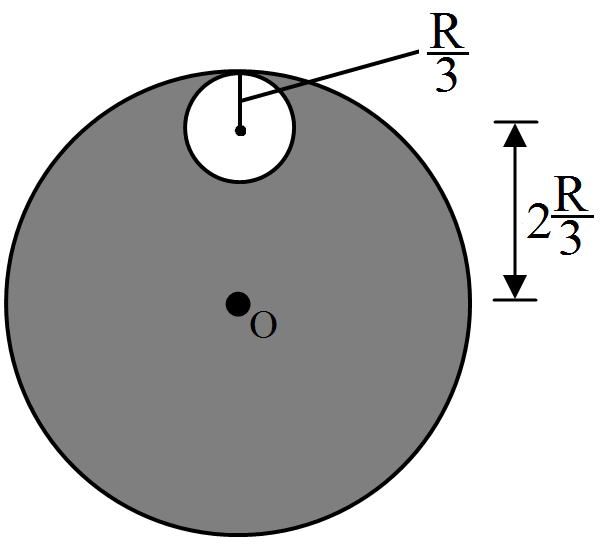
- 2From a circular disc of radius R and mass 9M, a small disc of radius $\frac{\text{R}}{3}$ is removed as shown in Fig. Find the moment of inertia of the remaining disc about an axis perpendicular to the plane of the disc and passing through the point O.View Solution
- 3Separation of Motion of a system of particles into motion of the centre of mass and motion about the centre of mass: Show $\text{K}=\text{K}'+\frac{1}{2}\text{M}\text{V}^2$ where K' is the total kinetic energy of the system of particles, K′ is the total kinetic energy of the system when the particle velocities are taken with respect to the centre of mass and $\frac{\text{MV}^2}{2}$ is the kinetic energy of the translation of the system as a whole (i.e. of the centre of mass motion of the system). The result has been used in $\sec7.14$View Solution
- 4Two masses $M_1$ and $M_2$ are separated by a distance r. Find the moment of inertia of this arrangement about an axis passing through the centre of mass and perpendicular to the line joining them.View Solution
- 5Separation of Motion of a system of particles into motion of the centre of mass and motion about the centre of mass: Show $\text{K}=\text{K}'+\frac{1}{2}\text{M}\text{V}^2$ where K' is the total kinetic energy of the system of particles, K′ is the total kinetic energy of the system when the particle velocities are taken with respect to the centre of mass and $\frac{\text{MV}^2}{2}$ is the kinetic energy of the translation of the system as a whole (i.e. of the centre of mass motion of the system). The result has been used in $\sec7.14$View Solution
- 6A disc of mass $5kg$ and radius $50cm$ rolls on the ground at the rate of $10ms^{-1}$. Calculate the K.E. of the disc. $\Big(\text{Given}:\text{I}=\frac{1}{2}\text{MR}^2\Big)$View Solution
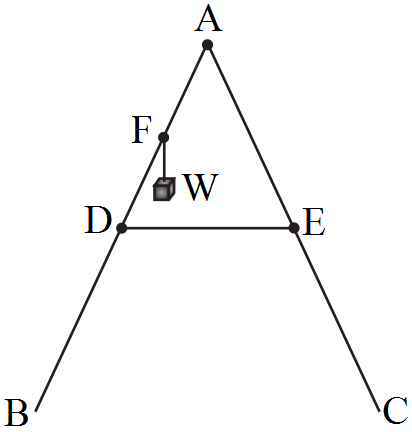
- 7As shown in the two sides of a step ladder BA and CA are $1.6m$ long and hinged at A. A rope DE, $0.5m$ is tied half way up. A weight $40kg$ is suspended from a point F, 1.2m from B along the ladder BA. Assuming the floor to be frictionless and neglecting the weight of the ladder, find the tension in the rope and forces exerted by the floor on the ladder. (Take $g = 9.8m/s^2$) (Hint: Consider the equilibrium of each side of the ladder separately).View Solution
- 8$(n - 1)$ equal point masses each of mass m are placed at the vertices of a regular n-polygon. The vacant vertex has a position vector a with respect to the centre of the polygon. Find the position vector of centre of mass.View Solution
- 9Find the centre of mass of a uniform $L-$shaped lamina $($a thin flat plate$)$ with dimensions as shown. The mass of the lamina is $3 \ kg.$View Solution
- 10A hoop of radius $2m$ weighs $100kg$. It rolls along a horizontal floor so that its centre of mass has a speed of $20cm/s$. How much work has to be done to stop it?View Solution