Question
Explain the procedure of balancing the personal accounts.

Answer

From the balancing of these accounts we can ascertain as to how much amount is owing from each individual customer and how much amount is owed to each individual creditor. If a personal account shows a debit balance, it indicates the amount owing from him. On the contrary, if a personal account shows a credit balance, it indicates the amount owing to him.In case the total of the debit side is in excess of the credit side, the difference between the two is inserted on the credit side of the account in order to make their totals equal. The words ‘By Balance c/d’, i.e., balance carried down are written against the amount of the difference. In the next accounting period, the balance is brought down on the debit side by writing the words ‘To Balance b/d'.
On the contrary, if the total of the credit side is in excess of the debit side, the difference between the two is inserted on the debit side of the account in order to make their totals equal. The words ‘To Balance c/d' are written against the amount of the difference. In the next accounting period, the balance is brought down on the credit side by writing the words 'By Balance b/d’.

Need a full question paper?

Generate a complete, print-ready paper with questions like this in minutes — across 16+ boards, with answer keys.

Start Generating Free

Similar questions

Journalise the following transactions:
  1. Goods for ₹ 50,000 were destroyed by fire.
  2. Goods worth ₹ 18,000 were distributed as free samples and ₹ 20,000 were given away as charity in cash.
  3. Goods worth ₹ 25,000 and cash ₹ 40,000 were taken away by the proprietor for his personal use.
  4. Goods worth ₹ 20,000 and cash ₹ 5,000 were given away as charity.
  5. Cash ₹ 1,00,000 were stolen from the Iron Safe of the trader.
On 1st January, 2019, X sold goods of ₹ 20,000 to Y and drew a bill on Y at three months for the amount. Y accepted the bill. The bill is met on maturity. Pass the necessary Journal entries in the books of X and Y, if X discounted the bill @ 12% p.a. from bank on 4th January.
Rectify the following errors:-
  1. ₹ 500 paid for the purchases of Radio set for the proprietor debited to General expenses account.
  2. Goods sold to Ram for ₹ 300 have been entered in the purchase book. However the account of Ram stands correctly posted.
  3. An amount of ₹ 50 paid to Kewal has been credited to the account of Kanwal.
  4. A sum of ₹ 450 paid as rent has been debited to Landlord's personal account.
  5. Wages paid for the month ₹ 300 was posted twice.
  6. Sales return book was undercast by ₹ 10.
  7. Goods for ₹ 100 have been returned by a customer. These have been taken into stock but no entry in respect thereof has been made in the books.
  8. Repairs ₹ 500 debited to machinery account as ₹ 550.
An asset was purchased for ₹ 10,500 on 1st April, 2012. The scrap value was estimated to to be ₹ 500 at the end of asset's 10 years' life. Straight Line Method of depreciation was used. The accounting year ends on 31st March every year. The asset was sold for ₹ 600 on 31st March, 2019. Calculate the following:
  1. The Depreciation expense for the year ended 31st March, 2013.
  2. The net book value of the asset on 31st March, 2017.
  3. The gain or loss on sale of the asset on 31st March, 2019
Record the following transactions in the books of Sahdev & Sons assuming all transactions have been entered within the state of Bihar, Charging CGST and SGST @ 9% each.
1.
Bought goods from Nanak Bros. for ₹ 4,00,000 at 10% trade discount and 3% cash discount on purchase price. 25% of the amount paid at the time of purchase.
2.
Sold goods to Kumar & Sons. for ₹ 2,00,000 at 20% trade discount and 5% cash discount on sale price. 60% of the amount received by Cheque.
3.
Received from Gopi Chand ₹ 38,000 by Cheque after deducting 5% cash discount.
4.
Paid ₹ 20,000 for rent by Cheque.
5.
Paid ₹ 50,000 for salaries by Cheque.
6.
Goods worth ₹ 10,000 distributed as free samples.
7.
₹ 5,000 due from Chanderkant are bad-debts.
8.
Sold household furniture for ₹ 15,000 and the proceeds were invested into business.
Mohit has the following transactions, prepare accounting equation:
a.
Business started with cash
₹ 1,75,000
b.
Purchased goods from Rohit
₹ 50,000
c.
Sales goods on credit to Manish (Costing ₹ 17,500)
₹ 20,000
d.
Purchased furniture for office use
₹ 10,000
e.
Cash paid to Rohit in full settlement
₹ 48,500
f.
Cash received from Manish
₹ 20,000
g.
Rent paid
₹ 1,000
h.
Cash withdrew for personal use
₹ 3,000
(Ans: Cash ₹ 1,32,500 + Goods ₹ 32,500 + Furniture ₹ 10,000 = ₹ 1,75,000; Liabilition = Capital ₹ 1,75,000)
Enter the following transactions in a petty cash book in analytical form. The book is kept on imprest system, amount of imprest being ₹ 5,000.
2016  
April 3 Petty Cash in hand ₹ 420. Received cash to make-up the imprest
Bought stamps for ₹ 300
April 5 Paid for office cleaning ₹ 200 and repairs to furniture ₹ 250
April 7 Paid bus fare ₹ 440, railway fare ₹ 330, wages ₹ 200
April 8 Paid for charity ₹ 350
April 9 Bought shorthand note book for office ₹ 250, Carriage on parcels ₹ 280
April 10 Bought envelopes ₹ 450, served refreshment to customers ₹ 150
April 12 Paid for conveyance ₹ 300. Wages ₹ 200. Stapler pins ₹ 280
April 15 Gave tips to office peon ₹ 250
Correct the following errors in Mohan Lal’s Book:
  1. A payment of ₹ 5,000 for salaries (to Mr. Ram) has been posted twice to the Salaries Account.
  2. ₹ 750 received from Rajesh are entered on the debit side of the Cash Book. No posting was done in Rajesh’s Account.
  3. Sales Book was overcasted by ₹ 3,000.
  4. Goods (Cost ₹ 2,000, Sales Price ₹ 2,500) distributed as samples among prospective customers were not recorded anywhere.
  5. A sum of ₹ 1,500 written off as depreciation on furniture was not debited to Depreciation Account.
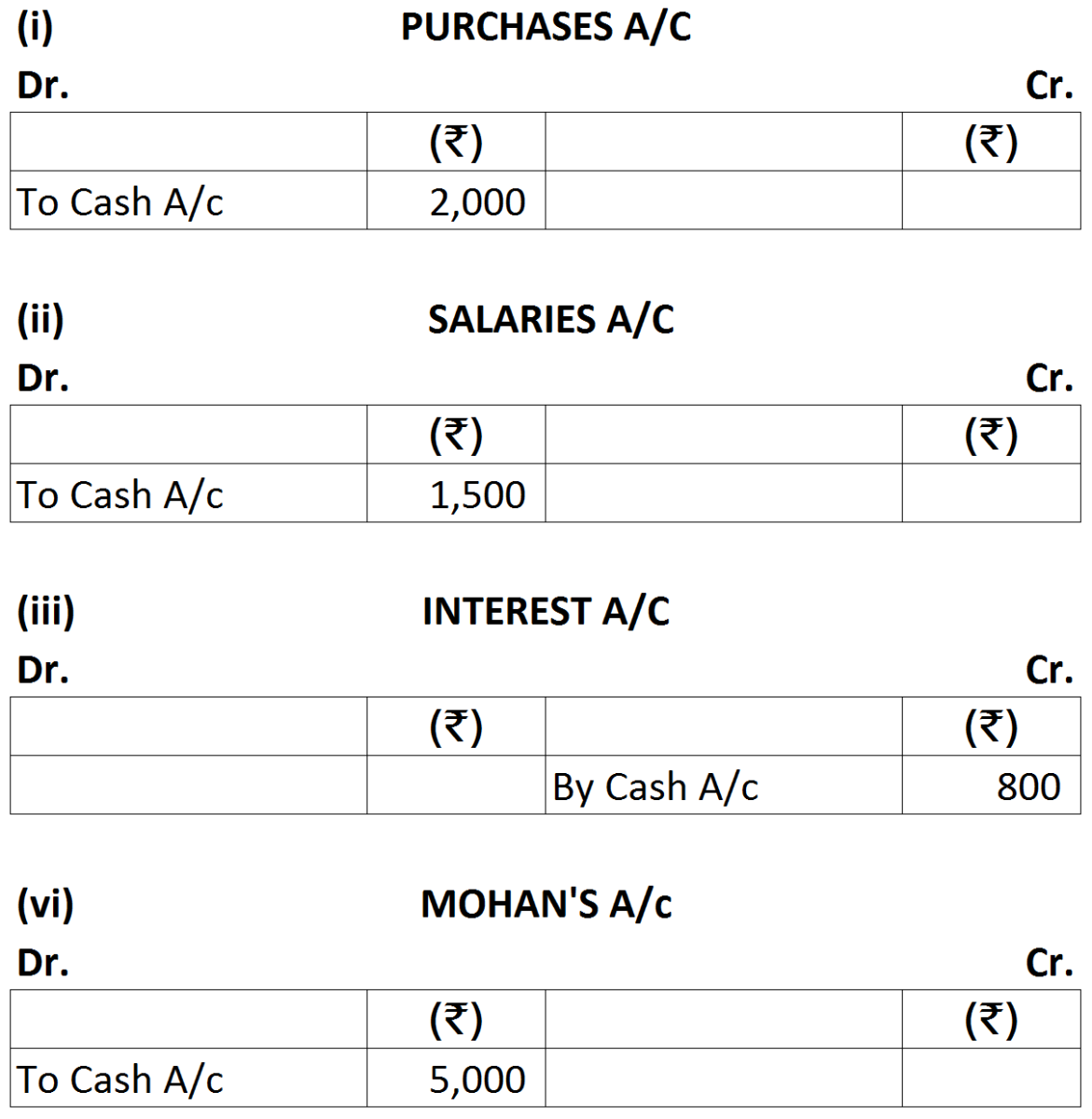
Prepare journal Entries of the following postings:
Rectify the following errors:
  1. Furniture purchased for ₹ 10,000 wrongly debited to Purchases Account.
  2. Machinery purchased on credit from Raman for ₹ 20,000 was recorded through Purchases Book.
  3. Repairs on machinery ₹ 1,400 debited to Machinery Account.
  4. Repairs on overhauling of second hand machinery purchased ₹ 2,000 was debited to Repairs Account.
  5. Sale of old machinery at book value of ₹ 3,000 was credited to Sales Account.