Question
Explain the process of inspiration under normal conditions.

Answer

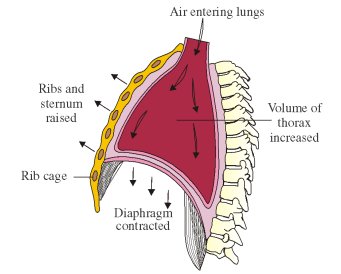
Inspiration: The process of filling the lungs with air from the external environment is called inspiration. During inspiration, the ribs are pulled forward and outward as a result of contraction of the external intercostal muscles. Due to this movement of the ribs the sternum bends downwards. Now due to the stretching of the ribs, contraction of the radial muscles of the diaphragm also occurs. Due to which its dome-like shape changes to a flat form, which increases the volume of the thoracic cavity. As the volume of the thoracic cavity increases, the volume of the lungs also increases, due to which suctorial force is generated due to reduction in the air pressure within it. As a result, atmospheric air enters the lungs through the respiratory tract. Respiration is an active process.
Image
Fig.: Mechanism of breathing showing inspiration. The airways are as follows:
Nostril → Nasal cavity → Internal nostril → Pharynx → Trachea → Bronchus → Bronchioles → Alveolar → duct → Alveolar sacs → Air alveoli.

Need a full question paper?

Generate a complete, print-ready paper with questions like this in minutes — across 16+ boards, with answer keys.

Start Generating Free

Similar questions

Write a note on bulliform cells. Write any three differences between exarch and endarch.
Write any four differences between Agnatha and Gnathostomata.
How are viroids different from viruses?
John was reading a chapter on different parts of a green plant. His mother asked him about the functions of roots. He replied that roots are meant for anchorage and absorbing water and minerals from soil. Then mother showed him carrot, radish and turnip and asked him about the additional functions that the roots perform. John was surprised to find that roots in some plants change their shape and structure and become modified to perform additional functions like support, storage of food and respiration.

(1). Carrot is a
(a) Tap root (b) Fibrous root (c) Adventitious root (d) Stilt root.

(2). Hanging structures that support a banyan are
(a) Prop (b) Tuber (c) Rhizome (d) Stilt

(3). Supporting structures coming out of the lower nodes of the stems of maize and sugarcane are
(a) Stilt (b) Tendrils (c) Runner (d) Prop

(4). Which function is performed by the modified roots of Asparagus?
(a) Storage (b) Support (c) Respiration (d) Transpiration.

(5). Pneumatophores are found in
(a) Rhizophora (b) Asparagus (c) Sugarcane (d) Maize.
Give a brief account of the counter current mechanism.
Could the number of eggs or young ones produced by an oviparous and viviparous mother be equal? Why?
Write any four differences between cartilaginous fishes and bony fishes.
Lipids form a heterogeneous group but all are made up of carbon hydrogen and oxygen. These are insoluble in water and soluble in organic solvents like acetone, ether, alcohol etc. The number of oxygen atoms is very small compared to carbon atoms. They need a large amount of oxygen for their oxidation to release energy. They could be simple lipids, compound lipids, and derived lipids. Simple lipids are esters of fatty acid and alcohol. Compound lipids are formed when simple lipids combine with another compounds for example glycolipids, phospholipids and lipoproteins. Derived lipids are of various types and important example being steroids.

(1) Lipids mainly consist of
(a) Carbon only
(b) carbon hydrogen and nitrogen
(c) carbon hydrogen and oxygen
(d) Hydrogen only

(2) Among the given options non-polymeric molecule is
(a) Nucleic acids (b) proteins (c) Lipids (d) polysaccharides

(3) An example of unsaturated fatty acid is
(a) oleic acid (b) stearic acid (c) Linoleic acid (d) both a and c

(4) The number of carbon atoms as compared to oxygen atoms in lipids is
(a) same (b) much less (c) much more (d) none of these.

(5) Steroids are an example of
(a) derived lipids (b) conjugated lipids (c) simple lipids (d) lipo proteins
The process to standardize the naming of living organisms is called nomenclature. Obviously, the nomenclature is only possible when the organism is described correctly and we know to what organism the name is attached to this is identification. The system of providing scientific name with two components is called Binomial Nomenclature. The scientific name ensures that each organism is identified by only one name all across the world. They also ensures that such a name has not been used for any other known organism. Scientific names for plants are provided in ICBN and for animals, in ICZN.

(1). Who proposed binomial nomenclature?
(A) Carolus Linnaeus  (B) Charles Darwin  (C) Francis crick  (D) Albert Einstein

(2)Which of the following is an example of binomial scientific name?
(A) Green algae  (B) Rana tigrina  (C) Snow leopard  (D) China rose

(3). In binomial nomenclature, the name of organism consists of
(A) kingdom   (B) genus   (C) species   (D) Both B and C

(4). ICBN stands for
(A) Internal botanical congress names
(B) International center of botanical names
(C) International code of botanical nomenclature
(D) Internal code of botanical nomenclature

(5). In binomial nomenclature,------- epithet starts with small letter
(A) Genus
(B) Species
(C) Both A and B
(D) None of the above