CBSE BoardEnglish MediumSTD 10ScienceLife Processes5 Marks
Question
Explain the process of nutrition in Amoeba.
✓
Answer
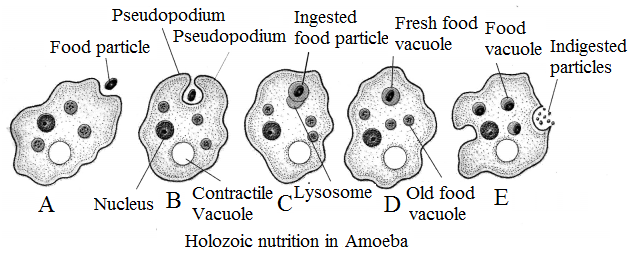
Ingestion: (L. ingestus - taken in). It is taking in of solid food with the help of temporary or permanent mouth. Amoeba can ingest food particles from any point on its surface. Paramoecium (another unicellular organism) has fixed point for the same. Amoeba captures food with the help of temporary finger-like processes called pseudopodia. Paramoecium has small hair-like processes called cilia. Beating of cilia creates current in water that pushes food particle through cytostome or cell mouth. The process of ingestion of solid food particle by a cell or unicellular organism is called phagocytosis.
As soon as Amoeba comes in contact with a food particle or prey, it throws pseudopodia all around the same. The tips of encircling pseudopodia fuse and the prey comes to lie in a vesicle or phagosome.
Digestion: It is conversion of complex insoluble food ingredients into simple absorbable form. Digestion can be intracellular or intercellular. Intercellular digestion occurs in a digestive tract. Intracellular digestion takes place in the cytoplasm of cells. Here, a lysosome fuses with phagosome to produce a food vacuole, also called gastriole or temporary stomach. Reaction of food vacuole is acidic at first and alkaline later on. Digestion of food occurs with the help of digestive enzymes brought by lysosome. It changes complex insoluble substances of food into simpler absorbable substances.
Absorption: The digested simple and soluble substances pass out of food vacuole into the surrounding cytoplasm.
The absorbed food materials are converted into various constituents of protoplasm including food reserve.
(L. egestus - discharge): It is throwing of undigested components of food out of the body. In Amoeba, the old food vacuole with heavier undigested material reaches the rear end, passes to the surface, fuses with surface membrane and throws out the undigested materials. The process is called egestion. Paramoecium has a definite cytopyge or cell anus.
Need a full question paper?
Generate a complete, print-ready paper with questions like this in minutes — across 16+ boards, with answer keys.