Question
Explain the process of transcription in prokaryotes.

Answer

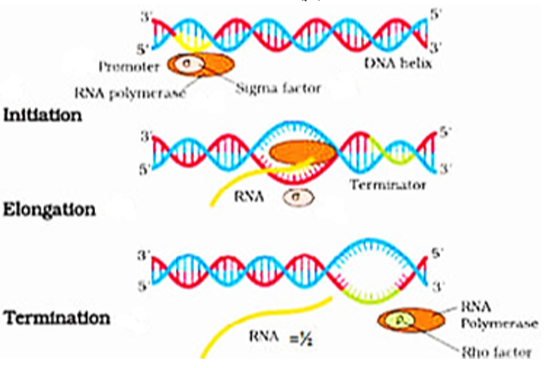
Process of transcription in Prokaryotes are as follows
DNA-dependent RNA polymerase that catalyses the process of transcription, three steps: initiation, elongation, and termination, Initiation: RNA polymerase binds to promoter, associated with initiation-factor (8) at 5' end of DNA,
Elongation: nucleoside phosphates serve as substrate following the rule of complementarity, RNA polymerase help in opening the helix and continuous elongation,
Termination: Terminator factor $(\rho)$, nascent RNA falls off along with RNA polymerase
Image

Need a full question paper?

Generate a complete, print-ready paper with questions like this in minutes — across 16+ boards, with answer keys.
Start Generating Free

Similar questions

  1. Draw a simplified model of phosphorus cycling in a terrestrial ecosystem.
  2. Write the importance of such cycles in ecosystems.
  1. Compare, giving reasons, the J-shaped and S-shaped models of population growth of a species.
  2. Explain "fitness of a species" as mentioned by Darwin.
Define decomposition and describe the processes and products of decomposition.
  1. How is amensalism different from parasitism and competition? Give an example for each.
  2. Define predation.
Answer the following questions:
When and where does spermatogenesis occur in a human male?
In a plant tallness is dominant over dwarfness and red flower is dominant over white. Starting with the parents work out a dihybrid cross. What is standard dihybrid ratio? Do you think the values would deviate if the two genes in question are interacting with each other?
Restriction enzymes are found in bacteria (and other prokaryotes). They recognize and bind to specific sequences of DNA, called restriction sites. Each restriction enzyme recognizes just one or a few restriction sites.
When it finds its target sequence, a restriction enzyme will make a double-stranded cut in the DNA molecule.
i. Write the palindromic nucleotide sequence for the following DNA segment.
5'-GAATTC-3'
ii. Name the restriction endonuclease that recognises this sequence.
iii. How are sticky ends produced? Mention their role.
What do you understand by the evidences of Evolutions describe in detail with suitable example the three evidences of evolution?
Write a short note on the following :
(i) Chargaff's equivalence rule
(ii) Replication in semi-conservative mode
(iii) Clover leaf model
(iv) Spliceosome
(v) Termination Codon
(vi) Reverse transcription
(vii) Polyribosome
(viii) hn-RNA
Answer the following questions:
During a cross involving true breeding red flowered and true breeding white flowered snapdragon plants, the F1 progeny did not show any of the parental traits, while they reappeared in F2 progenies. Explain the mechanism using Punnett Square.