-
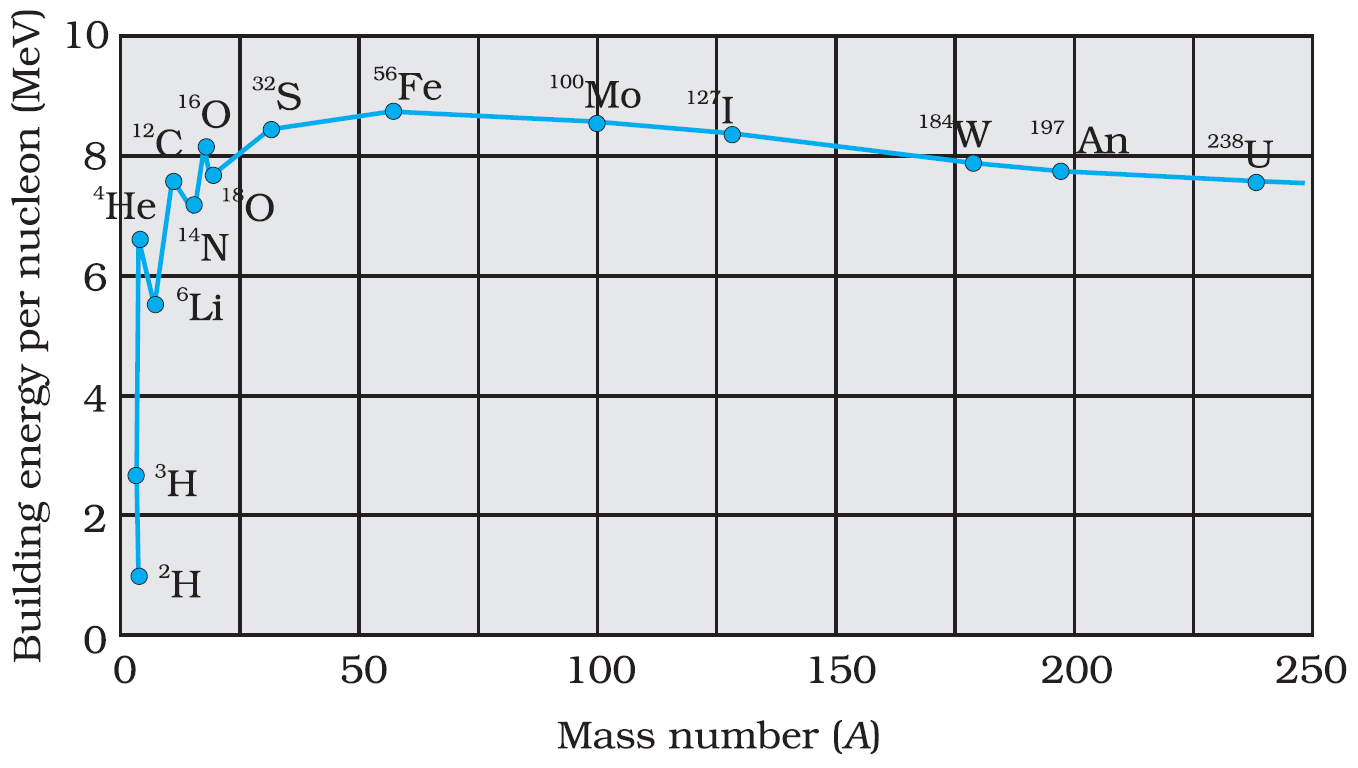
Nuclear fission: Binding energy per nucleon is smaller for heavier nuclei (greater than 200) i.e., heavier nuclei are less stable. When a heavier nucleus splits into the lighter nuclei, they become stable, this happens in nuclear fission.
Nuclear fusion: The binding energy per nucleon is small for light nuclei (between 2 to 20), i.e., they are less stable. So when two light nuclei combine to form a heavier nucleus, the higher binding energy per nucleon of the latter results in the release of energy. This is what happens in a nuclear fusion.
- $\frac{\text{R}}{\text{R}_0}=\frac{\text{N}}{\text{N}_0}=\Big(\frac{1}{2}\Big)^{\text{n}}$
$\frac{\text{R}}{\text{R}_0}=3.125\%=\frac{3.125}{100}=\frac{1}{32}=\Big(\frac{1}{2}\Big)^5$
$=\Big(\frac{1}{2}\Big)^\text{n}=\Big(\frac{1}{2}\Big)^5\Rightarrow\ \text{n}=5$
$\text{t}=\text{nT}_{\frac{1}{2}}=5\times10=50\text{ year}$