Question
Explain the reflection of a plane wave using Huygen's principle.
Answer


Image
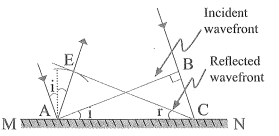
Consider a plane wave AB incident at an angle $i$ on a reflecting surface MN .
If $v$ is the speed of wave in the given medium, $\tau$ represents the time taken by the wavefront to advance from point B to C , then the distance $BC =v \tau$.
In order to construct the reflected wavefront we draw a sphere of radius $v \tau$ from the point A as shown in fig.
Let $C E$ represent the tangent plane drawn from the point C to this sphere.
Obviously,
$AE = BC =v \tau$
From fig., incident and reflected wave fronts make angle $i$ and $r$ with reflecting surface, MN respectively.
From fig.,
AC is the common side between $\triangle AEC$ and $\triangle ABC$.
Also, $\angle AEC =\angle ABC =\frac{\pi}{2}$.
$\text { and } AE = BC =v \tau$
So $\triangle AEC$ and $\triangle ABC$ are congruent.
And therfore, $\angle i=\angle r$,
which is law of reflection.

Need a full question paper?

Generate a complete, print-ready paper with questions like this in minutes — across 16+ boards, with answer keys.
Start Generating Free

Similar questions

A wire is bent in the form of a regular hexagon and a total charge q is distributed uniformly on it. What is the electric field at the centre? You may answer this part without making any numerical calculations.
A pendulum clock giving correct time at a place where $g = 9.800m/s^2$ is taken to another place where it loses 24 seconds during 24 hours. Find the value of g at this new place.
Derive the formula of torque for electric dipole placed in uniform electric field.$\#\#\#$ Explain behaviour of a dipole in a uniform electric field.
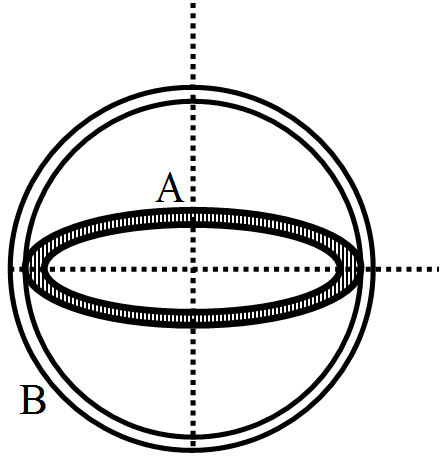
Two coils of wire A and B are placed mutually perpendicular as shown in figure. When current is changed in any one coil, will the current induce in another coil?
What conclusion can you draw from the following observations on a resistor made of alloy manganin?
Current A
Voltage V
Current A
Voltage V
0.2
0.4
0.6
0.8
1.0
2.0
3.94
7.87
11.8
15.7
19.7
39.4
3.0
4.0
5.0
6.0
7.0
8.0
59.2
78.8
98.6
118.5
138.2
158.0
The net charge in a current-carrying wire is zero. Then, why does a magnetic field exert a force on it?
A brass plate having surface area $200cm^2$ on one side is electroplated with 0·10mm thick silver layers on both sides using a 15A current. Find the time taken to do the job. The specific gravity of silver is 10.5 and its atomic weight is 107.9 g/mol.

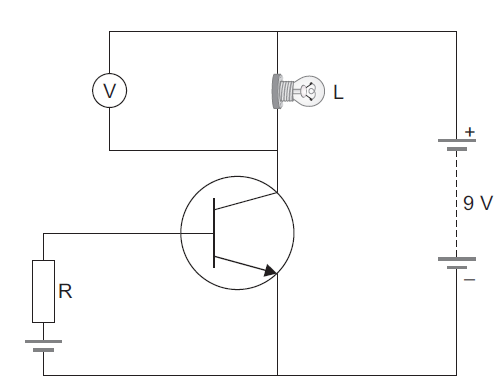
In the given circuit diagram, a voltmeter ‘V’ is connected aross a lamp ’L’. How would (i) the brightness of the lamp and (ii) voltmeter reading ‘V’ be affected, if the value of resistance ‘R’ is decreased? Justify your answer.
The electric field E due to any point charge near it is defined as $\text{E}=\lim\limits_{\text{q}\rightarrow0}\frac{\text{F}}{\text{q}}$ where q is the test charge and F is the force acting on it. What is the physical significance of $\lim\limits_{\text{q}\rightarrow0}$ in this expression?
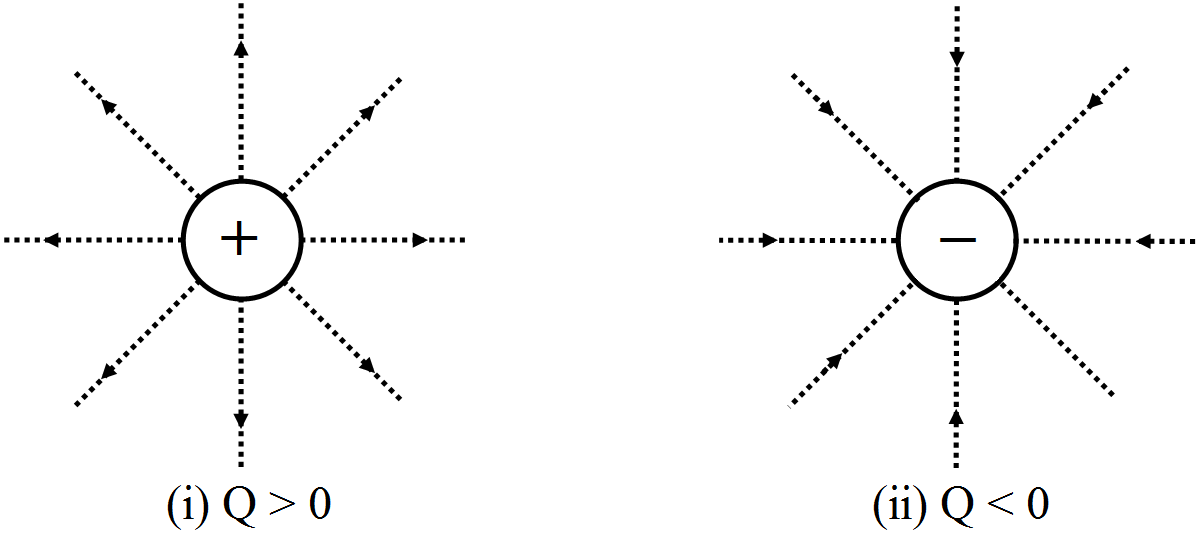
Draw the electric lines of point charge Q when,
  1. Q > 0
  2. Q < 0.
A parallel plate capacitor is being charged by a time varying current. Explain briefly how Ampere's circuital law is generalized to incorporate the effect due to the displacement current.