Question
Explain the reproductive system in cockroach with the help of suitable diagrams.
Answer

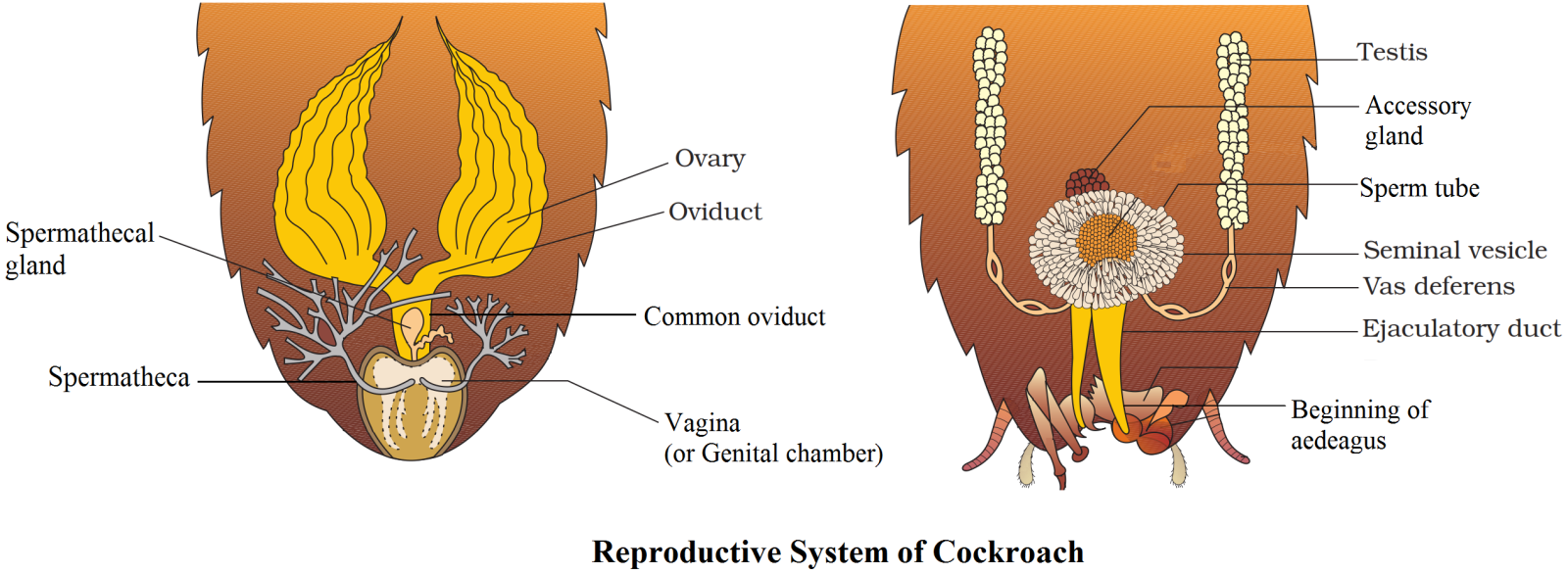
Reproductive System: Cockroaches are dioecious and both sexes have well developed reproductive organs. Male Reproductive System:
  • Male reproductive system consists of a pair of testes lying one on each later side in the 4th-6th abdominal segments.
  • From each testis arises a thin vas deferens, which opens into ejaculatory duc through seminal vesicle. The ejaculatory duct opens into male gonopore situate ventral to anus.
  • A characteristic mushroom shaped gland is present in the 6th-7th abdominal segments which functions as an accessory reproductive gland.
  • The external genitalia are represented by male gonapophysis or phallomer (chitinous asymmetrical structures, surrounding the male gonopore).
  • The sperms are stored in the seminal vesicles and are glued together in th form of bundles called spermatophores which are discharged during copulation.
Female Reproductive System:
  • The female reproductive system consists of two large ovaries, lying laterally in the 2nd - 6th abdominal segments. Each ovary is formed of a group of eight ovarian tubules or ovarioles, containing a chain of developing ova.
  • Oviducts of each ovary unite into a single median oviduct (also called vagina which opens into the genital chamber.
  • A pair of spermatheca is present in the 6th segment which opens into thi genital chamber.
Fertilisation:
  • Sperms are transferred through spermatophores.
  • Their fertilised eggs are encased in capsules called oothecae. Ootheca is a dark reddish to blackish brown capsule, about 3/8" (8 mm) long. They are dropped or glued to a suitable surface, usually in a crack or crevice of high relative humidity near a food source.
  • On an average, females produce 9-10 oothecae, each containing 14-16 eggs.
  • The development of P. Americana is paurometabolous, meaning there is development through nymphal stage. The nymphs look very much like adults The nymph grows by moulting about 13 times to reach the adult form. The next to last nymphal stage has wing pads but only adult cockroaches have wings.

Need a full question paper?

Generate a complete, print-ready paper with questions like this in minutes — across 16+ boards, with answer keys.

Start Generating Free

Similar questions

What is a flower? Describe the parts of a typical angiosperm flower.
Fill up the blank spaces appropriately:
Phylum/ Class
Excretory Organ
Circulatory Organ
Respiratory Organ
Arthropoda
-
-
Lungs/ Gills/ Tracheal System
-
Nephridia
Closed
Skin/parapodia
-
Metanephridia
Open
-
Amphibia
-
Closed
Lung
Explain the regulation of heart function with the help of a diagram.
Explain why:
  1. Exogenous application of auxin fails to enhance the growth of intact plants.
  2. Vitamins are not considered as plant growth hormones.
  3. Some plants, belonging to halophytes and growing in marshy lands, face great difficulty in seed germination.
  4. Gibberellins do not enhance the growth of isolated plant parts.
Match Column I with Column II :
  Column I   Column II
(a)
Smooth muscle
(i)
Myoglobin
(b) Tropomyosin (ii) Thin filament
(c) Red muscle (iii) Sutures
(d) Skull (iv) Involuntary
Try to collect all the currently accepted meanings for the word ‘species’. Discuss with your teacher the meaning of species in case of higher plants and animals on one hand, and bacteria on the other hand.
Describe phylum Coelenterata. Give suitable examples.
Explain the difference between cilia and flagella. Draw a diagram and describe their internal structure.
What is the relationship between germinal layers and the formation of body cavity in case of coelomate, acoelomates and pseudocoelomates?
A primary root grows from $5cm$ to $19cm$ in a week. Calculate the growth rate and relative growth rate over the period.