Question
Explain the resolution of a vector in a threedimensional coordinate system and prove that
$
|\overrightarrow{A}|=\sqrt{A_x^2+A_y^2+A_z^2}
$

Answer

self

Need a full question paper?

Generate a complete, print-ready paper with questions like this in minutes — across 16+ boards, with answer keys.

Start Generating Free

Similar questions

The cylindrical tube of a spray pump has a cross-section of 8.0cm2 one end of which has 40 fine holes each of diameter 1.0mm. If the liquid flow inside the tube is 1.5m min–1, what is the speed of ejection of the liquid through the holes?
A charge Q is placed at the centre of an uncharged, hollow metallic sphere of radius a:
  1. Find the surface charge density on the inner surface and on the outer surface.
  2. If a charge q is put on the sphere, what would be the surface charge densities on the inner and the outer surfaces?
  3. Find the electric field inside the sphere at a distance x from the centre in the situations (a) and (b).
A stone of mass m tied to the end of a string revolves in a vertical circle of radius R. The net forces at the lowest and highest points of the circle directed vertically downwards are: [Choose the correct alternative]
 
Lowest Point
Highest Point
(a)
mg - T1
mg + T2
(b)
mg + T1
mg - T2
(c)
mg + T1 - (mv12)/R
mg - T2 + (mv12)/R
(d)
mg - T1 - (mv12)/R
mg + T2 + (mv12)/R
T1 and v1 denote the tension and speed at the lowest point. T2 and v2 denote corresponding values at the highest point.
A block of mass 2.0kg moving at 2.0m/s collides head on with another block of equal mass kept at rest.
  1. Find the maximum possible loss in kinetic energy due to the collision.
  2. If the actual loss in kinetic energy is half of this maximum, find the coefficient of restitution.
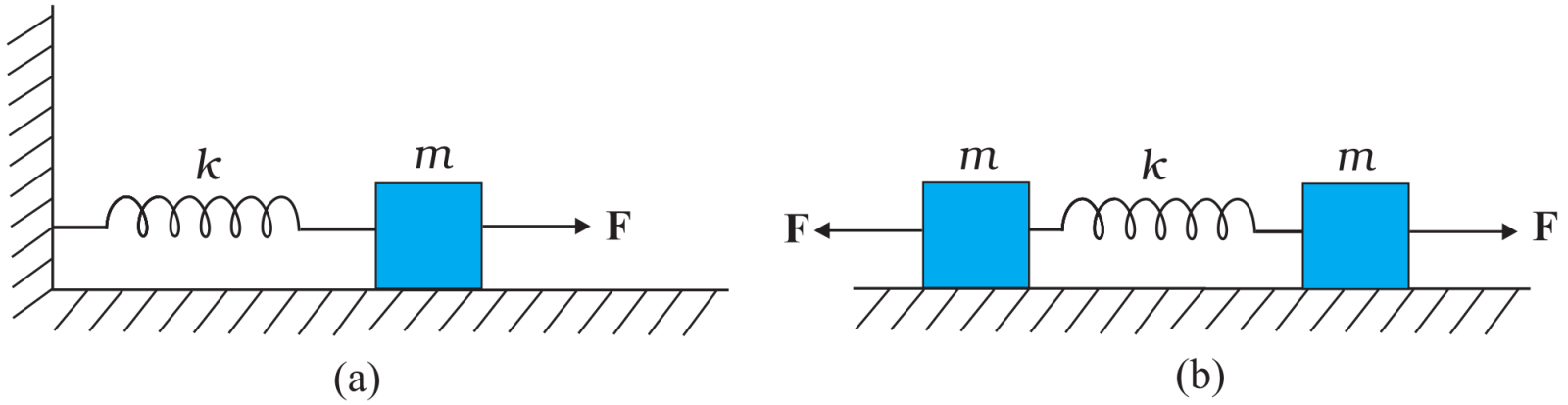
Figure (a) shows a spring of force constant k clamped rigidly at one end and a mass m attached to its free end. A force F applied at the free end stretches the spring. Figure (b) shows the same spring with both ends free and attached to a mass m at either end. Each end of the spring in Fig. (b) is stretched by the same force F.

If the mass in Fig. (a) and the two masses in Fig. (b) are released, what is the period of oscillation in each case?

A particle with a charge of 5.0 µC and a mass of 5.0 × 10⁻¹²kg is projected with a speed of 1.0km s-1 in a magnetic field of magnitude 5.0mT. The angle between the magnetic field and the velocity is sin-1 (0.90). Show that the path of the particle will be a helix. Find the diameter of the helix and its pitch.
A cyclist is riding with a speed of 27km/h. As he approaches a circular turn on the road of radius 80m, he applies brakes and reduces his speed at the constant rate of 0.50m/s every second. What is the magnitude and direction of the net acceleration of the cyclist on the circular turn?
A rain drop of radius 2mm falls from a height of 500m above the ground. It falls with decreasing acceleration (due to viscous resistance of the air) until at half its original height, it attains its maximum (terminal) speed, and moves with uniform speed thereafter. What is the work done by the gravitational force on the drop in the first and second half of its journey? What is the work done by the resistive force in the entire journey if its speed on reaching the ground is 10 m s-1?
What is the difference between cathode rays and beta rays? When the two are travelling in space, can you make out which is the cathode ray and which is the beta ray?
36. You are given, the following data about a group of particles, where n represents the number of molecules with speed vi
ni
2
4
8
6
3
vi(ms-1)
1.0
2.0
3.0
4.0
5.0
Calculate:
  1. Average speed.
  2. Rms speed.
  3. Most probable speed.