Question
Explain the Rutherford atomic model and its limitation.
Answer

As the planets revolves around the Sun, Rutherford suggested in the proposed atomic model, that nucleus at the centre and the electrons orbiting it around the nucleus.
$\rightarrow$ Thus the basic difference between the two is that the planets in the system of Sun are captured by gravitational force while the nucleus electron intersects according Coulomb law in a atom.
$\rightarrow$ The limitation of the Rutherford atomic model: According to classical physics, there is no constraint on the radius of the orbit of electron.
$\rightarrow$ Electron moving in a circular orbit performs an acceleration motion.
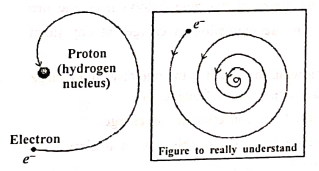
$\rightarrow$ According to classical electromagnetic theory an accelerated charge radiates energy in the form of electromagnetic radiation hence its energy goes on decreasing.
$\rightarrow$ Hence, its orbit would not be circular, it will be spiral terminating at its nucleus which is shown in the figure.
Image
$\rightarrow$ Thus, such an atom cannot be stable.
$\rightarrow$ Further, according to the classical electromagnetic theory, the frequency of the electromagnetic wave emitted by the revolving electrons is equal to the frequency of revolution.
$\rightarrow$ As the electrons spiral inwards, their angular velocities and hence their frequencies would change continuously and so will the frequency of the light emitted. Thus, they would emit a continuous spectrum in contradiction to the line spectrum actually observed.
$\rightarrow$ Hence, Rutherford's atomic model states that classical ideas are not sufficient to explain the atomic structure. Because, this model fails to understand the stability of atom.

Need a full question paper?

Generate a complete, print-ready paper with questions like this in minutes — across 16+ boards, with answer keys.

Start Generating Free

Similar questions

Distinguish between the terms 'average value' and 'rms value' of an alternating current. The instantaneous current from an a.c. source is I = 5 sin (314 t) ampere.
What are the average and rms values of the current?
According to the classical electromagnetic theory, calculate the initial frequency of the light emitted by the electron revolving around a proton in hydrogen atom.
Answer the following questions:
A low voltage supply from which one needs high currents must have very low internal resistance. Why?
A light bulb is rated at $100 W$ for a $220 V$ supply. Find (a) the resistance of the bulb; (b) the peak voltage of the source; and (c) the rms current through the bulb.
Two bar magnets are placed close to each other with their opposite poles facing each other. In absence of other force the magnets are pulled towards each other and their kinetic energy increases. Does it contradict our earher knowledge that magnetic forces cannot do any work and hence cannot increase kinetic energy of a system?
A transmission wire carries a current of 100A. What would be the magnetic field B at a point on the road if the wire is 8m above the road?
The radius of the innermost electron orbit of a hydrogen atom is 5.3×10⁻¹¹ m. What are the radii of the n = 2 and n = 3 orbits?
How does a charge q oscillating at certain frequency produce electromagnetic waves?

Sketch a schematic diagram depicting electric and magnetic fields for an electromagnetic wave propagating along the Z-direction.

A proton and an a-particle have the same de-Broglie wavelength. Determine the ratio of (i) Their accelerating potentials and (ii) Their speeds.
An infinite line charge produces a field of 9 × 10⁴ N/C at a distance of 2 cm. Calculate the linear charge density.