Question
Explain the Rutherford atomic model and its limitations.

Answer

→Rutherford suggested that negatively charged electron revolves around the central nucleus just like the planets revolve around the sun.
→In a planetary system, the planets are held together by the gravitational force, while in an atom the electrons around the nucleus are held together by the Coulomb force.
Limitations :
→An object which moves in a circular path is being constantly accelerated. This acceleration is called centripetal acceleration.
→According to classical electromagnetic theory, an accelerating charged particle emits radiation in the form of electromagnetic waves. Therefore the energy of an accelerating electron should continuously decrease.
→The electron would spiral inward and eventually fall into the nucleus. Thus, such an atom can not be stable.
→According to the classical electromagnetic theory, the frequency of the electromagnetic waves emitted by the revolving electrons is equal to the frequency of revolution.
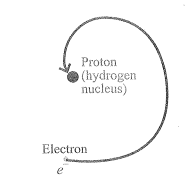
Image
→As the electrons spiral inwards, their angular velocities and their frequencies would change continuously, so the frequency of the light emitted also changes. Thus, they would emit a continuous spectrum, opposite to the line spectrum actually observed.
Need a full question paper?

Generate a complete, print-ready paper with questions like this in minutes — across 16+ boards, with answer keys.

Start Generating Free

Similar questions

In Exercises 7.3 and 7.4, what is the net power absorbed by each circuit over a complete cycle. Explain your answer.
Can a virtual image be photographed by a camera?
In a Young's double slit experiment $\lambda=500\text{nm},$ d = 1.0mm and D = 1.0m. Find the minimum distance from the central maximum for which the intensity is half of the maximum intensity.
Explain destructive interference using proper $($appropriate$)$ example.
$a$. State Ampere's circuital law connecting the line integral of $B$ over a closed path to the net current crossing the area bounded by the path.
$b$. Use Ampere's law to derive the formula for the magnetic field due to an infinitely long straight current carrying wire.
$c$. Explain carefully why the derivation as in $(b)$ is not valid for magnetic field in a plane normal to a currentcarrying straight wire of finite length and passing through the midpoint of the axis.
The space between the plates of a parallel plate capacitor is completely filled in two ways. In the first case, it is filled with a slab of dielectric constant K . In the second case, it is filled with two slabs of equal thickness and dielectric constants $\mathrm{K}_1$ and $\mathrm{K}_2$ respectively as shown in the figure. The capacitance of the capacitor is same in the two cases. Obtain the relationship between $\mathrm{K}, \mathrm{K}_1$ and $\mathrm{K}_2$.
Two voltameters, one having a solution of silver salt and the other of a trivalent-metal salt, are connected in series and a current of 2A is maintained for 1.50 hours. It is found that 1.00g of the trivalent-metal is deposited.
  1. What is the atomic weight of the trivalent metal?
  2. How much silver is deposited during this period? Atomic weight of silver is 107.9 g/mole.
Write the expression for Lorentz magnetic force on a particle of charge 'q' moving with velocity$\overrightarrow{\text{v}}$ in a magnetic field $\overrightarrow{\text{B}}.$ Show that no work is done by this force on the charged particle.
Two beams, one of red light and the other of blue light, of the same intensity are incident on a metallic surface to emit photoelectrons. Which one of the two beams emits electrons of greater kinetic energy?
Can we measure the potential difference across an unbiased p–n junction by connecting a sensitive voltmeter across it?