Question
Explain the shape of $BrF_5$.

Answer

Br-atom has configuration:
$1s^2, 2s^22p^6 , 3s^23p^63d^{10}, 4s^24p^5$
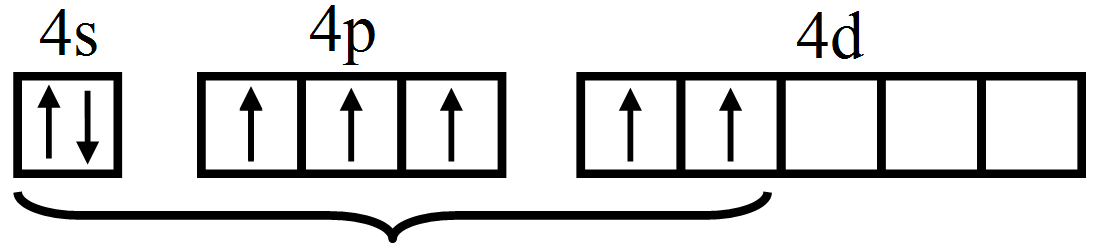
To get pentavalency, two of the p-orbitals are unpaired and electrons are shifted to 4d-orbitals.

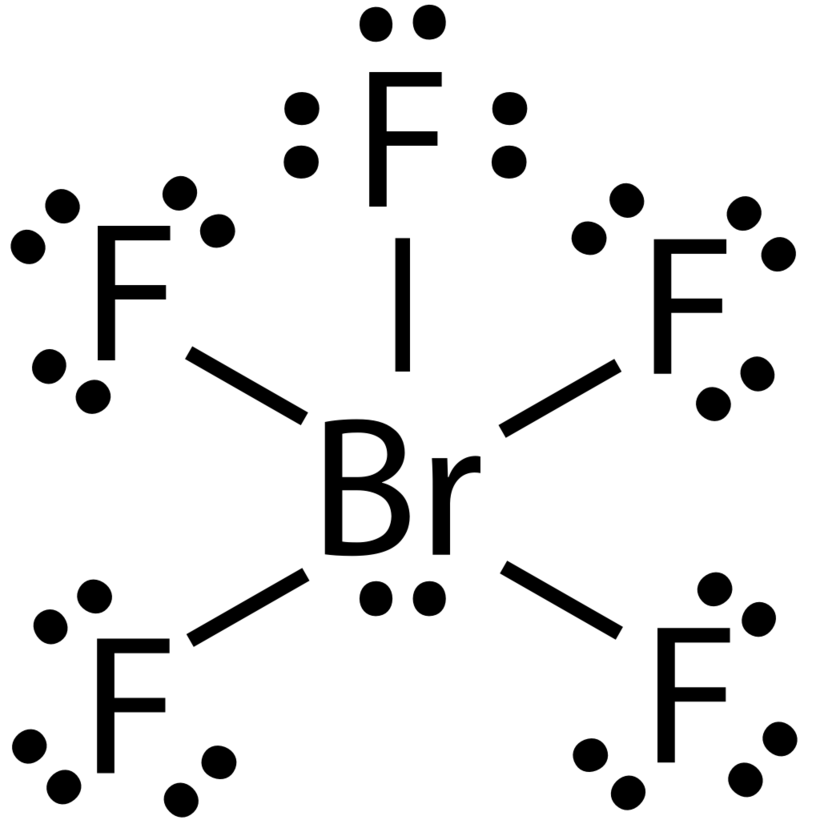
In this excited state, $sp^3d^2$ hybridisation occurs giving octahedral structure. Five positions are occupied by $F$ atoms forming sigma bonds with hybrid bonds and one position occupied by lone pair, i.e., the molecule as a square pyramidal shape.

Need a full question paper?

Generate a complete, print-ready paper with questions like this in minutes — across 16+ boards, with answer keys.
Start Generating Free

Similar questions

  1. How many gram atoms are there in $8.0g$ of S?
  2. The molarity of Solution of sulphuric acid is $1.35M$. Calculate its molality.
(The density of solution is $1.02g cm^{-3})$
Using molecular orbital theory, compare the bond energy and magnetic character of $\mathrm{O}_2^{+}$and $\mathrm{O}_2^{-}$.
For real gases the relation between p, V and T is given by van der Waals equation:
$\Big(\text{P}+\frac{\text{an}^2}{\text{V}^2}\Big)(\text{V}-\text{nb})=\text{nRT}$
Where ‘a’ and ‘b’ are van der Waals constants, ‘nb’ is approximately equal to the total volume of the molecules of a gas.
‘a’ is the measure of magnitude of intermolecular attraction.
  1. Arrange the following gases in the increasing order of ‘b’. Give reason. $O_2, CO_2, H_2, He.$
  2. Arrange the following gases in the decreasing order of magnitude of ‘a’. Give reason.$CH_4, O_2, H_2.$
  1. How does Ionic radii vary with effective nuclear charge? Give example.
  2. An element belongs to 3rd period and group-13 of the periodic table. Identify the element and write two properties of element.
2 Arrange the following set of compounds in order of their decreasing relative reactivity with an electrophile, $\mathrm{E}^{+}$. Chlorobenzene, 2,4-dinitrochlorobenzene, p-nitrochlorobenzene.
Why does water covered with excessive algal growth become polluted?
If $\mathrm{K}_{\mathrm{w}}=49 \times 10^{-14}$, what will be neutral pH of $\mathrm{H}_2 \mathrm{O}$ ?
Explain the following:
  1. A piece of Mg continues to burn in $SO_2$​​​​​​​.
  2. Al cannot be used for storing NaOH.
It has been found that 221.4J is needed to heat 30g of ethanol from 15° to 18°. Calculate:
  1. specific heat capacity.
  2. molar heat capacity of ethanol.
If the combustion of 1g of graphite produces 20.7kJ of heat, what will be molar enthalpy change? Give the significance of sign also.