Question
  1. How does Ionic radii vary with effective nuclear charge? Give example.
  2. An element belongs to 3rd period and group-13 of the periodic table. Identify the element and write two properties of element.

Answer

a. Ionic radii decreases as effective nuclear charge increases e.g. $\mathrm{Mg}^{2+}$ is smaller than $\mathrm{Na}^{+}$because $\mathrm{Mg}^{2+}$ has 12 protons which attract 10 electrons more strongly than 1 electrons attract 10 electrons in $\mathrm{Na}^{+}$.
- Inverse proportion to the effective nuclear charge.
- Direct proportion to the screening effect.
b. It is aluminum, good conductor of electricity, solid and metallic.

Need a full question paper?

Generate a complete, print-ready paper with questions like this in minutes — across 16+ boards, with answer keys.
Start Generating Free

Similar questions

The increasing order of reactivity among group 1 elements is Li < Na < K < Rb CI > Br > I. Explain.
Using the data (all values are in kilocalories per mole at $25^{\circ} C$ ) given below, calculate the bond energy of $C - C$ and C -
H bonds. $\Delta H ^{\circ}$ combustion (ethane) $=-372.0$
$\Delta H ^{\circ}$ combustion (propane) $=-530.0 \Delta H ^{\circ}$ for $C ($ graphite $) \rightarrow C ( g )=172.0$ Bond energy of $H - H =104.0 \Delta_{ f } H ^{\circ}$ of $H _2 O ( l )=-68.0 \Delta H ^{\circ}$ for $CO _2(g)=-94.0$
Describe the industrial applications of hydrogen dependent on:
  1. the heat liberated when its atoms are made to combine on the surface of a metal.
  2. its effect on the unsaturated organic systems in the presence of a catalyst.
  3. its ability to combine with nitrogen under specific conditions.
What happens:
  1. When $\mathrm{F}_2$ reacts with hot water
  2. Barium peroxide reacts with phosphoric acid
  3. Hydrogen peroxide reacts with ozone.
Write the chemical reacts involved.
Account for the following observations:
Though fluorine is more electronegative than chlorine yet $\mathrm{BF}_3$ is a weaker Lewis acid than $\mathrm{BCl}_3$
Prove that the excluded volume 'b' is four times the actual volume of the gas molecules.
i. What will be the minimum pressure required to compress $500 dm ^3$ of air at 1 bar to $200 dm ^3$ at $30^{\circ} C$.
ii. Critical temperature for $CO _2$ and $CH _4$ are $31.1^{\circ} C$ and $-81.9^{\circ} C$ respectively. Which of these has stronger intermolecular forces and why?
On the basis of Le Chatelier principle explain how temperature and pressure can be adjusted to increase the yield of ammonia in the following reaction.
$\text{N}_2\text{(g)}+\text{3H}_2\text{(g)}\rightleftharpoons\text{2NH}_3\text{(g)} \ \ \ \ \ \ \ \Delta\text{H}= – 92.38\text{kJ mol}^{–1}$
What will be the effect of addition of argon to the above reaction mixture at constant volume?
The dipole moment of a molecule AB is 0.54D and the bond distance is $1.41\mathring{\text{A}}.$ Calculate the fractional change $\delta$ on A and B atom in AB molecule (electronic charge, $\mathrm{e}=4.8 \times 10^{-10} \mathrm{esu}$.)
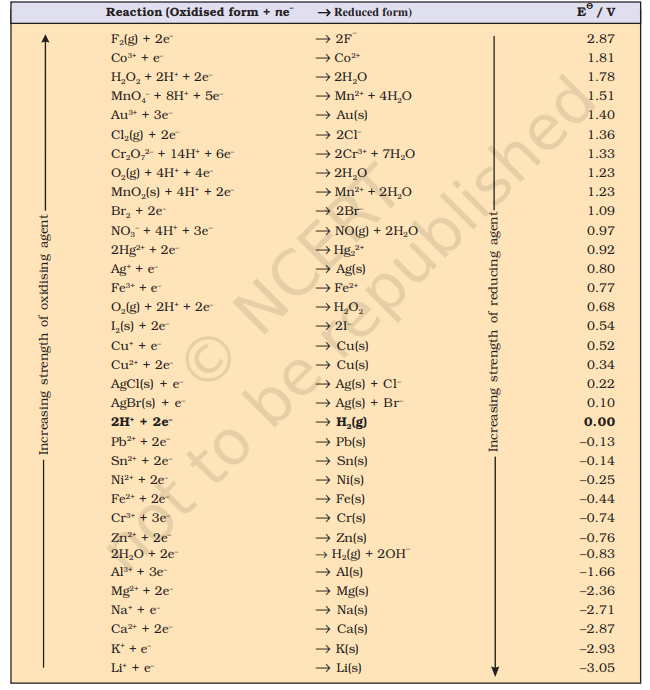
Using the standard electrode potentials given in the Table, predict if the reaction between the following is feasible:

$\mathrm{Fe}^{3+}(\mathrm{aq})$ and $\mathrm{Cu}(\mathrm{s})$.