Question
Explain the shapes of different atomic orbitals.

Answer

SELF

Need a full question paper?

Generate a complete, print-ready paper with questions like this in minutes — across 16+ boards, with answer keys.

Start Generating Free

Similar questions

  1. Heat(q) and work done (W) individually are not state functions but their sum is always a state function. Explain why?
  2. Calculate the standard enthalpy change $(\Delta_\text{r}\text{H}^\theta)$ and standard internal energy change $(\Delta_\text{r}\text{U}^\theta)$ for the following reaction at 300K:

OF2(g) + H2O(g) + O2(g) + 2HF(g)

Standard enthalpy of formation $(\Delta_\text{r}\text{H}^\theta)$ of e n various species are given below:

$\Delta_\text{f}\text{H}^\theta\text{kJ mol}^{-1}:$ OF2(g) = 23.0, H2O(g)= -241.8, HF(g) = -268.6, R = 8.314 JK-1mol-1.

1. Why is nitric acid added to sodium extract before adding silver nitrate for testing halogens?
2. How does
i. an electron withdrawing group (EWG) and
ii. an electron donating group (EDG) influence the acid strength of carboxylic end?
Explain the mechanism of sulphonation and Friedel Crafts reaction.
What is the valence shell electron pair repulsion principle? Explain how this determines the geometry of molecules.
The ionization constant of acetic acid is 1.74 × 10⁻⁵. Calculate the degree of dissociation of acetic acid in its 0.05M solution. Calculate the concentration of acetate ion in the solution and its pH.
Chlorine is used to purify drinking water. Excess of chlorine is harmful. The excess of chlorine is removed by treating with sulphur dioxide. Present a balanced equation for this redox change taking place in water.
Sulphuric acid reacts with sodium hydroxide as follows:
H2SO4 + 2NaOH Na2SO4 + 2H2O
When 1 L of 0.1 M sulphuric acid solution is allowed to react with 1 L of 0.1 M sodium hydroxide solution. Calculate the amount of sodium sulphate formed and its molarity in the solution obtained.
Four moles of PCl5 are heated in a closed 4dm3(L) container to reach equilibrium at 400K. At equilibrium 50% of PCl5 is dissociated. What is the value of Kc for the dissociation of PCl5 into PCl3 and Cl2 at 400K.
  1. Arrange the following according to given property

$\text{CH}_3\stackrel{\oplus \ \ \ }{\text{CH}}_2,\text{C}_6\text{H}_5-\stackrel{\oplus\ \ \ \ }{\text{CH}}_2,(\text{CH}_3)_3\stackrel{\oplus \ \ \ \ }{\text{CH}},$

$\text{CH}_2=\text{CH}-\stackrel{\oplus\ \ \ \ }{\text{CH}}_2$ (decreasing order of stability)

  1. $\text{HC}\equiv\text{C}^{\ominus},\text{Ch}_2=\stackrel{\ominus\ \ \ \ \ \ }{\text{CH}_2},\text{CH}_3-\stackrel{\ominus\ \ \ \ \ }{\text{CH}_2},\stackrel{\ominus \ \ \ \ \ }{\text{CH}_3}$ (increasing order of stabillity)

  2. $\text{C}_6\text{H}_5\stackrel{\bf. \ \ \ \ }{\text{CHCH}_3},\text{C}_6\text{H}_5\text{CH}_2\stackrel{\bf.\ \ \ \ \ }{\text{CH}_2},\text{C}_6\text{H}_5\stackrel{\bf.}{\text{C}}_3(\text{CH}_3)_2$ (increasing order of stabillity)

  3. $\text{CH}_3-\stackrel{\oplus \ \ \ \ }{\text{CH}}-\text{O}-\text{CH}_3,\text{CH}_3-\stackrel{\oplus \ \ \ \ }{\text{CH}},-\text{OCH}_3,$

${\ \ \ \ \ \ \ \ \ \ \ \ \ \ \ \ \ \ \ \ \text{O}}\\{\ \ \ \ \ \ \ \\ \ \ \ \ \ \ \ \ \ \ \ \ \ \\ \|}\\\ \text{CH}_3-\stackrel{\oplus \ \ \ \ }{\text{CH}}\text{C}-\text{OCH}_3$ (decreasing order of stability)
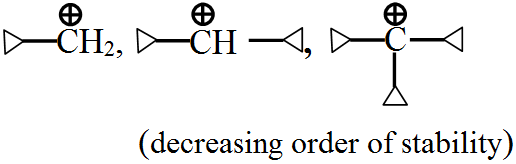
  1.  

Explain the following in contrast to alkynes: (i) Polymerisation (ii) Isomerisation (iii) Oxidation (iv) Ozonolysis