Question
1. Why is nitric acid added to sodium extract before adding silver nitrate for testing halogens?
2. How does
i. an electron withdrawing group (EWG) and
ii. an electron donating group (EDG) influence the acid strength of carboxylic end?
Answer

1. Nitric acid is added to sodium extract so as to decompose
$
NaCN+HNO_3 \longrightarrow NaNO_3+HCNNa_2 S+2 HNO_3 \longrightarrow 2 NaNO_3+H_2 S
$
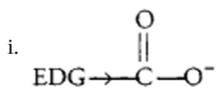
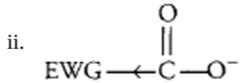
2. The influence of the inductive effect on acidity is best understood in terms of the conjugate base, $RCOO ^{-}$and can be summarised as follows
Image
Electron withdrawing group destabilises $RCOO ^{-}$because there exists a repulsion between electrons from EDG and negative charge of O. Hence, EDG weakens the acid.
Image
Electron withdrawing group stabilities $RCOO ^{-}$by taking negative charge from O . Hence, EWG strengthens the acid.

Need a full question paper?

Generate a complete, print-ready paper with questions like this in minutes — across 16+ boards, with answer keys.

Start Generating Free

Similar questions

All transition elements are d-block elements, but all d-block elements are not transition elements. Explain.
Describe the properties of covalent compounds.
Write the favourable factors for the formation of ionic bond.
Define the first law of thermodynamics and also derive its mathematical form.
1. Give IUPAC names of the following structures.
Image
2. Benzoic acid is an organic compound. Its crude sample can be purified by crystallization from hot water. What characteristic differences in the properties of benzoic acid and the impurity make this process of purification suitable?
Calculate the wavelength for the emission transition if it starts from the orbit having radius 1.3225nm and ends at 211.6pm. Name the series to which this transition belongs and the region of the spectrum.
What is meant by the term bond order? Calculate the bond order of : $\text{N}_2,\text{O}_2,\text{O}_2^+$ and $\text{O}_2^-$
The standard Gibbs energy change for the reaction, $\text{N}_2(\text{g})+3\text{H}_2(\text{g})\rightleftharpoons2\text{NH}_3(\text{g})$ is -33.2kJ mol-1 at 298K.
  1. Calculate the equilibrium constant for the above reaction.
  2. What would be the equilibrium constant if the reaction is written as $\frac{1}{2}\text{H}_2(\text{g})+\frac{3}{2}\text{H}_2(\text{g})\rightleftharpoons\text{NH}_3(\text{g})$
  3. What will be the equilibrium constant if the reaction is $\text{NH}_3(\text{g})\rightleftharpoons\frac{1}{2}\text{N}_2(\text{g})+\frac{3}{2}\text{H}_2(\text{g})$
Explain the non linear shape of H2S and non planar shape of PCl3 using valence shell electron pair repulsion theory.
The solubility product of lead bromide is 8 × 10⁻⁵ at 298K. If the salt is 80% dissociated in saturated solution, calculate the solubility of the salt (in g/ L).