Explain the term dialysis.
Download our app for free and get startedPlay store
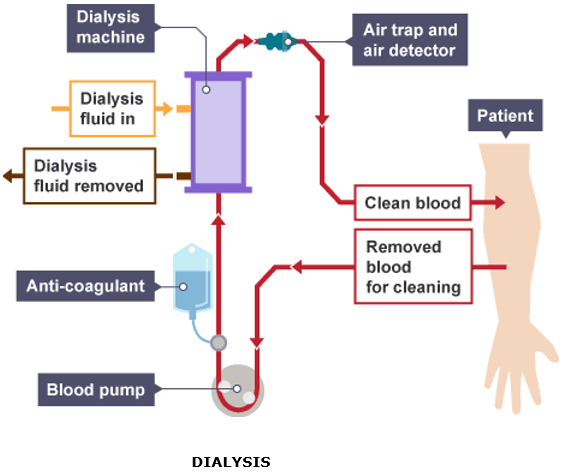
Dialysis is the process of removing nitrogenous wastes and excess water from the body by using a clinical device, called as artificial kidney and a dialyzing fluid. When kidney function decreases to a critical level or complications arise, a person may need to start dialysis.
There are two main types of dialysis, hemodialysis and peritoneal dialysis.
Hemodialysis uses a machine and a filter to remove waste products and water from the blood.
Peritoneal dialysis uses a fluid (dialysate) that is placed into the patient's abdominal cavity to remove waste products and fluid from the body.
art

Download our app
and get started for free

Experience the future of education. Simply download our apps or reach out to us for more information. Let's shape the future of learning together!No signup needed.*

Similar Questions

  • 1
    1. List the three events that accur during the process of photosynthesis. Explain the role of stomata in this process.
    2. Describe an experiment to show that ''sunlight is essential for photosynthesis.''
    View Solution
  • 2
    Draw the diagram of alimentary canal of man and label the following parts.Mouth, Oesophagus, Stomach, Intestine.
    View Solution
  • 3
    Each and every respiration organ is structurally specialised in its function. Justify with examples.
    View Solution
  • 4
    When a person puts food in his mouth, then teeth cut it into small pieces, chew and grind it. The glands A in the mouth secrete a substance B which is mixed with the food by tongue. The substance B contains an enzyme C which starts the digestion of food in the mouth. The slightly digested food from the mouth goes down a tube D. The special type of movements E in the walls of tube D push the food into stomach for further digestion. The stomach wall secretes gastric juice containing three substance F, G and H. One of the functions of F is to kill bacteria which may enter the stomach with food. The substance G protects the inside layer of stomach from the damaging effect of substance F whereas substance H is and enzyme for digestion. The partially digested food then enters into small intestine for further digestion.
    1. What is Gland A, Substance B and Enzyme C?
    2. Name the tube D.
    3. What is the movement E known as?
    4. What are F, G and H?
    View Solution
  • 5
    Distinguish between photosynthesis and respiration.
    View Solution
  • 6
    With a schematic diagram, explain the overall process of respiration.
    View Solution
  • 7
    How do carbohydrates, fats and proteins get digested in human beings?
    View Solution
  • 8
    Breathing cycle is an essential process for the exchange of gases’. Justify this statement.
    View Solution
  • 9
    With a schematic diagram, explain the overall process of respiration in animals.
    View Solution
  • 10
    Explain the process of digestion of food in mouth, stomach and small intestine in human body.
    View Solution