Question
Explain the terms ‘adaptation’ and ‘accommodation’ with reference to the eye.

Answer

Adaptation is the ability to adjust vision in bright and dark areas. When we enter a dark room from bright light, the rhodopsin pigment broken down in bright light is regenerated. It dilates the pupil and allows more light to enter the eyes. This is called dark adaptation. On the other hand, if we enter bright area from a dark room, the rhodopsin pigment is bleached. This constricts the pupil and reduces the light entering the eyes. This is called 'light adaptation'
Accommodation is the process of focusing the eye at different distances. This is mainly brought about by a change in the curvature of the lens. When the ciliary muscles contract, the lens becomes thicker and we are able to focus a nearby object. On the other hand when the ciliary muscles relax, the lens remains stretched i.e. the normal condition and we are able to focus on distant object.

Need a full question paper?

Generate a complete, print-ready paper with questions like this in minutes — across 16+ boards, with answer keys.
Start Generating Free

Similar questions

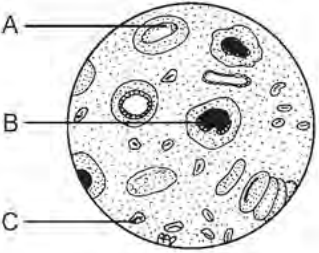
The diagram given alongside represents a blood smear. Answer the questions given below:
(i) Identify A, B and C.
(ii) State an important function of each.
(iii) State two important characteristics of B that enable it to carry out its function.

Image
Why are the stomata in most plants more numerous on the lower surface of a leaf instead of being on the upper surface?
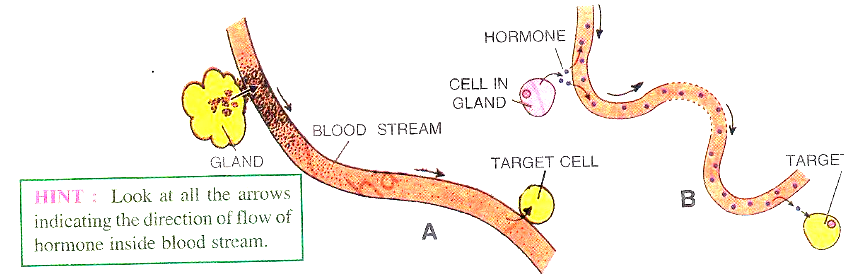
Given below are two diagrams (one is correct, the other one is somewhat incorrect) showing the transport of a hormone from its source gland/cell to the target organ/cell.

What is the error?
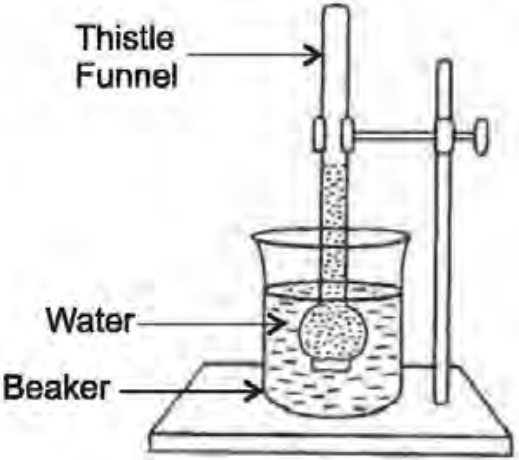
Given diagram represents an apparatus set-up to study a very important physiological process.
(i) Name the process being studied.
(ii) Explain the process.
(iii) What change would you observe in the thistle funnel containing sugar Thistle Funnel solution after about 10 minutes?

Image
Give three exceptions to Mendel's laws.
What is the cause of haemophilia and colour blindness?
Draw a labeled diagram of sperm.
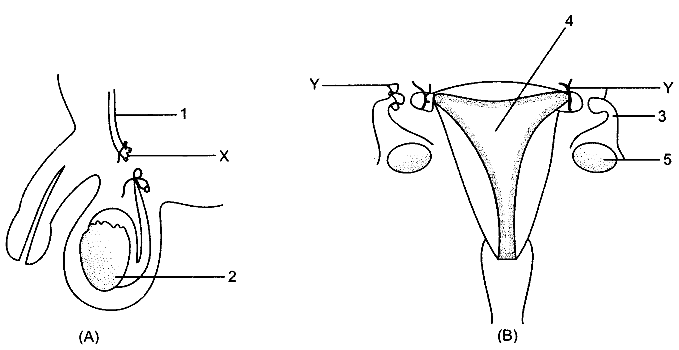
Observe the diagram A and B given below:
  • Label parts 1 – 5.
  • What does diagram A depict?
  • What does diagram B depict?
  • What comment on X and Y.
  • State one function each of part 2 and 4.
  • Arrange and rewrite the terms in each group in the correct order so as to be in a logical sequence beginning with the term that is underlined.
    (i) Cytokinesis, telophase, anaphase, metaphase
    (ii) interphase, prophase, metaphase, anaphase
    (iii) G1 phase, S phase, G2 phase, M phase
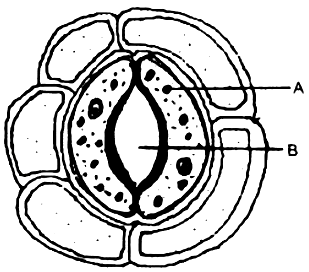
    The diagram below represents a structure found in a leaf.

    Study the same and answer the questions that follow:
    (i) Name the pis labeled A and B.
    (ii) What is the biological term for the above structure?
    (iii) What is the function of the part labeled A?
    (iv) Mention two structural features of A, which help in the function mentioned in (iii) above.
    (v) Where is this structure likely to be found in a leaf?
    (vi) The above structure helps in the process of transpiration. Explain the term transpiration.
    (vii) How many other cells are found surrounding this structure as seen in the diagram?